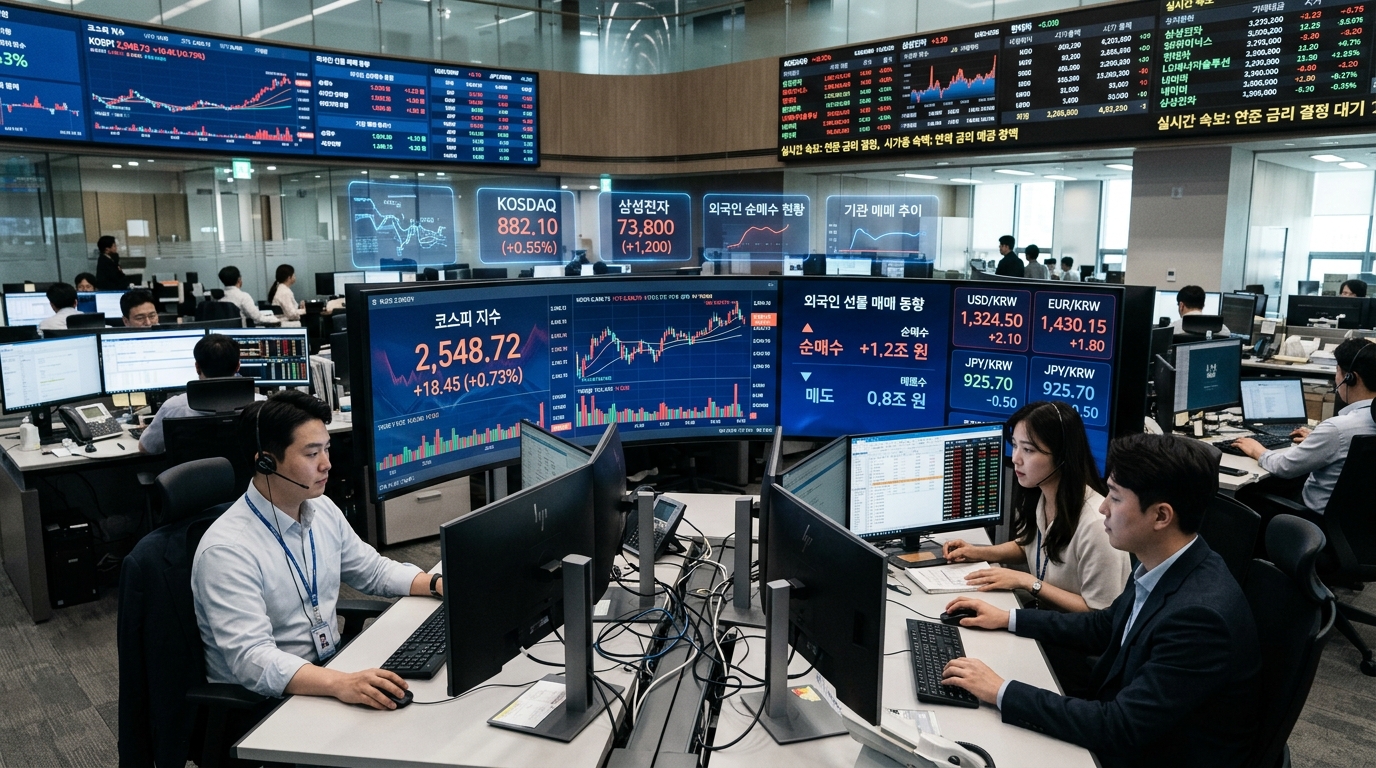
Hello, this is Daily Stock, closely examining the market's core supply-demand dynamics and macro inflection points every day.
[이미지: /stdaily/uploads/202609/gen_6ab4ca97741844.84929610.png]
Key Summary
- Following the September simultaneous futures and options expiration, foreign investors executed rollovers into December KOSPI 200 futures contracts and entered an exploration phase for fresh directional positioning.
- As the USD/KRW exchange rate maintains a limited range around 1,366.70 KRW, cash equity trading in large-cap semiconductor, financial, and automotive names alongside shifts in the futures basis are driving index volatility.
- As of the close on September 24, 2026, the KOSPI finished at 7,080.92 points, with Daily Stock's proprietary Fear & Greed Index at a Neutral level of 53.8, reflecting a significant easing of sentiment from the Fear zone (30.6) recorded one week prior.
Current Market Overview
On September 24, 2026, the domestic equity market closed its regular trading session with the KOSPI index at 7,080.92 and the KOSDAQ index at 844.48.
The USD/KRW exchange rate moved slightly from the previous session to close at 1,366.70 KRW, mitigating the pressure of rapid capital flight from FX-sensitive passive funds.
Having navigated through the September quadruple witching day (simultaneous expiration of futures and options), foreign investors have been leveraging spread dynamics shifting between contango and backwardation in December futures positions.
Whenever the futures basis recovers into positive (+) territory, program arbitrage buying primarily led by financial investment entities (broker-dealers) flows in, supporting the index's lower boundary.
| Key Metric | Close on Sep 24, 2026 | 1 Week Ago | Trend vs. Prior Month-End |
|---|---|---|---|
| KOSPI Index | 7,080.92 | 6,995.10 (Est.) | Testing the upper bound of a mild range |
| USD/KRW Exchange Rate | 1,366.70 KRW | 1,374.20 KRW (Est.) | Attempting downward stabilization |
| KOSPI Fear & Greed Index | Neutral (53.8) | Fear (30.6) | Sentiment recovery vs. 1 week ago |
| Nasdaq Fear & Greed Index | Fear (34.6) | Fear (28.3) | Global macro wait-and-see stance continues |
According to Daily Stock's proprietary Fear & Greed Index, the KOSPI currently sits in the Neutral range at 53.8.
While it has rapidly climbed out of the Fear territory of 30.6 seen a week ago, confirmation of consecutive net foreign buying in December futures will be necessary to transition into a robust rally on par with the level recorded one month ago (55.6).
[이미지: /stdaily/uploads/202609/gen_6ab4caa47b3667.72089691.png]
Financial Analysis
The overall financial stamina of listed KOSPI firms remains heavily reliant on the profit-generating capacity of top market-cap semiconductor names and core export manufacturing industries.
According to recent import/export trend statistics from the Korea Customs Service, a solid trade surplus trend led by key export items—including artificial intelligence (AI) semiconductors, eco-friendly vehicles, and power infrastructure equipment—remains firmly in place.
The combined 12-month forward operating profit consensus for large-cap stocks demonstrates quarterly stability, serving as a firm support buffer against downward pressure.
In contrast, marginal small- and mid-cap (SME) firms with high raw material import burdens or heavy exposure to exchange rate fluctuations are seeing deteriorating interest coverage ratios, progressively widening the fundamental financial divide between large-cap leaders and smaller companies.
The Bank of Korea's policy rate trajectory also serves as a crucial factor dictating index fundamentals.
While domestic inflation is cooling, the central bank is carefully calibrating the pace of potential rate cuts alongside the management of household debt and currency volatility, fostering an earnings-driven fundamental environment rather than a broad liquidity-driven rally.
Valuation
Currently, the KOSPI's 12-month forward price-to-book ratio (PBR) rests near its historical average, indicating that valuation multiples are not excessively stretched.
Compared to key global benchmark indices such as Taiwan's TAIEX or the U.S. S&P 500, Korea's relative valuation appeal remains intact.
In terms of relative valuations between KOSPI 200 large caps and KOSDAQ/KOSPI small-to-mid caps, a stark liquidity polarization is evident.
As foreign passive capital and institutional funds such as pension funds concentrate on mega caps exhibiting governance improvement initiatives and superior 'Value-up' metrics, the valuation discount on SMEs is becoming prolonged.
The 12-month forward price-to-earnings ratio (PER) also sits in a stable range relative to historical peaks, suggesting high downward rigidity as long as systemic risks do not flare up.
Ultimately, the key to an index re-rating hinges on the longevity of the semiconductor cycle and the expansion rate of free cash flow (FCF) among major exporters.
[이미지: /stdaily/uploads/202609/gen_6ab4cab21e0b50.51711725.png]
Expert & Institutional Analysis
Securities industry derivatives analysts emphasize that the volume of contracts rolled over by foreign investors following the September expiration was largely in line with historical quarterly averages.
Their assessment indicates that rather than establishing massive bearish short bets, foreign accounts are taking a neutral stance, pairing cash and futures trades to navigate short-term basis fluctuations.
Major research centers highlight that the mid-1,360 KRW zone for USD/KRW serves as a vital inflection point for foreign spot buying.
Stabilization of the exchange rate around 1,366.70 KRW mitigates foreign exchange loss concerns, creating a constructive backdrop for foreign investors to weigh increasing their large-cap exposure alongside program arbitrage inflows.
Institutional investors view the timing of a shift to cumulative net buying in foreign futures contracts as the primary leading indicator ahead of the Q3 earnings season kicking off in early October.
Consensus suggests that if futures supply/demand pivots to sustained net buying alongside an increase in open interest, the index can mount a gradual breakout attempt anchored by the 7,080 support line.
Risk Factors
The most pressing risk factor to monitor is a potential temporary pause in export momentum triggered by global growth slowdown concerns.
If macroeconomic indicators in primary trading partner economies deteriorate, earnings projections for KOSPI's large-cap export leaders could face downward revisions.
Abrupt foreign exchange volatility also demands continued vigilance.
If USD/KRW breaks above the 1,366.70 KRW support boundary and surges toward the 1,380 KRW level, foreign futures selling could trigger massive program liquidation cascades.
Caution is also warranted from a sentiment perspective.
While domestic KOSPI sentiment has improved to 53.8 (Neutral), the Nasdaq Fear & Greed Index remains depressed at 34.6 (Fear). Any contagion from global risk-off sentiment could prolong the domestic market's support retest.
Investment Perspective & Summary
At present, the KOSPI appears to be in a phase of validating floor support around the 7,080 line after clearing the September expiration turning point.
A prudent strategy involves monitoring daily net trading directions and open interest trends in foreign futures to decipher the underlying intentions of December contract market movers.
Rather than aggressively betting on short-term volatility, investors should verify whether USD/KRW establishes stability around 1,366 KRW and assess the earnings resilience of large caps.
While the benchmark index consolidates around key support levels, an phased accumulation strategy focused selectively on major export bellwethers with clear earnings visibility remains sensible.
Investor Checkpoint Q&A
Q1. What direct impact do foreign futures positions have on the KOSPI following the September expiration?
Whether foreign investors turn into net buyers or net sellers of the new December contract determines the futures basis—the price spread between futures and the underlying cash index. An expanding basis (contango) triggers arbitrage program buying from financial investment firms, reinforcing index support; conversely, a deteriorating basis (backwardation) sparks program selling, exacerbating downward pressure on the market.
Q2. What is the significance of the USD/KRW exchange rate at 1,366.70 KRW for foreign capital flows?
The exchange rate settling in the mid-1,360s signifies that the rapid short-term spike has calmed, reducing currency risk concerns for foreign institutional investors. However, an additional downward stabilization will be necessary to spark sustained, synchronized foreign net buying across both cash equities and futures.
Q3. How should one interpret the current KOSPI Fear & Greed Index reading of 53.8?
It reflects a completely "Neutral" state, where the market is neither overheated nor mired in extreme distress. Given that investor psychology has stabilized significantly from the Fear reading of 30.6 a week ago, this environment favors measured portfolio rebalancing driven by company fundamentals and supply-demand flows rather than emotional panic selling.
Q4. Why does the valuation divergence between large caps and small-to-mid caps persist?
Capital continues to concentrate into large-cap champions boasting robust balance sheets, strong cash flows, and shareholder return capabilities amid global supply chain reconfigurations and lingering higher interest rates. Furthermore, policy benefits surrounding corporate governance enhancements and Value-up initiatives tend to be priced into large-cap benchmarks first.
Q5. What are the key watchpoints ahead of the early October Q3 earnings season?
The primary checkpoints are shifts in foreign cumulative net buying balances in December futures contracts and preliminary earnings guidance from benchmark semiconductor and automotive leaders. If earnings meet or beat market bars and are accompanied by an unwinding of foreign downside bets, the technical confirmation of the index floor will be complete.