[이미지: /stdaily/uploads/202609/gen_6ab316af4a44f6.71494871.png]
Welcome to Daily Stock. Today, we take an in-depth look at the business structure and performance trajectory of ServiceNow, a company demonstrating unmatched execution in the AI monetization phase of the enterprise software industry.
Key Takeaways
- Moving beyond basic generative AI assistive features, ServiceNow is fully deploying an "enterprise AI agent" platform designed to autonomously complete end-to-end business workflows.
- As enterprise client transitions to Pro Plus pricing tiers accelerate, both current remaining performance obligations (cRPO) and annual contract value (ACV) are expanding simultaneously.
- Valuations across Nasdaq growth stocks remain sensitive to the 10-year US Treasury yield (US10Y) trajectory and the extent of real software trickle-down effects from Big Tech CAPEX.
- Backed by an industry-leading contract renewal rate exceeding 98%, the company continues to maintain low-20% subscription revenue growth alongside expanding free cash flow (FCF) margins.
Current Market Context
As of September 23, 2026, 09:00 intraday (provisional), domestic and international financial markets are displaying divergent trends amid inflection points in macroeconomic indicators.
The KOSPI is trading at 7017.91, the KOSDAQ at 834.38, the Nasdaq Composite at 27244.28, and the USD/KRW exchange rate is fluctuating around 1355.50 KRW.
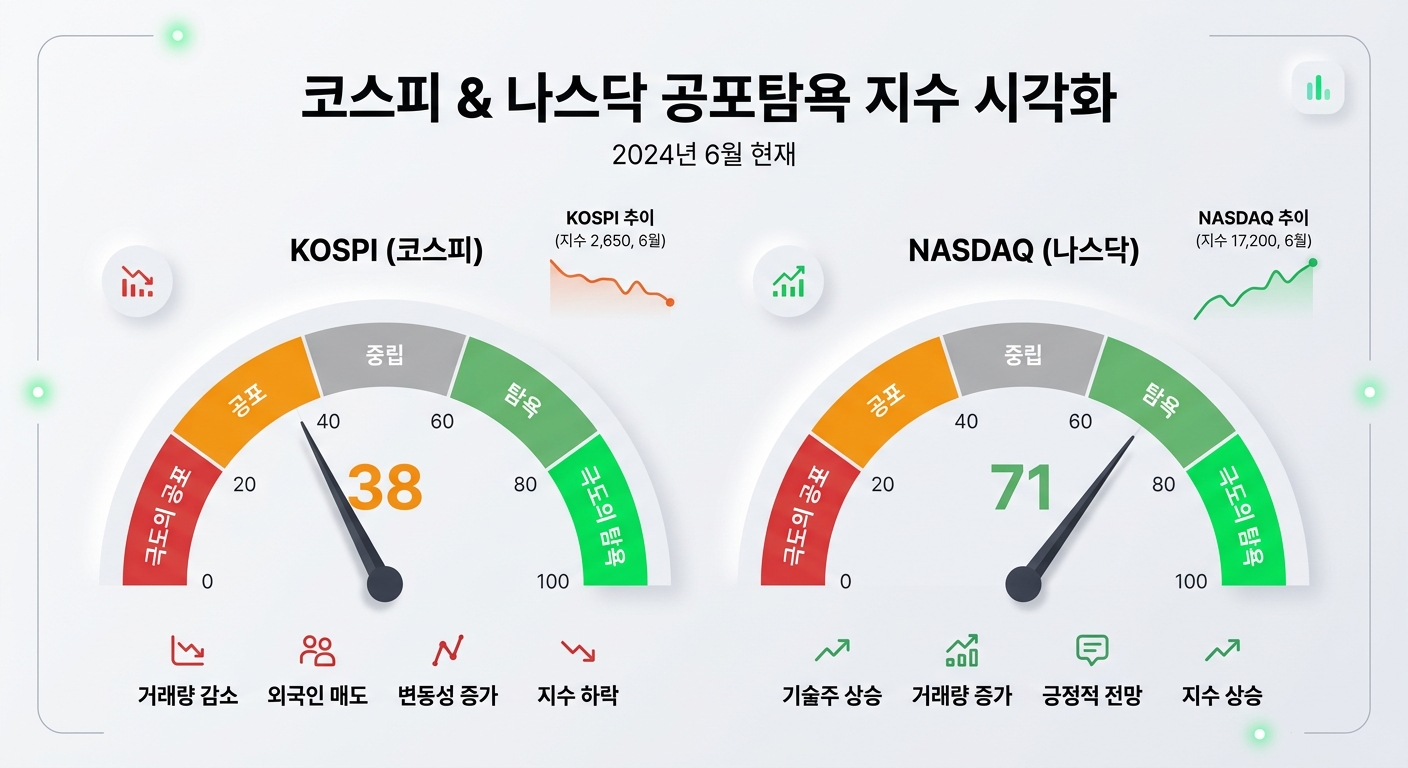
According to Daily Stock's proprietary Fear & Greed Index, the Nasdaq Fear & Greed Index is currently in the Fear zone at 35.3.
While this is a modest improvement from Fear (28) a week ago, it indicates that investor sentiment remains subdued compared to Neutral (54.7) a month ago and Greed (66.5) three months ago.
Conversely, the KOSPI Fear & Greed Index stands at Neutral (51.3), rebounding from Fear (29.2) a week ago to recover toward its month-ago level (51.4), though investors remain cautious of residual volatility from the Fear territory (35.7) recorded three months ago.
Across global FX markets, the US Dollar Index (DXY) and the Volatility Index (VIX) continue to track bond yield dynamics, directly influencing growth stock valuations.
[이미지: /stdaily/uploads/202609/gen_6ab316b22362a2.98513325.png]
Within the software sector, following the hardware cycle led by the Philadelphia Semiconductor Index (SOX), market focus is dominated by verifying whether massive hardware infrastructure capital expenditures (CAPEX) are converting into actual subscription revenues for enterprise business applications.
ServiceNow is establishing practical billing benchmarks for B2B AI software by deploying autonomous AI agents across IT Service Management (ITSM) and Customer Service Management (CSM).
Financial Analysis
Subscription revenue, ServiceNow’s core performance metric, continues to post solid double-digit growth despite broader concerns over a global economic slowdown.
In quarterly results, subscription revenue accounts for over 95% of total revenue, offering high visibility and predictability.
Current remaining performance obligations (cRPO), representing revenue expected to be recognized over the next 12 months, stand at approximately $12 billion, maintaining a year-over-year growth rate of 21% to 22%.
This confirms that existing clients are not only continually renewing contracts, but are also steadily upgrading to higher-priced AI-integrated tiers.
| Key Metric | 2024 Actual | 2025 Actual | 2026 Consensus Estimate | Notes |
|---|---|---|---|---|
| **Annual Subscription Revenue** | ~$10.4 billion | ~$12.8 billion | ~$15.2B–$15.5B | Maintaining ~20% YoY growth trajectory |
| **cRPO (Current Remaining Performance Obligations)** | ~$8.6 billion | ~$11.3 billion | Projected over $13.0 billion | 12-month forward revenue visibility metric |
| **Renewal Rate** | 98–99% | 98–99% | Stable at 98%+ | Strong lock-in effect among global large enterprises |
| **FCF Margin** | Low 30% range | ~33% | Potential to reach 34%+ | Operating leverage driving cash generation |
| **Now Assist Cumulative ACV** | Initial adoption phase | Exceeded $600 million | Approaching $1.0 billion run-rate | Accelerated adoption of autonomous AI agents |
Cumulative Annual Contract Value (ACV) for the company's native generative AI solution, 'Now Assist', is scaling rapidly and heading toward a $1 billion annual run-rate.
Furthermore, the "AI Control Tower" that oversees autonomous workflows, coupled with lightweight inference models developed in collaboration with NVIDIA, is helping keep the Cost of Goods Sold (COGS) in check.
Valuation
ServiceNow's real-time price is currently unconfirmed for the session (based on the latest verified data), but the stock continues to trade at the highest valuation premium among traditional enterprise SaaS companies.
Both its 12-month forward Price-to-Earnings (Forward P/E) and EV/Sales multiples sit at the upper end compared to the Nasdaq 100 average and large-cap S&P 500 growth peers.
This premium is directly exposed to discount rate adjustments driven by shifts in the 10-year US Treasury yield (US10Y).
Should yields rebound, pressure to reprice high-multiple tech stocks could increase; however, ServiceNow maintains defensive resilience supported by free cash flow margins exceeding 30%.
Additionally, ServiceNow is widely viewed as a prime beneficiary in bridging Big Tech's massive AI infrastructure spend (CAPEX) to actual enterprise productivity gains.
Unlike pure infrastructure providers, ServiceNow automates workflows directly inside client operational environments, reducing customer resistance to price increases and supporting multiple justification.
Expert & Institutional Analysis
Wall Street investment banks and global research firms highlight that enterprise AI is fundamentally transitioning from simple "prompt-driven assistive tools" to "autonomous agents (Agentic AI)."
Major research institutions, including Morgan Stanley and Goldman Sachs, note that ServiceNow's single data model and platform integration provide the essential underlying architecture for enterprise-wide agent adoption.
Institutions place significant weight on the conversion rate of existing customers upgrading from standard Pro tiers to premium Pro Plus and Enterprise Plus packages.
The consensus view holds that structural expansion in Average Revenue Per User (ARPU) will drive sustained long-term margin appreciation.
[이미지: /stdaily/uploads/202609/gen_6ab316bd86db89.32703198.png]
Risk Factors
The primary external variable is the potential delay in corporate IT budget deployment caused by macroeconomic uncertainty.
As enterprise CIOs scrutinize the tangible return on investment (ROI) of AI solutions more stringently, sales cycles for large-scale enterprise contracts could lengthen.
Increasing competitive intensity also warrants close monitoring.
Big Tech and rival SaaS platforms, including Microsoft's Copilot Studio and Salesforce's Agentforce, are aggressively targeting their respective install bases to capture market share in enterprise autonomous agents.
Furthermore, if the Federal Reserve shifts its monetary policy stance or if inflation figures rebound, dampening expectations for Treasury yield cuts, growth stock valuations could come under pressure.
A strengthening US Dollar (rising DXY) driven by geopolitical tensions also presents translation headwinds for multinational software companies with substantial overseas revenue.
Investment Perspective Summary
As the commercialization of AI transitions from "infrastructure buildout" to "application deployment," ServiceNow delivers some of the highest earnings visibility across the sector.
A stable cRPO backlog and a renewal rate near 99% offer solid downside protection, while AI agent-driven tier upgrades provide strong upside potential.
However, with the Nasdaq Fear & Greed Index lingering in the Fear territory (35.3), investors should account for broader market volatility.
Rather than chasing short-term price spikes, a phased dollar-cost averaging strategy—calibrated against fluctuations in the 10-year US Treasury yield and quarterly net new ACV prints—presents a more prudent scenario.
Investor Checkpoint Q&A
Q1. How do ServiceNow's "AI Agents" differ from standard chatbots?
While traditional generative AI chatbots are primarily confined to assisting with isolated tasks like document summarization or Q&A, autonomous agents execute multi-step workflows directly across integrated systems—such as IT incident remediation, access provisioning, and HR database updates—under user authorization.
Q2. How does the rollout of AI agents contribute to realized ARPU?
When enterprise clients upgrade from standard tiers to Pro Plus or Enterprise packages featuring embedded AI capabilities, per-user pricing generally sees double-digit percentage uplifts, flowing directly into Net New ACV growth.
Q3. Why are Current Remaining Performance Obligations (cRPO) critical during earnings?
cRPO represents contracted revenue expected to be recognized over the next 12 months as services are delivered. It serves as the most reliable leading indicator to gauge earnings resilience and revenue continuity, even during broader economic slowdowns.
Q4. What impact do the 10-year US Treasury yield (US10Y) and DXY have on the stock?
Because growth software valuations discount future cash flows back to present value, rising Treasury yields compress multiples. Additionally, a stronger DXY negatively impacts reported revenue, as more than 30% of total revenue is generated outside the United States.
Q5. What differentiates ServiceNow from competitors like Salesforce or Microsoft?
ServiceNow operates as a vendor-neutral "platform of platforms," orchestrating disparate legacy IT, HR, and customer service systems. Its AI Control Tower capability, which governs multi-LLM workflows without enterprise lock-in to a single underlying model vendor, creates a durable structural moat.