Hello, this is Daily Stock, delivering reliable investment insights through precise, real-time analysis of global financial markets.
[Image: /stdaily/uploads/202607/gen_6a456cc4e64823.94262847.png]
Executive Summary
- Amid the Hang Seng Index's 10.73% decline during the first half of 2026, "Southbound Capital" flowing from mainland China is emerging as a critical variable supporting the market downside.
- The cumulative net inflow of Southbound Capital in H1 stood at HK$305.486 billion, down approximately 60% year-on-year, yet long-term dip-buying sentiment remains resilient.
- Hong Kong financial authorities are accelerating capital attraction efforts by pushing for unprecedented regulatory easing, such as the "IPO Connect" which would allow mainland retail investors to participate in Hong Kong public offerings.
Market Overview
As of July 2, 2026, global stock markets are showing a distinct "tri-polar decoupling" trend, with the fundamentals of three major regions—the US, Europe, and Asia—moving on different paths.
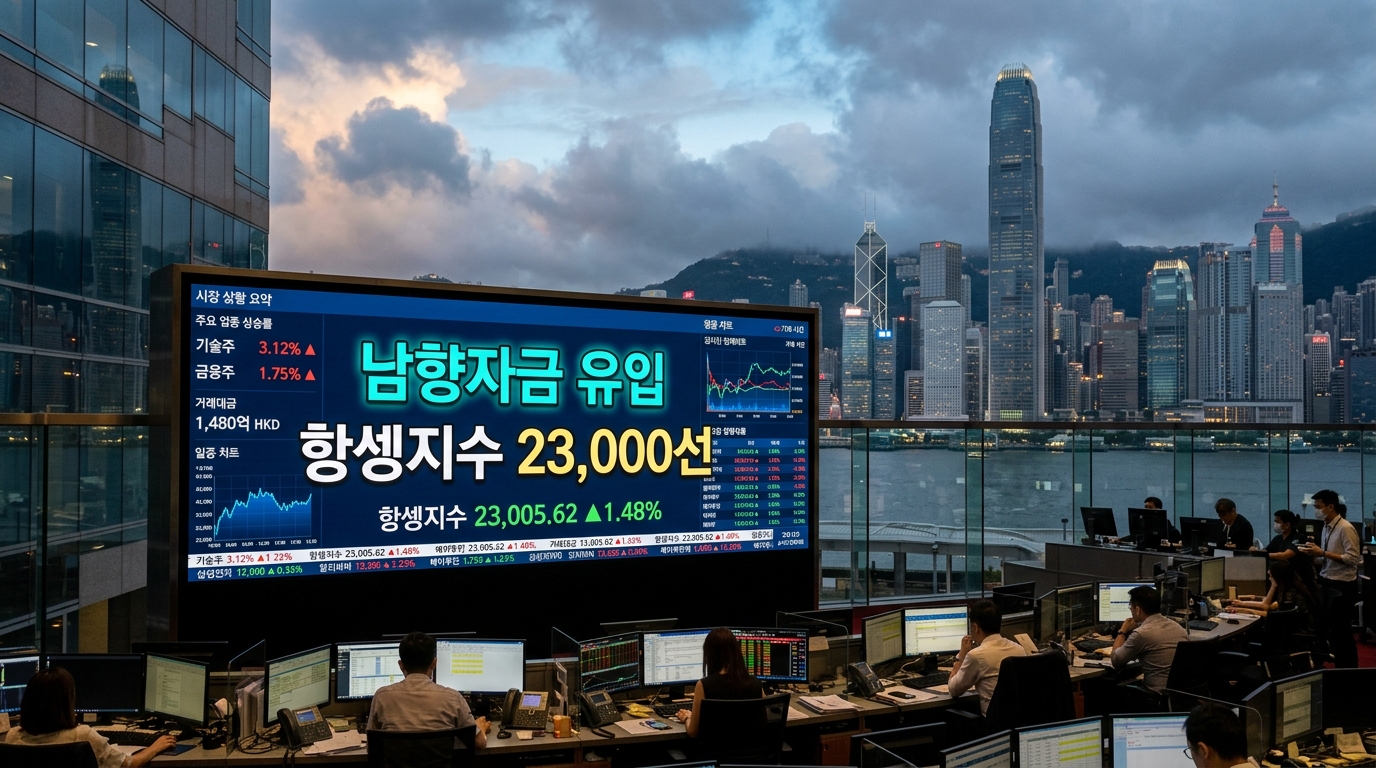
While the US Nasdaq Index sees heightened volatility centered around high-valuation tech stocks, the Hong Kong Hang Seng Index closed out the first half of 2026 with a 10.73% drop, fighting a fierce battle around the 23,000 level.
Amid this sluggish performance, market attention is highly focused on the movement of "Southbound Capital," which refers to mainland Chinese investors purchasing Hong Kong stocks.
The net inflow of Southbound Capital in the first half of this year was approximately HK$305.486 billion. This is a sharp plunge of nearly 60% compared to the record-setting H1 2025 (HK$731.193 billion).
Nonetheless, with daily trading volumes hovering around HK$100 billion, Southbound Capital continues to serve as a reliable liquidity pillar for the Hong Kong stock market.
Furthermore, Hong Kong regulatory bodies revealed they are in deep discussions with the mainland government to introduce the "IPO Connect" to further stimulate mainland capital inflows.
This massive regulatory liberalization would permit mainland retail investors to directly subscribe to IPO shares of newly listing companies in Hong Kong.
If implemented, the intensity of Southbound Capital inflows, which had lately cooled down, could see a strong revival.
Meanwhile, according to Daily Stock's proprietary Fear & Greed Index, the domestic KOSPI Fear & Greed Index is currently in "Fear" (33.2), showing cooled sentiment compared to last week's "Neutral" (53.8).
The Nasdaq Fear & Greed Index is also sitting in "Fear" (30.5), recovering slightly from last week's reading of 26, but still reflecting high investor caution.
Financial Analysis
Looking closer at Southbound Capital flows, a clear "K-shaped polarization" is taking place, departing from the past trend of indiscriminate market-wide buying.
While mega-cap internet stocks like Tencent and Kingboard recorded steady net inflows, massive profit-taking hit companies like Alibaba, which saw sharp short-term gains or faced fundamental concerns.
This suggests that mainland capital is reshaping its portfolio based on clear earnings visibility and reasonable valuations, rather than simply tracking index benchmarks.
| Classification | First Half of 2025 | First Half of 2026 | Key Features & Implications |
|---|---|---|---|
| **Southbound Capital Net Inflow** | HK$ 731.193 billion | HK$ 305.486 billion | Slumped ~60% YoY; two-way volatility widened |
| **Hang Seng Index Return** | Robust upward trend (~28% annual surge) | -10.73% decline (Correction phase) | Reflects global liquidity tightening fears & profit-taking |
| **Primary Buying Targets** | General tech & internet platforms | Hard tech, high-dividend stocks, biotech | Selectivity intensified, forming a distinct K-shaped portfolio |
| **Hong Kong IPO Funds Raised** | ~HK$ 280 billion (Annual) | HK$ 110.4 billion (Q1 only) | Jumped 6-fold YoY, returning to global top-tier levels |
Hong Kong's initial public offering (IPO) market is exhibiting a clear recovery, raising HK$110.4 billion in Q1 2026 alone—a six-fold jump compared to the same period last year.
The consecutive listings of large-scale technology enterprises are acting as a powerful magnet drawing mainland capital into Hong Kong.
Valuation
The greatest appeal of the Hong Kong stock market at present lies in its outstanding price attractiveness relative to major global indices—namely, low valuation.
The Hang Seng Index is trading at a discount of over 35% compared to developed market indices, sitting near the bottom of its historical average valuation multiple.
The "AH Premium Index," which measures the price gap between A-shares and H-shares, also remains in an attractive range compared to its historical average, supporting the price appeal of H-shares.
Even in a phase of contracting global liquidity, mainland Chinese investors' reluctance to abandon Hong Kong stocks is precisely due to this extreme undervaluation.
In particular, high-dividend paying financial stocks and the energy sector are highly favored as safe havens and value investing targets for mainland funds.
Low valuations limit additional downward pressure while laying the groundwork for powerful elasticity when macro conditions improve.
[Image: /stdaily/uploads/202607/gen_6a456ccd317b35.01120334.png]
Institutional & Expert Analysis
Global investment bank Goldman Sachs assessed that, for the Hong Kong stock market, "it is more effective to take a tactical approach focusing on specific alpha themes rather than expecting beta expansion of the index itself for the time being."
This analysis suggests that selective rallies in individual sectors favored by mainland capital are more likely than a broad-based index recovery.
Conversely, Baring Asset Management maintains an optimistic outlook, stating, "Supported by technological innovation and government policy backing, Hong Kong and mainland Chinese stock markets have entered a long-term structural rebound phase."
Major institutions such as Morgan Stanley and HSBC also positively evaluate Chinese companies' growing global technological competitiveness and aggressive high-dividend policies.
Amid policy divergence among central banks, the People's Bank of China (PBOC) maintains an accommodative liquidity stance, which stands in contrast to the European Central Bank's (ECB) monetary tightening and the US Fed's policy uncertainty.
Experts forecast that final approval of policies aimed at diversifying mainland capital attraction, including the "IPO Connect," will serve as a key milestone determining the future path of the Hang Seng Index.
Risk Factors
The most prominent risk hanging over the Hong Kong stock market is the prolongation of geopolitical friction surrounding US-China trade and technological hegemony.
The US government's expansion of Chinese tech entity blacklists and tariff barriers deepens global institutional investors' avoidance of Chinese assets.
The resulting outflow of offshore foreign capital acts as a factor that offsets the downside support of Southbound Capital, magnifying volatility.
Additionally, mixed readings in global manufacturing PMIs and instability in commodity prices place a burden on the Hang Seng Index, which has a high weighting of cyclical stocks.
If major commodity prices like crude oil and copper fluctuate sharply due to global supply chain disruptions, it could lead to margin pressure on Hong Kong-listed heavy industry and materials firms.
The recent trend of mainland investors temporarily exiting risk assets to rotate capital into safe havens or onshore domestic tech stocks is another point of caution.
Investment Outlook Summary
In conclusion, the Hong Kong Hang Seng Index is currently in a phase where extreme valuation attractiveness and the continuous downside support of mainland capital are locked in a tug-of-war.
The temporary slowdown in H1 Southbound Capital inflows and global macro uncertainties are acting as short-term corrective pressures.
However, if institutional upgrades like the 'IPO Connect' are fully implemented, the strength of mainland capital inflows could intensify again and drive a market rebound.
Therefore, at this juncture, rather than betting on a trend-wide rise of the broader index, a rational strategy would be to narrow down portfolios to high-dividend stocks or hard tech fields with dominant proprietary technology where Southbound Capital is actively flowing.
Under the US-EU-Asia tri-polar decoupling framework, it is necessary to closely monitor how Hong Kong's unique status as the "gateway to mainland China" is re-evaluated.
Investor Checklist Q&A
Q1. How large is the impact of 'Southbound Capital' on the Hang Seng Index?
A1. Southbound Capital is the channel through which mainland Chinese investors purchase Hong Kong stocks. It recently accounted for a substantial portion of Hong Kong's total market trading volume, playing a pivotal role in determining market liquidity and support levels.
Q2. What caused the sharp year-on-year drop in Southbound Capital during H1 2026?
A2. Investment sentiment was dampened by global monetary policy uncertainties and intensifying US-China tensions, leading mainland investors to take profits on some highly valued names and adjust their pace of capital allocation.
Q3. What is the 'IPO Connect' and what effects can be expected?
A3. It is a regulatory relaxation proposal that would allow mainland retail investors to directly subscribe to IPO shares of companies newly listing in Hong Kong. If finalized, it is expected to bring a massive influx of new capital.
Q4. How does the current valuation level of the Hang Seng Index compare to global stock markets?
A4. It is in an extremely undervalued state, trading at a discount of more than 35% compared to developed market indices. This high price attractiveness acts as a defensive buffer against additional sharp declines.
Q5. What is the most important risk for investors to consider when accessing the Hong Kong market?
A5. Investors should be most wary of potential sudden outflows of foreign capital due to ongoing US-China geopolitical friction, as well as earnings volatility in cyclical stocks caused by disruptions in global commodity supply chains.