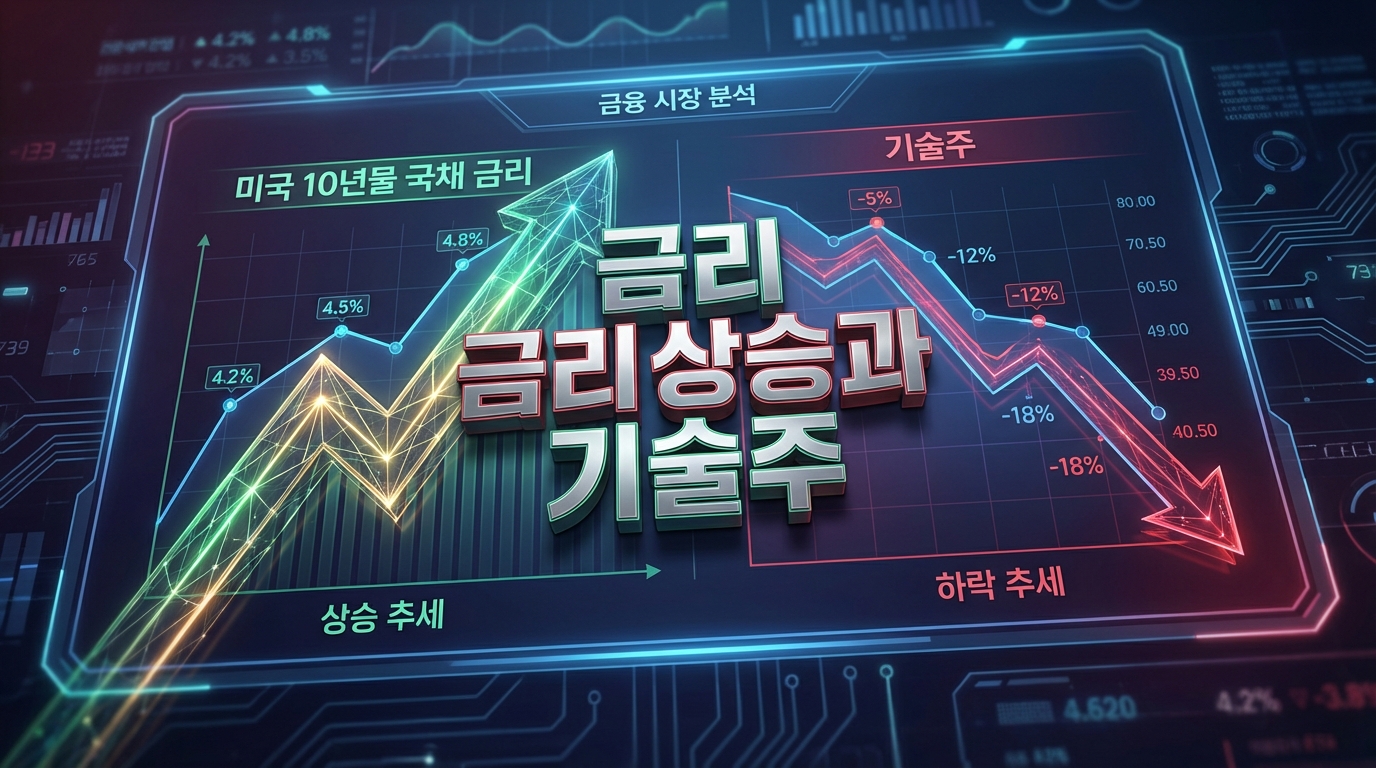
Title: [KOSDAQ Story] The US 10-Year Yield Tantrum and Tech Stock Dilemma, KOSDAQ Growth Stock Valuation Check
Hello, this is Daily Stock, analyzing the latest macroeconomic variables and key trends in the KOSDAQ market.
Key Summary
[Image: /stdaily/uploads/202603/gen_69c397141ea366.47042568.png]
Today (March 25, 2026), the KOSDAQ market is facing a massive wave: the rise in the US 10-year Treasury yield.
Inflation concerns triggered by geopolitical risks are leading to higher discount rates, putting the brakes on the growth stock-driven market.
In particular, volatility is noticeably expanding among top-tier tech stocks by market capitalization on the KOSDAQ, which share a strong synchronization with the NASDAQ.
Current Situation Summary
The KOSDAQ index closed at 1159.55 today, directly reflecting macroeconomic uncertainties.
On the same day, the KOSPI recorded 5642.21, and the NASDAQ hit 21761.89. The KRW/USD exchange rate is at 1499.80 KRW, threatening the 1500 KRW mark right at its chin.
According to the Fear & Greed Index calculated by Daily Stock, the NASDAQ is currently in the 'Extreme Fear (16.9)' zone.
This indicates that market sentiment remains deeply frozen, following a week ago (15.4). (1 month ago: 45.8 Neutral, 3 months ago: 29.3 Fear)
The KOSPI has also shifted to 'Fear (33.5)', showing a significantly heightened sense of caution among investors compared to a week ago (48.9 Neutral). (1 month ago: 58.1 Neutral, 3 months ago: 52.9 Neutral)
At the center of this psychological contraction lies the surge in the US 10-year Treasury yield, which is threatening the 4.4% level.
Geopolitical risks originating from the Middle East and surging oil prices are dampening expectations of Federal Reserve interest rate cuts, squeezing overall market liquidity.
Financial Analysis
Rising interest rates increase the discount rate applied to future earnings, adding financial burden to growth stocks that are not currently generating profits.
The AI software, biotech, and secondary battery sectors, which have led the KOSDAQ market, attracted funds based on high expectations for earnings growth.
However, if the high-interest-rate environment becomes entrenched, corporate interest coverage ratios will drop, and the cost of raising new investment capital will inevitably surge.
The KOSDAQ 150 index, which includes many top-tier KOSDAQ stocks by market cap, is reacting even more sensitively to these macroeconomic pressures.
On the other hand, KOSDAQ Small index constituents—which have relatively lower valuation burdens or solid earnings-based fundamentals—are showing trends of defending against the decline.
This suggests a potential partial shift of market funds from growth themes to small-and-mid-cap stocks with defensive characteristics and secured financial soundness.
[Image: /stdaily/uploads/202603/gen_69c3972aba2162.80223763.png]
Valuation
The tantrum-like surge in the US 10-year yield has put the valuation appropriateness of leading KOSDAQ theme stocks to the test.
AI software and robot component stocks, whose Price-to-Sales Ratio (PSR) or Enterprise Value-to-EBITDA (EV/EBITDA) indicators had reached historical highs, are facing multiple contraction pressure.
Below is a table summarizing the potential for valuation shifts in major KOSDAQ growth sectors.
| Sector Category | Key Valuation Metric | Valuation Impact in High-Rate Environment | Market Fund Supply & Demand Trend |
|---|---|---|---|
| **AI Software** | PSR (Price-to-Sales Ratio) | Potential for rapid multiple contraction | Foreign program net selling |
| **Biotech/New Drugs** | EV/Pipeline Value | Increased discount rate due to rising R&D funding costs | Stagnation of retail deposit inflows |
| **Secondary Battery Materials** | EV/EBITDA | Increased interest burden for CAPEX investments | Institutional profit-taking sell-offs |
| **IT Parts/Equipment** | PER (Price-to-Earnings Ratio) | Concerns over earnings slowdown due to delayed downstream investments | Selective fund inflow focused on value stocks |
As seen in the table, the higher the valuation multiple of a growth sector, the more severe the supply and demand distortion can become when interest rates rise.
Expert & Institutional Analysis
Market experts are wary of the negative impact that the current extent of interest rate hikes and surging exchange rates are having on KOSDAQ supply and demand.
According to domestic brokerage analyses, including Kiwoom Securities, there are concerns that the sustained rise in the US 10-year yield acts as a proxy for the stock market's discount rate, potentially damaging the long-term trend of the domestic stock market.
Additionally, foreign institutions like Bloomberg warn that if Middle East tensions persist for 1-2 months, upward pressure on interest rates could further intensify alongside a spike in oil prices.
This is pinpointed as a primary cause driving foreign investor capital outflow from the KOSDAQ market and massive program net selling.
Experts predict that the volatile market will continue until the impact of major macroeconomic indicators, such as the Manufacturing Purchasing Managers' Index (PMI), on the real economy is confirmed.
Therefore, the prevailing advice is to adopt a conservative perspective focused on traditional value stocks backed by dividend yields or solid earnings, rather than aiming for short-term rebounds.
Risk Factors
Currently, the biggest risk in the KOSDAQ market is the 'low-liquidity gap volatility' triggered by the combination of a high exchange rate and high interest rates.
With the KRW/USD exchange rate approaching 1500 won, foreign investors' concerns about foreign exchange losses have grown, serving as a direct catalyst for supply and demand outflow.
Furthermore, if retail investors' margin debt balances remain high, margin call volumes triggered by interest rate volatility could exacerbate the market's downward pressure.
In the absence of clear domestic policy momentum, investors must also be cautious of the synchronization where the corrective trend in NASDAQ tech stocks directly spills over into KOSDAQ growth stocks.
Ultimately, theme stocks that have inflated their valuations solely on expectations carry the risk of a sharp plunge due to a lack of waiting buyers to absorb profit-taking sell-offs.
Investment Perspective Summary
The rise in the US 10-year yield and the volatility of NASDAQ tech stocks serve as a severe testing ground requiring fundamental improvements in the KOSDAQ market's constitution.
Investments reliant on vague growth stories should be avoided; instead, a strategy of objectively evaluating financial stamina and cash-generating ability may be effective.
Particularly since a return gap could occur between KOSDAQ 150 large-cap growth stocks and the KOSDAQ Small index, securing portfolio flexibility appears critical.
Until market uncertainties are resolved, it is a time to prioritize risk management and closely track changes in macroeconomic indicators.
[Image: /stdaily/uploads/202603/gen_69c3973f438d31.31633812.png]
Investor Checkpoint Q&A
Q1. What impact does the US 10-year Treasury yield have on KOSDAQ tech stocks?
A1. The US 10-year yield serves as the benchmark for risk-free returns, determining the stock market's discount rate. When rates rise, the present value of future earnings falls, which is highly likely to exert downward pressure on highly valued tech and growth stocks on the KOSDAQ.
Q2. Which is more advantageous, the KOSDAQ 150 Index or the KOSDAQ Small Index?
A2. The KOSDAQ 150 contains many highly valued large-cap growth stocks, making it vulnerable to foreign program selling in a high-interest-rate environment. In contrast, undervalued stocks with solid earnings among the small and mid-caps in the KOSDAQ Small Index are more likely to exhibit downside defense.
Q3. What is the significance of the KRW/USD exchange rate threatening to break 1500 won?
A3. A high exchange rate raises import prices, stimulating domestic inflation, and signifies a depreciation in the value of KRW-denominated assets (FX translation loss) from the perspective of foreign investors. This can act as a factor accelerating the outflow of foreign capital from the KOSDAQ market.
Q4. When will the 'extreme fear' sentiment in the NASDAQ likely be resolved?
A4. Investor sentiment will likely improve only when Middle East geopolitical risks ease, international oil prices stabilize, and US inflation indicators are confirmed to align with the Federal Reserve's policy path. At present, it is difficult to predict a short-term resolution.
Q5. What is the most important risk to watch out for when investing in the KOSDAQ right now?
A5. Investors must be most vigilant against gap-down volatility occurring in a high-rate, low-liquidity environment, as well as the potential for margin calls resulting from the liquidation of retail investors' margin debt. It may be advantageous to maintain cash portions and approach the market conservatively.
---