Hello, as a professional writer for Daily Stock, I welcome you all who are contemplating successful investment strategies today.
[Image: /stdaily/uploads/202603/gen_69be507c42df05.62814958.png]
Core Summary
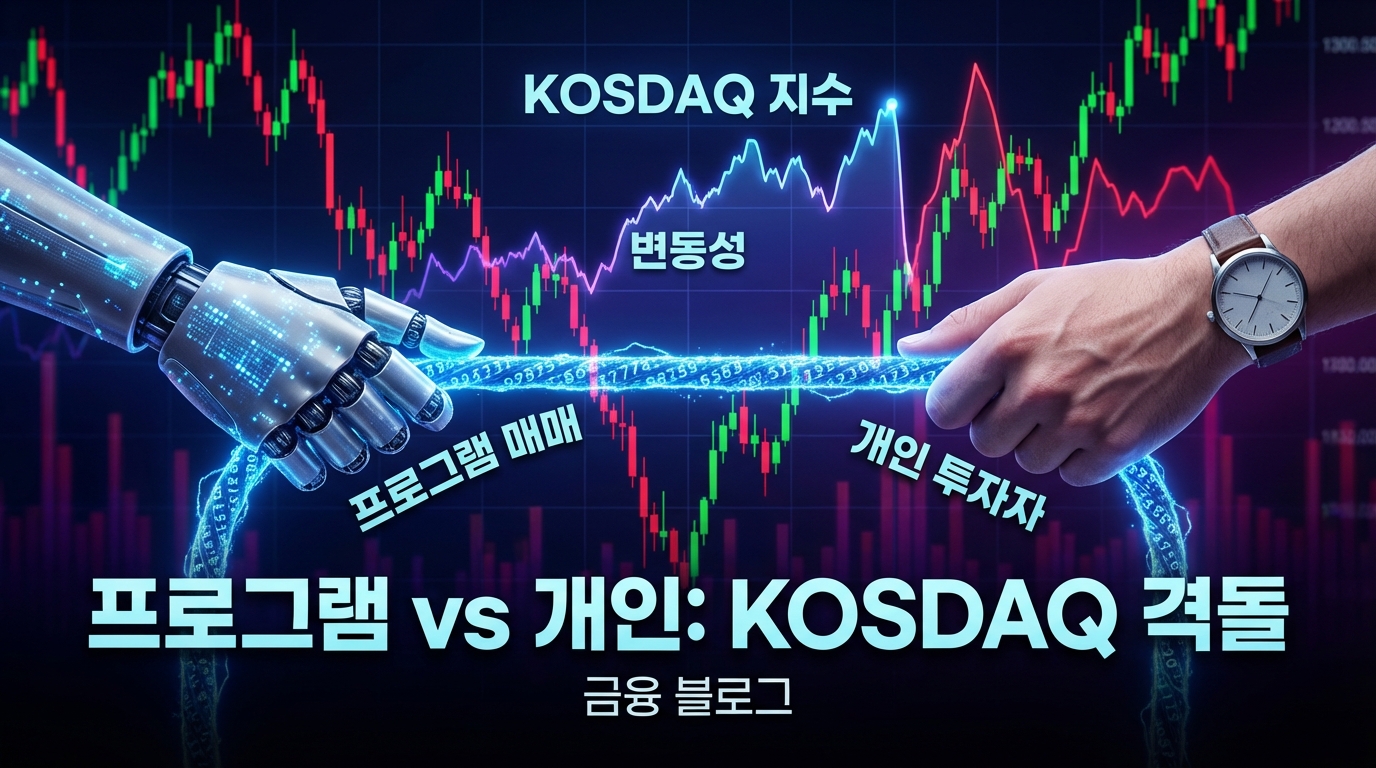
The KOSDAQ 150 index is currently entering a phase of extreme volatility expansion, with a fierce tug-of-war unfolding among supply and demand participants.
Recently, as large-scale funds have flowed into active ETFs targeting the KOSDAQ market, the capital shift between large-cap and small/mid-cap stocks is accelerating.
While foreign program trading shakes the direction of the index, retail and institutional investors are building defense lines centered around specific theme stocks.
As growth stock valuations are being re-evaluated, distinguishing the gems from the stones is more crucial than ever.
Current Situation Summary
As of the closing on March 21, 2026, the KOSDAQ index recorded 1161.52, and the KOSPI closed at 5781.20.
The NASDAQ index showed a solid performance at 21647.61, but the USD/KRW exchange rate surged to 1,506.50 won, putting pressure on foreign supply and demand.
According to Daily Stock's proprietary Fear & Greed Index, the flip side of the current market can be clearly identified.
KOSPI Fear & Greed: Current Fear (39.1), 1 week ago Fear (28.2), 1 month ago Neutral (57.3), 3 months ago Neutral (46.1), showing persistent anxiety.
NASDAQ Fear & Greed: Current Extreme Fear (14.6), 1 week ago Fear (22.6), 1 month ago Neutral (44.4), 3 months ago Fear (21.7), indicating a significant contraction in investor sentiment.
Unlike the superficial figures of the indices, volatility and momentum indicators still reflect strong market caution.
[Image: /stdaily/uploads/202603/gen_69be5094ed9b73.90410440.png]
Financial Analysis
The financial structure of the top KOSDAQ 150 constituents is being reshaped around growth stocks such as bio, secondary batteries, and AI software.
For these companies, sales growth rates and R&D investment scales serve as key indicators explaining corporate value, rather than immediate operating profit margins.
Valuations utilizing the Price-to-Sales Ratio (PSR) or EV/EBITDA are gaining more traction in the market than the traditional Price-to-Earnings Ratio (PER).
In particular, stocks included in the AI and robot sectors are granted premiums based on future cash-generating capabilities, even if they record deficits due to initial investment costs.
Recently listed KOSDAQ active ETFs are intensively purchasing small and mid-cap stocks with clear earnings improvements, leading to prominent stock price increases for companies with excellent fundamentals.
On the other hand, existing KOSDAQ 150 large-cap stocks face the heavy task of proving their earnings, potentially increasing their financial burden.
Valuation
The valuation of the KOSDAQ 150 index is currently situated near its historical upper bound amidst synchronization with the NASDAQ.
While abundant retail deposits and institutional funds driven by active ETFs are supporting the bottom, controversies over overheating relative to fundamentals continue to arise.
| Index/Sector | Key Valuation Indicator | Current Evaluation Level | Market Expectation Factors |
|---|---|---|---|
| KOSDAQ 150 Overall | Exceeds 12M Forward PER 20x | Overvaluation controversy exists | Expectations for global liquidity and interest rate cuts |
| AI & Software | High PSR applied | Future value pre-reflected | Full-scale technology exports and B2B sales |
| Robot & IT Parts | EV/EBITDA 15~25x | Growth premium maintained | Capital expenditure expansion and automation demand |
| KOSDAQ Small/Mid-Caps | Mixed around PBR 1x | Relative undervaluation | Benefiting from active ETF fund inflows |
Institutions are showing a movement to reduce overvalued large-caps within the KOSDAQ 150 index and replace them with small and mid-cap stocks with high valuation appeal in their portfolios.
This shift in supply and demand is simultaneously lowering the valuation burden of the entire index while maximizing the return deviation among individual stocks.
Expert & Institutional Analysis
Financial investment industry experts diagnose that the recent influx of over 1 trillion won in active ETF funds into the KOSDAQ market is changing the market landscape.
Unlike passive funds, as fund managers actively select stocks, stocks with high potential for new index inclusion are receiving attention.
The perspective of foreigners is somewhat conservative, employing a hedging strategy of crossing spot selling and futures buying due to concerns about FX losses from the rising exchange rate.
Institutional investors advise that rather than predicting the market's direction, they should strictly focus on individual themes backed by earnings and policy momentum.
[Image: /stdaily/uploads/202603/gen_69be50aa23d4d9.88744380.png]
Risk Factors
The biggest risk is that if the high exchange rate of 1,506.50 won is prolonged, massive foreign program selling volume could pour out.
Since the KOSDAQ market has thin liquidity, there is a high risk that intraday gap volatility will expand abnormally depending on the direction of foreign basket trading.
Furthermore, if the funds concentrated in active ETFs flow out all at once to realize short-term profits, the stock prices of small and mid-cap stocks with a high weighting could plummet.
If the extreme fear (14.6) sentiment of the NASDAQ spreads to domestic tech stocks in general, the possibility of valuation support collapsing must also be left open.
Investment Perspective Summary
In the current KOSDAQ market, rather than betting on the rise of the index itself, it is a phase where a thorough bottom-up approach to stock selection is advantageous.
A strategy of adjusting the weighting of overvalued large-caps targeted by foreign program trading and paying attention to undervalued growth stocks attracting institutional supply and demand can be effective.
Rather than being swayed by short-term volatility, it is advisable to compress the portfolio based on the core competitiveness of the business and future earnings visibility.
Maintaining a certain level of cash and having the patience to wait for the market's fear sentiment to calm down can also be an excellent investment countermeasure.
Investor Checkpoint Q&A
Q1. Why has the volatility of the KOSDAQ 150 index become exceptionally large?
Recently, massive funds flocked to KOSDAQ-exclusive active ETFs, causing a reorganization of supply and demand among stocks, and foreign program trading driven by the high exchange rate was added, maximizing intraday volatility.
Q2. The Fear & Greed Index indicates 'Extreme Fear'. Does this mean a bear market?
It does not necessarily mean a decline; rather, regardless of the index's absolute position, the recent expansion of volatility and slowing momentum have been quantified as strong cautionary sentiment among investors.
Q3. Why is it important to track foreign program trading?
Since the stock prices of top KOSDAQ market cap companies are strongly inclined to be determined by foreigners' algorithm-based basket trading, it is a key indicator for grasping the continuity of supply and demand.
Q4. What should be noted when investing in stocks included in active ETFs?
Because stock prices may have surged beyond their fundamentals due to a short-term concentration of funds, one must absolutely consider the risk of a sudden drop that may occur upon future fund outflows.
Q5. Which sectors are advantageous in the current high exchange rate (1,506.50 won) situation?
Traditionally, IT parts stocks, which have a high export share and can enjoy exchange rate effects, or certain bio companies pursuing global technology exports, may have relatively better defensive capabilities.