Hello, this is DailyStock, bringing you the latest market trends as the Q1 2026 earnings season kicks off and the true sorting of KOSDAQ growth stocks begins in earnest.
Key Summary
[Image: /stdaily/uploads/202604/gen_69d60bb2225fe6.04375531.png]
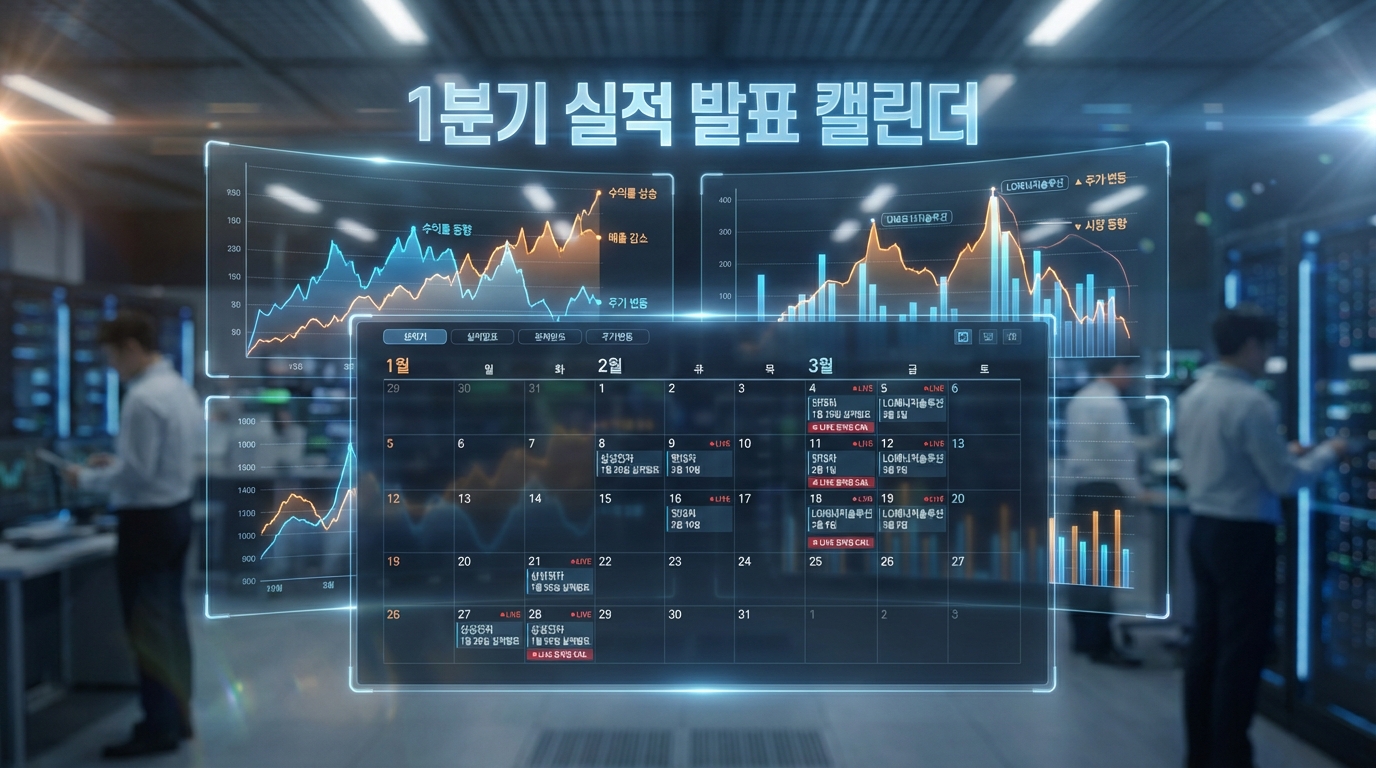
Starting the second week of April, the Q1 2026 earnings release calendar is in motion, newly reshaping the volatility of the KOSDAQ market.
On the 7th, as Samsung Electronics announced a record-high preliminary operating profit of 57.2 trillion KRW, expectations for an earnings turnaround in KOSDAQ IT and semiconductor materials, parts, and equipment (so-bu-jang) companies have heightened [1].
However, the high interest rate stance and the high KRW/USD exchange rate reaching 1,474.90 KRW are providing a clear pretext for profit-taking in small-to-mid-cap KOSDAQ growth stocks.
The valuation polarization between large-cap KOSDAQ 150 stocks proving tangible profits and theme stocks moving solely on expectations is expected to become distinct.
Current Situation Summary
On the 8th, the Korean stock market closed with KOSPI at 5,872.34 and KOSDAQ at 1,089.85, entering a wait-and-see phase ahead of the full-fledged Q1 earnings season.
According to DailyStock's proprietary Fear & Greed Index, the KOSPI Fear & Greed is currently Neutral (51), improving from Fear (31.3) a week ago, Fear (35.9) a month ago, and Greed (73.5) three months ago. However, the NASDAQ Fear & Greed is currently at Fear (22.1), remaining in a sluggish trend from Extreme Fear (13.8) a week ago, Fear (25.3) a month ago, and Extreme Fear (2.9) three months ago.
Following record volatility, including a KOSPI sidecar triggered in mid-March due to geopolitical risks, investor deposits have decreased from the 132 trillion KRW range to the 108 trillion KRW range, indicating reduced liquidity [2].
In this low-liquidity environment, just a single Q1 earnings guidance from an individual company can maximize intraday gap volatility.
Financial Analysis
Starting this week, the Q1 earnings announcement schedules for major KOSDAQ theme leading stocks are taking shape.
The explosive increase in operating profit of Samsung Electronics' memory division is expected to prove direct and indirect trickle-down effects on the Q1 order backlogs of HBM and advanced process equipment stocks within the KOSDAQ [1].
| Sector/Company Group | Major Earnings Announcement (Expected) Period | Q1 Earnings Momentum and Valuation Characteristics |
|---|---|---|
| **Semiconductor Equipment & Parts** | 2nd to 3rd Week of April | Trickle-down effect from memory turnaround expected, EV/EBITDA revaluation phase |
| **Secondary Battery Materials** | Mid to Late April | Gradual sales increase expected centered on silicon anodes (Daejoo Electronic Materials, etc., 5.8 billion KRW profit forecast) [3] |
| **AI Software** | Late April to Early May | Confirmation of B2B cloud order expansion needed, justification of high PSR required |
| **Bio/Pharmaceuticals** | After 4th Week of April | Check pipeline milestone inflows and R&D cost burdens due to high exchange rates |
In particular, some companies among secondary battery material stocks are expected to see a gradual increase in sales volumes starting in Q1 following preemptive inventory adjustments, and are projected to maintain a surplus trend [3].
However, for AI software or certain bio sectors, whether the H2 guidance is upgraded, rather than immediate EPS (Earnings Per Share), will be the key to establishing a financial defense line.
Valuation
[Image: /stdaily/uploads/202604/gen_69d60bc9d86d00.74566952.png]
Growth stocks within the KOSDAQ are experiencing extreme price differentiation based on the valuation metrics currently applied to them.
Semiconductor equipment stocks included in the KOSDAQ 150 that are backed by earnings are becoming a safe haven for institutional supply and demand as their EV/EBITDA multiples stabilize at historical average levels.
On the other hand, KOSDAQ Small companies or AI software theme stocks in an unrealized profit state are still subject to a high PSR (Price-to-Sales Ratio), posing a significant valuation burden.
In the current phase where synchronization with the NASDAQ index has weakened, if they cannot self-prove their PSR logic through earnings announcements, there is a possibility of a rapid downward multiple revision.
Expert & Institutional Analysis
Market experts analyze that there are supply-and-demand constraints for Samsung Electronics' Q1 surprise to spread as warmth across all KOSDAQ growth stocks.
The fact that 90% of the operating profit came from memory is a clear boon for the KOSDAQ semiconductor value chain, but it could induce a concentration phenomenon that blocks the circulation of funds to other sectors [1].
Furthermore, due to the high exchange rate of 1,474.90 KRW, there is a high hurdle for foreign program trading to shift into strong, large-scale net buying in the KOSDAQ market.
Ultimately, during this earnings release calendar period, it is highly anticipated that institutional investors will execute selective buying only in specific turnaround companies.
Risk Factors
The biggest risk is the emergence of short-term profit-taking volume, centered on stocks where expectations of strong earnings have already been priced in.
The frequent triggering of sidecars and the outflow of retail deposits recently observed in the domestic stock market suggest that the market's stamina has thinned accordingly [2].
Additionally, as the high-interest-rate phase prolongs, the fact that the NASDAQ Fear & Greed Index has dropped to 22.1 (Fear) places a psychological burden on the supply and demand for KOSDAQ growth stocks.
In a low-liquidity market, even if a company's actual earnings guidance slightly misses market expectations, there is a concern that combined algorithmic selling could increase downward gap volatility.
Investment Perspective Summary
[Image: /stdaily/uploads/202604/gen_69d60be0e03b30.03573206.png]
For KOSDAQ investments this week, a strategy of approaching after directly confirming the actual reported earnings figures may be more advantageous than short-term "buy the rumor, sell the news" trading.
The true valuation revaluation phase will be the point when the earnings turnarounds of KOSDAQ parts companies are confirmed following the earnings announcements of large anchor companies.
It is necessary to thoroughly check whether individual companies' PSRs are not excessively high, or whether their operating cash flows are turning positive.
As it is a period of high uncertainty, it is worth considering a conservative response scenario that prepares for volatility by meticulously checking the earnings calendar.
Investor Checkpoint Q&A
Q1. What is the key momentum for the KOSDAQ market this week?
Following the announcements of Q1 preliminary earnings surprises by large anchor companies, whether the earnings of KOSDAQ semiconductor materials, parts, and equipment, as well as IT parts stocks, synchronize with them is the most important focal point.
Q2. What is the current market liquidity situation, including investor deposits?
Due to geopolitical risks and high index volatility, overall market liquidity is showing a contracted state, with investor deposits dropping to the 108 trillion KRW range at one point.
Q3. How is the Q1 earnings direction for secondary battery material stocks projected?
Some core material companies, such as those in silicon anodes, are expected to see a gradual expansion in their operating profit surplus from Q1 due to the effects of preemptive inventory adjustments.
Q4. Why is there a valuation gap between KOSDAQ 150 large-cap stocks and KOSDAQ Small companies?
This is because KOSDAQ 150 equipment stocks are evaluated by EV/EBITDA based on actual cash generation capacity, whereas unrealized-profit small-to-mid-cap theme stocks are subjected to relatively overvalued PSR metrics, widening the valuation gap.
Q5. What is the impact of the high exchange rate of 1,474.90 KRW as of today on the KOSDAQ market?
It has the potential to act as a trigger for profit-taking by limiting the large-scale inflow of foreign program supply and demand, and by aggravating the financial cost burdens of small and medium-sized enterprises with a high proportion of dollar settlements.