Hello, this is Daily Stock, providing financial market context with verified data.
Key Summary
[Image: /stdaily/uploads/202603/gen_69bdee073e5470.30330732.png]
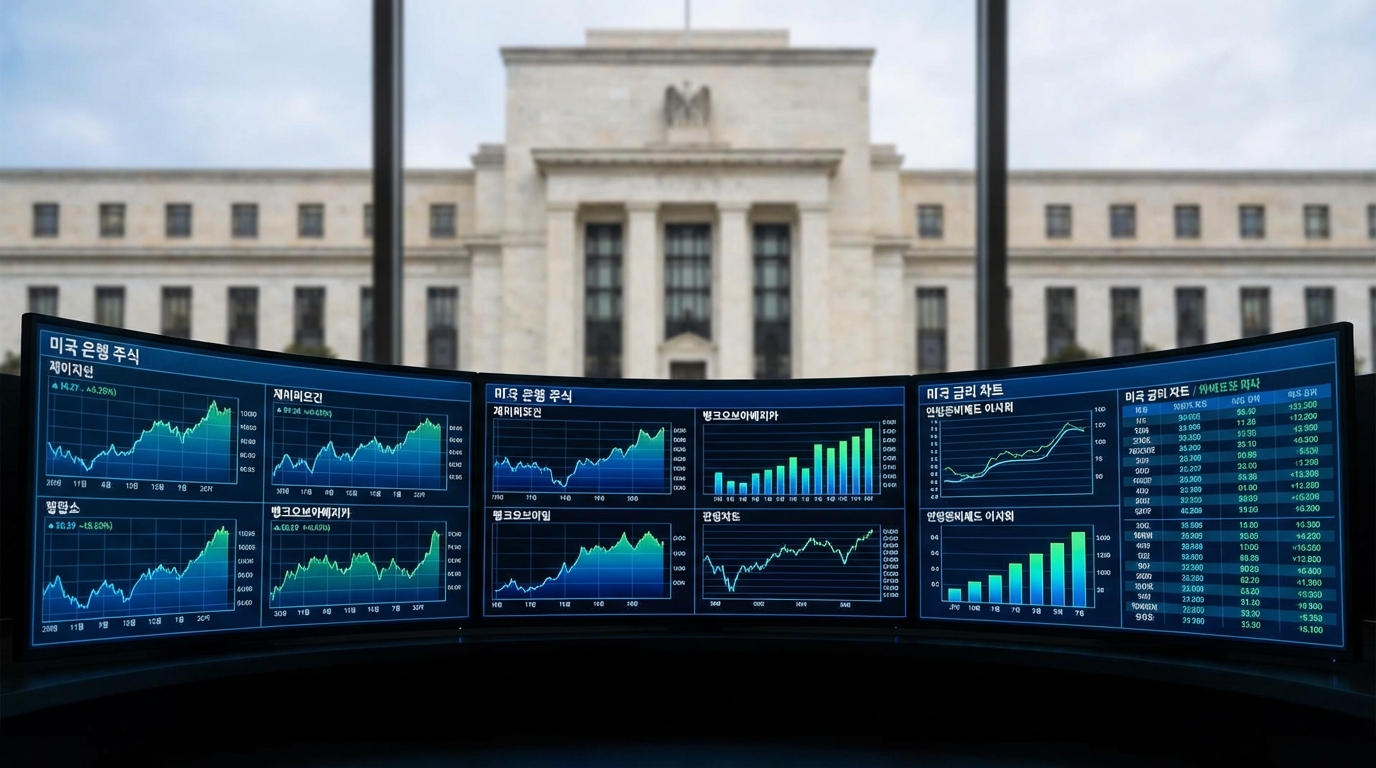
As expectations for a rate cut retreat following the March 2026 FOMC, the interest rate sensitivity of US bank stocks is re-emerging as a key market variable.
The fundamental gap between large-cap and small-to-mid-sized banks is widening amid concerns over net interest margin (NIM) contraction.
Amid shifting valuation gaps between value and growth stocks, the direction of the financial sector within the S&P 500 could determine the overall direction of the index.
In particular, managing the potential risks of regional banks included in the Russell 2000 index is more required now than ever.
Current Situation Summary
As of intraday trading on March 21, 2026 (provisional), KOSPI is at 5781.20, KOSDAQ at 1161.52, and NASDAQ at 21647.61.
The USD/KRW exchange rate shows high volatility at 1506.50, reflecting the tension in the macro environment.
Looking at Daily Stock's proprietary Fear & Greed Index (0-100), the KOSPI Fear & Greed is currently at Fear (39.1), 1 week ago at Fear (28.2), 1 month ago at Neutral (57.3), and 3 months ago at Neutral (46.1).
On the other hand, the NASDAQ Fear & Greed indicates investor sentiment has severely contracted, currently at Extreme Fear (14.6), 1 week ago at Fear (22.6), 1 month ago at Neutral (44.4), and 3 months ago at Fear (21.7).
Observing the recent 11-sector rotation within the S&P 500, a trend of supply and demand gradually restructuring from specific themes like IT is captured.
In this process, the earnings guidance of bank stocks, which react sensitively to changes in EPS estimates, is acting as a major catalyst for capital movement.
Financial Analysis
Net Interest Margin (NIM), the core profitability indicator for the banking sector, was initially expected to gradually stabilize along with expectations of Fed rate cuts.
However, concerns over sticky inflation have driven up deposit funding costs, pressuring core Net Interest Income (NII) once again.
Large banks are relatively well-equipped to defend against interest rate fluctuations through diversified revenue structures and asset-liability maturity matching.
Conversely, regional banks with a high proportion of commercial real estate (CRE) loans are highly likely to see their earnings dragged down by future loan loss provisioning burdens.
| Category | Net Interest Margin (NIM) Trend | Deposit Funding Cost Pressure | Credit Risk Exposure |
|---|---|---|---|
| **Large Commercial Banks** | Relative defense possible | Low (Solid core deposits) | Low (Diversified portfolio) |
| **Small-to-Mid Regional Banks** | Structural contraction concerns | High (High interest rate sensitivity) | High (CRE-focused) |
Valuation
[Image: /stdaily/uploads/202603/gen_69bdee1c0a2673.65274793.png]
Currently, the 12-month forward P/E ratio for major large-cap bank stocks is formed at a conservative level slightly below the 10-year historical average.
This can be interpreted as the result of regulatory uncertainties and macroeconomic risks being largely priced into the valuation.
Relatively higher dividend yields can serve as an excellent alternative for investors exhausted by the concentration in growth stocks over value stocks.
However, considering the scenario of delayed rate cuts, caution is needed to avoid falling into a value trap by only looking at superficial figures.
In particular, small-to-mid-sized banks included in the Russell 2000 may face further multiple contraction pressure due to a lack of distinct earnings growth momentum.
Expert & Institutional Analysis
According to the recently released March 2026 FOMC Dot Plot, the projection for rate cuts within the year has been reduced to one.
Accordingly, the dominant analysis on Wall Street is that the benchmark interest rate will be maintained at 3.50%~3.75% for an extended period.
Institutional experts evaluate that the CPI at 2.4% and the Core PCE inflation indicator still hovering around 3.1% support the Fed's cautious stance.
Solid employment indicators are also acting as a key factor lowering market expectations for early rate cuts.
Real-time economic growth rate data generated by the Atlanta Fed's GDPNow model suggests the remarkable resilience of the US economy.
However, experts warn of the need to closely track the rising trend in loan delinquency rates among vulnerable borrowers hidden behind superficial top-line indicators.
Risk Factors
The most concerning risk is that the real economy's soft landing scenario could be compromised by the 'Higher for Longer' stance.
If the accumulated interest burden spills over to marginal companies, unexpected recession signals could rapidly emerge in the market.
If expanded energy price volatility driven by geopolitical conflicts stimulates inflation again, the Fed's monetary policy dilemma will deepen further.
This could ultimately lead to margin pressure across S&P 500 companies, providing an excuse for a strong correction in the stock market.
In particular, when a large volume of interest-rate-sensitive commercial real estate maturities arrive, the possibility of a liquidity crisis sparked by small-to-mid-sized banks reigniting cannot be ruled out.
Investment Perspective Summary
[Image: /stdaily/uploads/202603/gen_69bdee3061eb66.49552354.png]
Currently, US bank stocks are undergoing severe price polarization based on each company's interest rate sensitivity and capital strength.
Therefore, rather than blindly adding to the financial sector, a selective approach focused on prime large banks capable of withstanding harsh stress tests is required.
In the short term, downside rigidity should be secured with attractive dividend yields, while weightings should be flexibly adjusted around the release of macro indicators such as employment and CPI.
Aiming for the phase where the return gap between growth and value stocks narrows after reaching extremes can also be an excellent strategy.
It is advisable to be cautious about increasing the weighting of Russell 2000 financial stocks until the rate cut cycle becomes clear and the credit risks of small-to-mid commercial real estate ease.
Investment Checklist
- Have you incorporated the 2026 terminal benchmark interest rate projection indicated by the Fed's March Dot Plot into your portfolio return and risk calculations?
- Do the 12-month forward P/E ratio and dividend yield of the US bank stocks of interest possess true attractiveness compared to historical averages and industry peers?
- Do the Atlanta Fed's GDPNow forecasts and employment, CPI, and PCE inflation indicators continue to support an economic soft landing scenario?
- In a prolonged interest rate environment, have you thoroughly examined the potential credit risk exposure scale of individual banks, such as commercial real estate (CRE) exposure?
- Are you periodically tracking the capital flow of the 11-sector rotation within the S&P 500 and the relative disparity rate of the Russell 2000 Index against large-cap stocks?