Hello, this is Daily Stock, delivering market insights and sustainable investment strategies.
[이미지: /stdaily/uploads/202610/gen_6ac34b1ad69c84.46590224.png]
Executive Summary
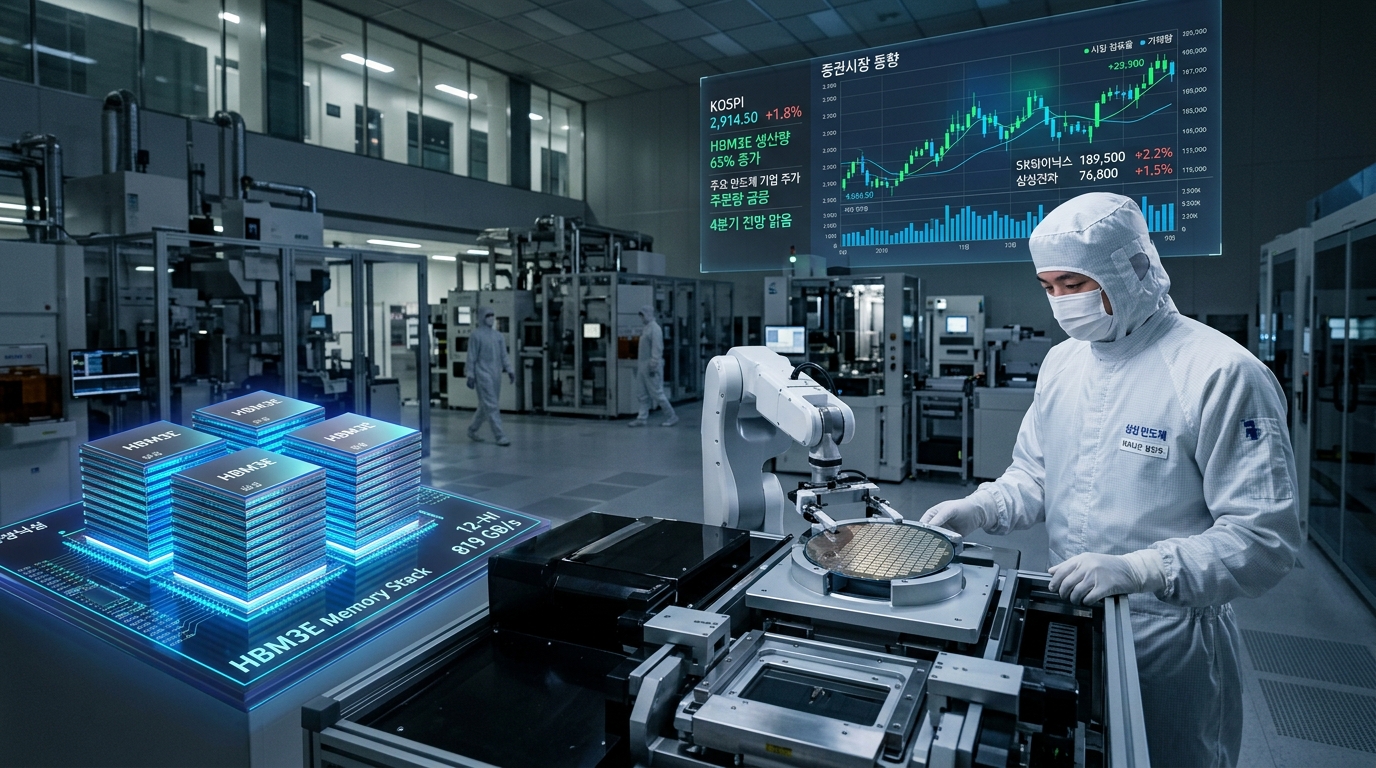
Following mass volume shipments of 5th-generation high-bandwidth memory (HBM3E) 8-layer products, SK hynix has initiated mass production of the world’s first 12-layer units, reinforcing its dominant leadership in the AI memory market.
Continued AI infrastructure investments by global Big Tech and an expanding mix of high-value products have raised market expectations for third-quarter operating profit.
Today, the KOSPI closed at 7,003.74, while Daily Stock's proprietary KOSPI Fear & Greed Index recorded 41.9 (Neutral), entering a phase of gradual stabilization compared to 28.7 (Fear) one month ago.
With the USD/KRW exchange rate fluctuating around 1,347.00 KRW, the strength of foreign institutional inflows into large-cap semiconductor stocks will likely serve as a key variable during the upcoming Q3 earnings season.
Current Status Overview
Driven by explosive demand for AI accelerators, shipments of 8-layer HBM3E to Nvidia have firmly settled onto a stable trajectory.
At the same time, customer delivery schedules for the 36GB high-capacity 12-layer HBM3E have become visible, helping sustain the technological gap with competitors.
As of October 5, 2026, the real-time quote for SK hynix remains unverified (based on the latest confirmed data), yet expectations of earnings expansion across large-cap semiconductor stocks remain robust.
Robust earnings released by Micron Technology—often viewed as a leading indicator for the global memory industry—have provided solid support for the Q3 earnings outlook of South Korea's top two memory players.
However, investors should closely monitor the moderate recovery in legacy general-purpose DRAM for PCs and mobile devices, along with shipment mix variations stemming from line conversions toward HBM.
Financial Analysis
SK hynix's third-quarter results are projected to be driven by explosive growth in high-value HBM and enterprise SSDs (eSSDs).
A steady upward trend in memory average selling prices (ASP) combined with yield stabilization on advanced nodes makes achieving a double-digit quarterly operating margin highly likely.
| Classification | Q2 2024 (Confirmed) | Q3 2024 (Confirmed) | FY 2025 (Annual) | Q3 2026 (Consensus) |
|---|---|---|---|---|
| **Revenue** | KRW 16.4233T | KRW 17.5731T | KRW 66.1920T | Around KRW 24.5T |
| **Operating Profit** | KRW 5.4685T | KRW 7.0300T | KRW 23.4670T | KRW 7.0T – 7.8T range |
| **Operating Margin** | 33.3% | 40.0% | 35.5% | Mid-to-high 30% range (est.) |
| **Key Growth Driver** | HBM3 revenue expansion | HBM3E 8-layer supply launch | 1b nm transition acceleration | HBM3E 12-layer shipment scaling |
The steep rise of HBM's share within total DRAM revenue continues to buffer against the sharp earnings volatility typically seen during traditional memory downcycles.
Furthermore, the eSSD segment maintains high margins fueled by strong enterprise data center storage demand, providing solid backing for sustained profitability in the NAND division.
[이미지: /stdaily/uploads/202610/gen_6ac34b2752be98.20801571.png]
Valuation
In the domestic equity market, the KOSPI closed at 7,003.74, maintaining resilient momentum relative to global indices.
SK hynix's price-to-book ratio (PBR) is fluctuating near the upper band of its historical range; however, considering the dramatic improvement in return on equity (ROE), it is difficult to mechanically apply legacy cyclical valuation discounts.
While the Nasdaq Fear & Greed Index stands at 31.2 (Fear), reflecting valuation pressures across tech equities, the KOSPI Index sits at 41.9 (Neutral), securing downside rigidity despite foreign flow volatility.
Large-cap semiconductor constituents in the KOSPI 200 command an HBM premium over small- and mid-cap IT component plays, holding a relative valuation advantage backed by earnings visibility.
Expert & Institutional Analysis
Major domestic and global brokerages maintain that SK hynix's HBM leadership will remain intact through the second half of 2026.
However, some institutions, including DS Investment & Securities, have slightly calibrated their earnings forecasts to account for the stabilization of the USD/KRW exchange rate around the mid-1,340s and short-term product mix adjustments during the next-generation transition.
Nevertheless, analysts note that the revenue recognition of 12-layer HBM3E starting in Q4 and SK hynix's leading schedule for HBM4 development will form formidable defensive moats against competitors.
Institutional investors widely agree that the robust tripartite alliance linking Nvidia, TSMC, and SK hynix guarantees firm order visibility across upcoming GPU architectures.
Risk Factors
The most immediate risk involves foreign exchange volatility.
If the USD/KRW exchange rate declines further from the 1,347.00 KRW level, memory chips priced predominantly in USD could experience downward pressure on KRW-denominated operating profits.
Potential erosion of pricing power, should Samsung Electronics clear quality qualifications and expand its HBM market share, also warrants medium- to long-term monitoring.
From a global macroeconomic perspective, the Federal Reserve's rate trajectory, Bank of Korea monetary policy decisions, and delayed demand recovery in finished IT devices (smartphones/PCs) leading to extended legacy inventory adjustments remain potential headwinds.
[이미지: /stdaily/uploads/202610/gen_6ac34b32c8c9a2.69232557.png]
Investment Perspective
SK hynix has successfully transformed from a traditional memory cycle producer into an AI-customized, high-performance semiconductor solutions provider.
Considering the critical weighting of semiconductors in Korea's total exports and trade balance surplus, the company's leading role in the KOSPI is poised to continue for the foreseeable future.
A prudent strategy would be to approach positions via phased dollar-cost averaging while tracking foreign investor futures rollover trends and cash net-buying volume under the current 1,347 KRW exchange rate backdrop.
While exercising caution regarding short-term price volatility around earnings announcements, investors should focus on the long-term fundamental direction supported by the high-value product mix transition centered on 12-layer HBM3E.
Investor Checkpoint Q&A
Q1. When will mass production of SK hynix's 12-layer HBM3E be meaningfully reflected in earnings?
Following the completion of production readiness at the end of Q3, customer shipments will ramp up in Q4, leading to a steep increase in revenue contribution.
Q2. How does the USD/KRW exchange rate remaining around 1,347.00 impact operating profits?
While converted KRW revenues may slightly decrease compared to earlier high-exchange-rate regimes in the 1,380–1,400 range, mid-1,300 KRW levels remain distinctly favorable for export-driven chipmakers.
Q3. Does competitor Samsung Electronics' entry into HBM pose an immediate threat to SK hynix's market share?
Even if competitors narrow the gap, the overall TAM for AI accelerators is expanding rapidly. Structural supply constraints in the near term will likely diffuse market share risks.
Q4. What does the KOSPI Fear & Greed Index at 41.9 (Neutral) signal for the semiconductor sector?
It indicates that sentiment has migrated out of extreme fear into a wait-and-see, earnings-verification phase, where upside momentum will largely be determined by upcoming earnings surprises.
Q5. How should investors view sluggish demand concerns for legacy DRAM, PCs, and mobile devices?
Because advanced wafer capacity is heavily allocated toward HBM production, supply expansion for conventional DRAM is naturally curtailed, partially mitigating the risk of steep price declines.