Hello, this is Daily Stock, delivering in-depth insights into key trends across the global tech and semiconductor value chains.
[Image: /stdaily/uploads/202610/gen_6ac197245c1be2.23272798.png]
Key Summary
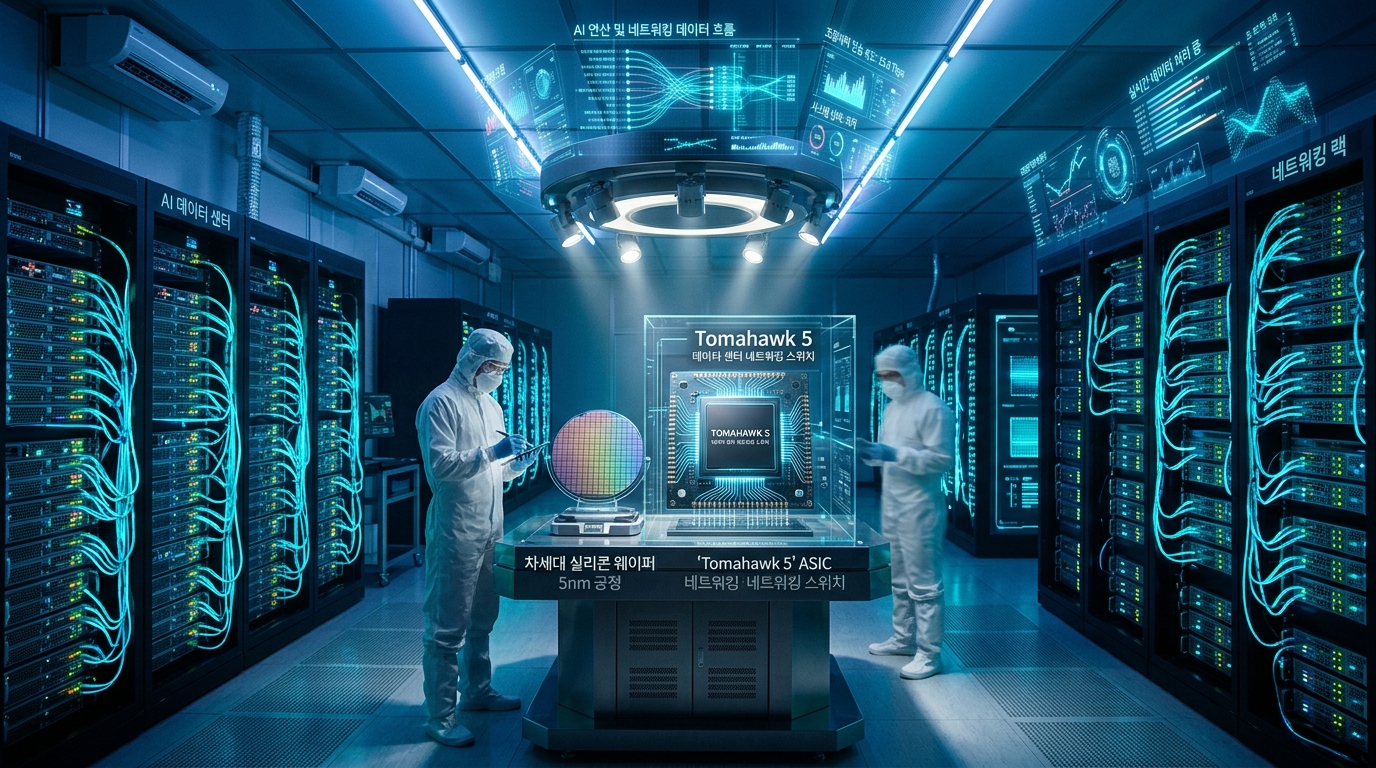
Broadcom (AVGO) is rapidly expanding its AI semiconductor portfolio, driven by Big Tech companies' increasing adoption of custom artificial intelligence (AI) chips and soaring demand to interconnect ultra-large-scale computing clusters. Alongside partnerships with Google and Meta, collaborative efforts to develop next-generation custom accelerators (ASIC/XPU) with leading frontier AI labs are materializing. Meanwhile, its 51.2 Tbps Tomahawk 5 and Jericho3-AI-based open Ethernet switch chips have firmly established themselves as data center backbones.
While the macroeconomic backdrop calls for close monitoring of 10-year U.S. Treasury yield volatility and the sustainability of Big Tech capital expenditures (CapEx), Broadcom is proving its differentiated earnings stability backed by tailored chip design capabilities and an overwhelming high-bandwidth networking ecosystem.
Current Status Overview
Global AI data center architecture is evolving beyond single-GPU performance competitions into a scale-out capability battle that connects over 100,000 compute nodes with low latency. In this transition, Big Tech hyperscalers are accelerating a shift toward open-standard, Ultra Ethernet Consortium (UEC)-centric networks to counter Nvidia's proprietary InfiniBand ecosystem.
Broadcom maintains a market share of over 70% in the Ethernet switching market and is ramping up shipments of its Tomahawk 5 chipset. Simultaneously, in addition to supporting designs for Google's next-generation TPU lineup and Meta's proprietary MTIA inference chips, it is building a solid order backlog through discussions with major global AI firms to co-develop tens of gigawatts (GW) worth of custom accelerators.
Looking at major domestic and international indicators as of the October 4 close, the Nasdaq Composite Index recorded 27,190.86, the KOSPI stood at 7,003.74, the KOSDAQ at 893.29, and the KRW/USD exchange rate stood at 1,349.00 KRW. Amid a phase where the Philadelphia Semiconductor Index (SOX) and the Nasdaq 100 are digesting growth stock multiple pressures, Broadcom's share price shows robust downside support powered by a sturdy AI revenue proportion, though the day's market price remains unconfirmed (based on the latest verified data).
| Classification | Key Indicator & Value | Detailed Trends & Remarks |
|---|---|---|
| **Nasdaq Composite Index** | 27,190.86 | Wait-and-see stance ahead of mega-cap tech earnings juncture |
| **KOSPI / KOSDAQ** | 7,003.74 / 893.29 | Maintaining domestic index consistency |
| **KRW/USD Exchange Rate** | 1,349.00 KRW | In the orbit of FX volatility and foreign supply/demand dynamics |
| **Daily Stock Nasdaq Sentiment Index** | Fear (31.2) | Continued caution compared to Fear (36.9) 1 week ago (46.1 1 month ago, 54.5 3 months ago) |
| **Daily Stock KOSPI Sentiment Index** | Neutral (41.9) | Slight improvement compared to Neutral (40.5) 1 week ago (28.7 1 month ago, 15.1 3 months ago) |
| **Broadcom Stock Price** | Unconfirmed on the day (Latest confirmed basis) | Driven by AI semiconductor growth and VMware integration performance |
Financial Analysis
Broadcom's earnings structure generates high-margin cash flow anchored by two main pillars: Semiconductor Solutions and Infrastructure Software (integrated with VMware). Alongside a gradual recovery in traditional telecommunications and enterprise storage segments, AI-related semiconductor revenue is spearheading overall growth in semiconductor solutions.
In particular, the revenue share of AI accelerators (ASICs) and Ethernet networking chips within quarterly top-line figures has been rising sharply quarter after quarter. Driven by hyperscaler clients' surging demand for high-spec custom silicon, the semiconductor segment's gross margins remain stable, while the adjusted EBITDA margin continues to comfortably surpass the mid-to-high 60% range following VMware's transition to subscription-based licensing.
[Image: /stdaily/uploads/202610/gen_6ac1972eb5a660.18391015.png]
Valuation
Broadcom's valuation is undergoing a re-rating from a conventional semiconductor manufacturer into an AI infrastructure platform and systems architecture company. Its forward 12-month price-to-earnings ratio (Forward P/E) trades between the high-20s and low-30s range, commanding a premium compared to the average S&P 500 growth stock.
During periods when discount rate sensitivity for Nasdaq growth stocks increases in tandem with swings in the 10-year U.S. Treasury yield (US10Y), multiples could face temporary contraction pressure. However, its outstanding cash generation capacity—with a free cash flow (FCF) conversion rate exceeding 40%—alongside consistent share repurchases and regular quarterly dividend increases, acts as a primary buffer providing downside resilience.
Expert & Institutional Analysis
Major Wall Street investment banks and global research institutions view Broadcom as the sole "full-stack AI networking and ASIC partner" capable of complementing or offering an alternative to Nvidia's dominant ecosystem. Analysts point out that as hyperscalers seek to increase custom silicon to curb massive total cost of ownership (TCO), Broadcom's ASIC design intellectual property (IP) and advanced packaging know-how are indispensable.
Furthermore, the 51.2T Tomahawk 5, designed to eliminate network bottlenecks, and the upcoming roadmap for mass production of the 102.4T Tomahawk 6 are recognized for demonstrating unmatched power efficiency over competitors in large-scale distributed training clusters. Leading institutions such as Morgan Stanley and Cantor Fitzgerald project that Broadcom will likely maintain its quasi-monopolistic position in the data center backbone switch market for the next 3 to 5 years.
Risk Factors
The most prominent risk factor to watch is the potential delay in AI CapEx payback across major Big Tech firms. If the monetization pace of hyperscalers' generative AI services fails to match their capital expenditures, infrastructure expansion plans slated beyond 2027 could be scaled back.
Additionally, a long-term scenario where major cloud customers fully internalize their in-house chip design capabilities and gradually lessen reliance on external ASIC partners cannot be ruled out. From a macro perspective, a surging U.S. Dollar Index (DXY), rising Cboe Volatility Index (VIX) dampening liquidity for high-multiple tech stocks, and potential tightening of U.S. export controls on advanced semiconductors to China warrant continuous monitoring.
Investment Perspective Summary
Broadcom sits squarely at the center of AI's second expansion phase, where computing structures diversify away from general-purpose GPUs toward custom accelerators and standardized Ethernet fabrics. Rather than engaging in a direct, head-on conflict with Nvidia's dominant accelerated computing domain, Broadcom has carved out a strategic position absorbing hyperscalers' demands to diversify away from Nvidia.
Therefore, rather than being swayed by short-term interest rate volatility, a phased, conditional accumulation strategy tracking quarterly Big Tech infrastructure guidance and Tomahawk 5 switch shipment trends appears effective. As power consumption constraints and data bandwidth bottlenecks intensify within the AI ecosystem, Broadcom's competitive edge in interconnect and networking technologies is likely to become even more pronounced.
Investor Checkpoint Q&A
Q1. Why does Broadcom benefit when Big Tech develops custom ASICs in-house?
Even when Big Tech designs chip architectures, turning them into physical silicon on cutting-edge advanced nodes requires extensive IP and proven design assets, including high-speed SerDes, memory interfaces (HBM), and 3.5D packaging technologies. Broadcom bridges this design and mass-production gap, securing proprietary fees and healthy margins.
Q2. Why is Ethernet gaining traction over Nvidia's InfiniBand in AI clusters?
While InfiniBand is an expensive, single-vendor proprietary architecture, Ethernet is fully compatible with existing data center infrastructures and offers superior scalability. As latest-generation Ethernet switch chips like Tomahawk 5 significantly improve packet loss rates and latency, Ethernet delivers superior cost efficiency and power economy during massive node expansions.
Q3. How does the VMware acquisition create synergy with Broadcom's AI strategy?
Through VMware Cloud Foundation (VCF), Broadcom provides a software virtualization environment where enterprises can securely run proprietary AI models within private environments. This enables Broadcom to move beyond selling hardware silicon and establish a dependable cash-generating structure that captures recurring software subscription revenues.
Q4. How does a rise in the 10-year U.S. Treasury yield affect Broadcom's stock?
Rising long-term bond yields increase discount rates applied to future growth, placing valuation multiple pressure across tech stocks. However, with robust free cash flow and a shareholder dividend return policy, Broadcom possesses a defensive buffer against macro shocks compared to unprofitable growth names.
Q5. How should investors navigate when the Daily Stock Nasdaq Sentiment Index is in 'Fear' (31.2)?
The index residing in the fear territory reflects subdued market sentiment driven by macro volatility and tech valuation concerns. Historically, periods where excessive market pessimism compresses multiples of fundamentally sound large-cap semiconductor infrastructure leaders offer disciplined monitoring opportunities for dollar-cost averaging.