[Image: /stdaily/uploads/202608/gen_6a78ce8d8f8999.26529353.png]
Hello, this is Daily Stock, delivering precise analysis of global macroeconomic developments and subtle market trends.
Key Summary
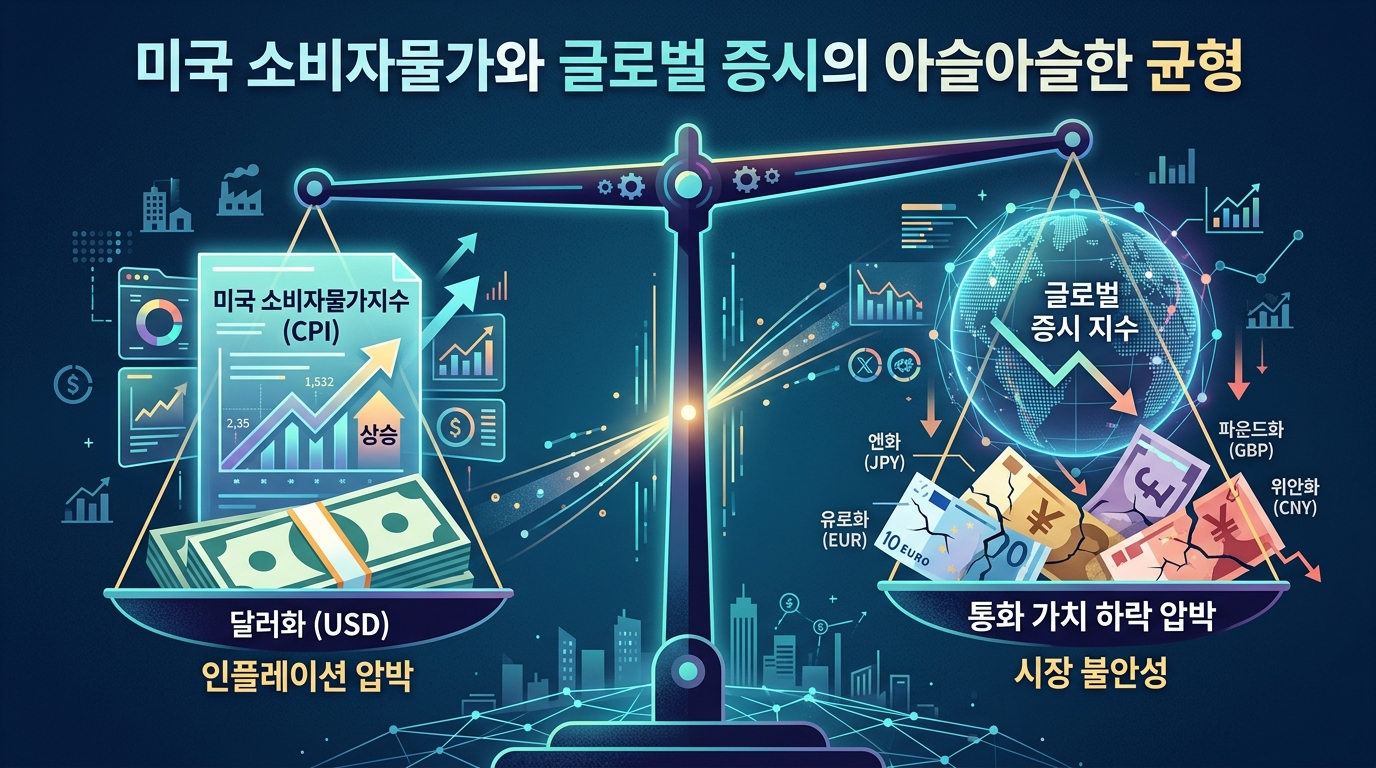
The US July Consumer Price Index (CPI), scheduled for release on August 12, is expected to serve as a major turning point that will determine whether the Fed's pivot (rate cuts) will accelerate amid the three-way decoupling structure of global stock markets.
Market consensus projects headline CPI to rise 3.3% to 3.42% year-on-year, continuing a moderate deceleration trend following June's 3.5% reading.
As divergence in fundamentals and monetary policies deepens among the US, Eurozone, and Asian stock markets, this inflation gauge is a critical variable that will dictate the direction of global liquidity.
Current Status Summary
[Image: /stdaily/uploads/202608/gen_6a78ce9660d017.10601592.png]
Currently, global stock markets are showing a stark regional divergence known as "three-way decoupling."
The New York stock market remains in the "Greed" territory (63.7) on the Daily Stock Fear & Greed Index, supported by strong tech-driven buying that has pushed the Nasdaq index to 26,690.62.
Conversely, Asian markets, including South Korea, face capital outflow pressures as the KRW/USD exchange rate has surged to 1,412.00 KRW.
As a result, during intraday trading, the KOSPI index hovered around 6,258.77, sitting in the "Extreme Fear" territory (17.1), while the KOSDAQ index stalled at 798.81.
In Europe, the monetary easing path remains uncertain as the Eurozone's preliminary July inflation ticked up slightly to 2.9%, exposing the region to energy price volatility driven by geopolitical risks.
Financial Analysis
A detailed look at the components of the July CPI suggests that the buffer from energy sectors, such as falling gasoline prices driven by recent US-Iran truce gestures, will help lead the decline in headline inflation.
Owner's Equivalent Rent (OER), a critical variable, is also expected to trace a moderate downward curve as the leading indicators of the rent index are reflected with a time lag.
However, robust service demand from the baby boomer generation and high wage growth remain resistance factors that support the floor of core service prices.
| Inflation Indicator | June Actual | July Consensus (RBC) | July Nowcast (Cleveland Fed) | Month-on-Month Outlook |
|---|---|---|---|---|
| Headline CPI (MoM) | -0.09% | +0.1% | +0.09% | Shift to a slight increase |
| Headline CPI (YoY) | 3.5% | +3.3% | +3.42% | Continued downward stabilization |
| Core CPI (MoM) | 0.24% | +0.2% | +0.21% | Maintaining flat level |
| Core CPI (YoY) | 2.8% | +2.4% | +2.52% | Maintained slowing trend |
Valuation
While the US stock market justifies its valuation premium through strong AI hardware export performance and solid corporate earnings, a price burden persists as the Nasdaq Fear & Greed Index has entered the Greed territory at 63.7.
Major European indices are moving sideways with limited multiple expansion due to oil price concerns (projected at $89 per barrel) and supply chain bottleneck risks.
Asian markets, particularly South Korea's KOSPI, have entered a historically undervalued phase relative to valuation in the Extreme Fear territory (17.1), but a lack of foreign capital due to the high exchange rate is holding the index back.
Until clear pivot signals emerge from the Fed, the relative strength gap and valuation polarization among the US, Europe, and Asia are unlikely to narrow easily.
Expert & Institutional Analysis
RBC Economics analyzed that while falling gasoline prices will create a favorable environment for bringing down headline CPI, it will take time to settle into the Fed's target unless wage growth slows down.
The Federal Reserve Bank of Cleveland's Nowcasting model estimated July headline CPI growth at 3.42% year-on-year and core CPI growth at 2.52%, supporting a moderate deceleration in inflation.
The International Monetary Fund (IMF), in its revised July World Economic Outlook (WEO), warned that geopolitical conflicts in the Middle East and tensions in the Strait of Hormuz could cause commodity supply chain disruptions, rekindling inflation concerns in the second half of the year.
Risk Factors
The biggest risk is a scenario where the geopolitical crisis surrounding the Strait of Hormuz leads to physical supply chain disruptions, pushing up international oil and natural gas prices once again.
With global manufacturing PMIs showing regional stagnation, a simultaneous rise in raw material prices could add to the cost burden on businesses, raising fears of stagflation once more.
Furthermore, if the Fed's rate cuts are delayed beyond market expectations, the prolonged high exchange rate of 1,412.00 KRW/USD poses a risk of worsening liquidity drainage in emerging financial markets.
Investment Perspective Summary
[Image: /stdaily/uploads/202608/gen_6a78ce9f1dd234.19203540.png]
If the July CPI results meet or fall below market expectations (around 3.3% headline), it could strengthen confidence in a September rate cut by the Fed and signal a global easing of liquidity.
This could provide short-term technical rebound momentum for the domestic stock market (KOSPI at 17.1), which has been experiencing "Extreme Fear" under the pressure of high exchange rates.
However, if supply chain disruptions and sticky service inflation are confirmed, high-interest-rate-for-longer scenarios may gain ground, deeping the decoupling between the US and Asia. Thus, a conservative approach focusing on buying in installments appears prudent.
Investor Checklist Q&A
Q1: When is the US July CPI release date, and what is the most important focal point?
A1: It is scheduled to be released on the evening of August 12 (Korean time). The key points to watch are whether headline inflation stabilizes in the 3.3% range and the speed at which shelter costs (OER) slow down.
Q2: What is the main driver behind the recent easing of US inflation?
A2: It is largely due to stabilized international oil prices and falling gasoline prices, driven by the temporary easing of tensions between the US and Iran, which significantly reduced energy-related price pressures.
Q3: Why has the investment sentiment gap (Fear & Greed Index) between the US and South Korean markets widened so much?
A3: This decoupling is because the US market indicates "Greed (63.7)" driven by AI innovation leadership and solid corporate performance, whereas the South Korean market remains in "Extreme Fear (17.1)" due to a rising USD/KRW exchange rate (1,412.00 KRW) and foreign capital outflows.
Q4: How do geopolitical conflicts in the Middle East affect the future inflation outlook?
A4: If supply chain disruptions in the Strait of Hormuz cause oil prices to rise back above $89 per barrel, gasoline and raw material prices could rise in tandem, disrupting the downward trajectory of inflation in the second half of the year.
Q5: How will this CPI result affect the USD/KRW exchange rate, which is hovering around 1,412.00 KRW?
A5: If a clear slowdown in inflation strengthens rate cut expectations, the dollar could weaken, leading to the downward stabilization of the USD/KRW exchange rate. Conversely, upward pressure on the exchange rate could persist.