[Image: /stdaily/uploads/202608/gen_6a7388b007fb44.59918895.png]
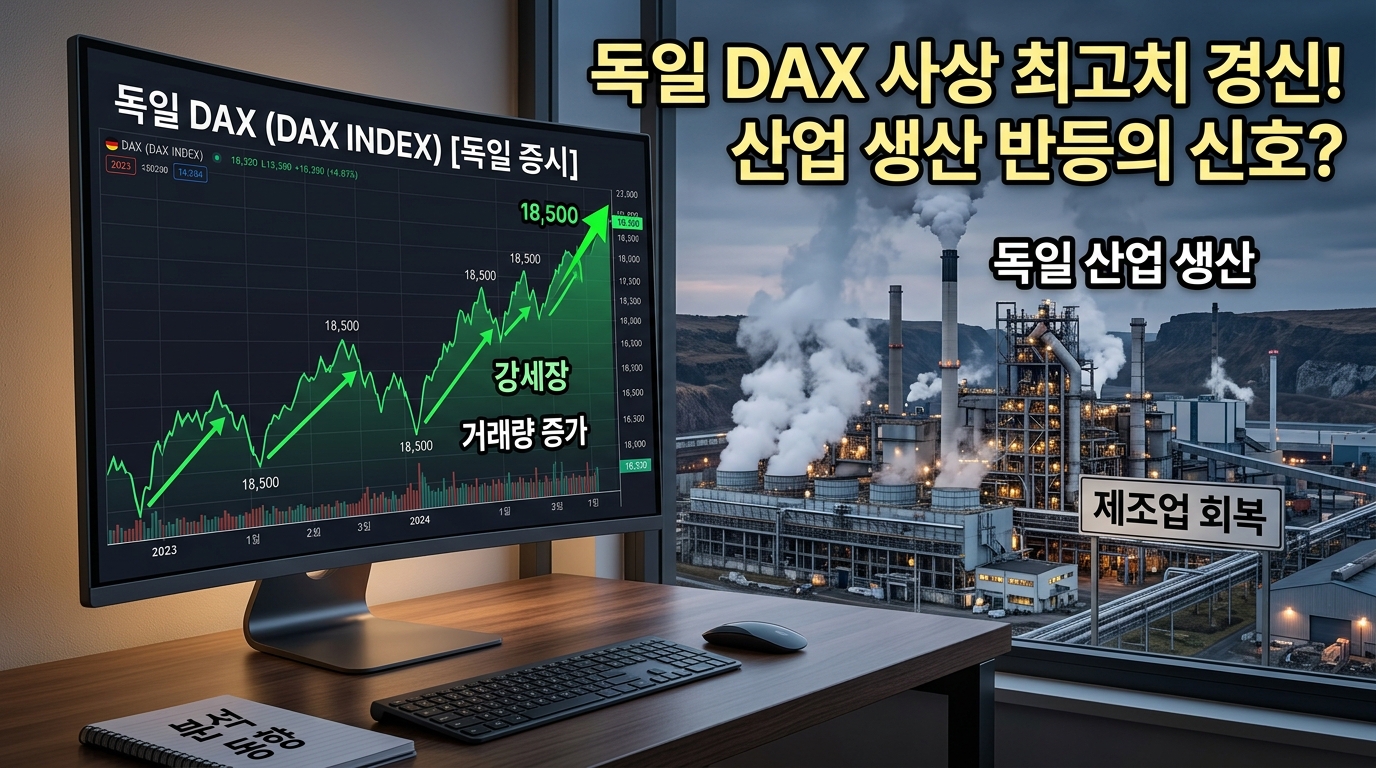
Despite concerns over a sluggish real economy, Germany's DAX index has recently hit all-time highs, drawing intense focus from global investors.
Key Summary
- Supported by easing Middle East tensions leading to lower oil prices and expectations of rate cuts, Germany's DAX index is attempting to stabilize above the 26,100 mark.
- On the other hand, the real economic sector—specifically German industrial production—shows a dual-track trend, with long-term structural stagnation driven by high energy costs and a decline in manufacturing jobs.
- The global market is currently entering a "three-pole" phase, where fundamental decoupling among the US, Europe, and Asia is accelerating.
Current Situation Summary
Global financial markets are exhibiting a distinct decoupling pattern based on regional fundamental differences.
US stock markets maintain robust momentum supported by positive manufacturing data surprises and warmth in tech stocks.
Conversely, Asian stock markets remain exposed to monetary policy volatility, including Japan's monetary tightening steps and China's considerations over reserve requirement ratio (RRR) cuts.
In Europe, Germany's DAX index was recently hovering around its historic record high of 26,126.30 points during intraday trading (provisional), yet the domestic economy has failed to escape its contractionary state.
As of today's intraday trading (provisional), the KOSPI is at 6,598.26 points, and the KOSDAQ is at 799.59 points.
The tech-heavy NASDAQ is moving through 26,457.98 points (provisional), while the USD/KRW exchange rate is trading around 1,423.20 won.
According to DailyStock's proprietary Fear & Greed Index (0 to 100), the KOSPI Fear & Greed Index is currently in the "Fear" stage at 30.1.
While this is a moderate improvement compared to the "Extreme Fear" stage of a week ago (11.9) and a month ago (12.5), it remains far below the "Greed" stage (67.7) of three months ago.
Meanwhile, the NASDAQ Fear & Greed Index is currently at the "Neutral" level of 59.2.
Following "Fear" readings a week ago (34.7) and a month ago (32.5), sentiment is gradually recovering, continuing a trend similar to the "Neutral" territory (55.0) seen three months ago.
Financial Analysis
Germany's recent macroeconomic indicators reveal real economic stagnation and a sharp restructuring of the manufacturing sector.
In May, German industrial production rose 0.9% month-on-month, beating market expectations, but year-on-year growth stood at 0.0%, fully reflecting a long-term stagnation phase.
In addition, the June Producer Price Index (PPI) rose only 1.8% year-on-year and fell 0.3% month-on-month, showing some moderation in upward price pressures.
According to the Federal Statistical Office of Germany (Destatis), upcoming releases of June manufacturing new orders (to be announced on August 6) and the industrial production index (to be announced on August 7) will serve as major turning points for the index's trajectory.
[Image: /stdaily/uploads/202608/gen_6a7388b96ae908.42060737.png]
| Classification | US (S&P 500 / NASDAQ) | Europe (German DAX) | Asia (Japan / China) |
|---|---|---|---|
| **Fundamental Situation** | ISM manufacturing data surprises; growth resilience sustained, driven by tech stocks. | Real economy stagnation; manufacturing restructuring underway (approx. 15,000 jobs lost monthly). | Japan BOJ rate hike momentum vs. China PBOC stimulus and RRR cut dilemma. |
| **Major Index Trend** | NASDAQ marks 26,457.98 points during intraday trading (provisional). | DAX stabilizes above 26,126.30 points (provisional), reaching historic record-high territory. | Yen volatility widens; valuation gap-filling attempts through Southbound capital inflows. |
| **Monetary & Macro Policy** | Cautious view on rate cut path; liquidity maintained. | ECB additional rate cut expectations heighten (aimed at defending weak economic growth). | Monetary decoupling: BOJ hawkish shift vs. PBOC accommodative liquidity injection. |
| **Core Risk Factors** | Concerns over an economic slowdown due to prolonged high interest rates. | Energy price instability and supply chain bottlenecks driven by Middle East (Iran) tensions. | Reignited US-China trade conflicts, domestic market distortions, and currency instability. |
Valuation
The phenomenon of the German DAX index fluctuating above the historic high of 26,100 points is somewhat unusual from a valuation perspective.
Indeed, Germany's second-quarter GDP growth was sluggish, recording just 0.2% quarter-on-quarter growth.
Nevertheless, the DAX index remains strong because the 40 major corporations constituting the index are mostly multinationals that generate revenues in global markets rather than inside the domestic German economy.
The European Central Bank's (ECB) preemptive rate cuts and the relatively lower valuation appeal compared to US tech stocks have also served as catalysts driving global capital inflows.
Expert & Institutional Analysis
The Federation of German Industries (BDI) recently issued a stark warning regarding the weakening competitiveness of German manufacturing.
According to the BDI, high energy costs, heavy administrative regulations, and a shortage of skilled labor are intensifying downward pressures, resulting in a loss of about 15,000 industrial jobs every month.
Major economic research institutes, such as Capital Economics, also pointed out that while a temporary rebound in auto parts production might create an illusion of recovery, overall order backlogs are depleting and economic uncertainty persists.
Consequently, unless supported by a gradual recovery in manufacturing indices going forward, further upside momentum for the stock index could gradually slow down.
Risk Factors
The most immediate risk is geopolitical tension in the Middle East and the resulting oil price volatility.
Germany's energy-intensive manufacturing sectors, such as chemicals and steel, are highly vulnerable to cost pressures.
Disruptions in global supply chains caused by intensifying US-China trade conflicts are also chronic risks impacting Germany as an export-driven nation.
Lastly, concerns exist that the services sector could also turn stagnant as the labor market cools down and domestic consumption slows.
[Image: /stdaily/uploads/202608/gen_6a7388c1e045e6.58081833.png]
Investment Perspective Summary
At this juncture, the German DAX market is moving under a "decoupling scenario" where sluggish real economic indicators stand in stark contrast to the strength of multinational stock prices.
While rate cut liquidity and hopes for stable oil prices are supporting stock prices in the short term, upside gains could be capped without fundamental improvements in manufacturing.
Therefore, rather than chasing short-term record-high breakouts with buy orders, a rational strategy for investors would be to take a phased approach while monitoring Destatis's upcoming June manufacturing data release.
Investor Checklist Q&A
Q1. Why has the German DAX index broken record highs despite the weak real economy?
A1. The DAX index is composed of large multinational corporations that generate most of their revenue in global markets outside of Germany, meaning they are relatively less affected by the domestic economic downturn.
Q2. What is the primary cause of job losses in German manufacturing?
A2. A combination of chronic structural issues, such as high energy cost burdens, excessive administrative bureaucracy, and a shortage of skilled labor, has led to a contraction of approximately 15,000 jobs per month.
Q3. What are the key German economic indicators scheduled for release on August 6 and 7, 2026?
A3. According to the Federal Statistical Office of Germany (Destatis), June manufacturing new orders and revenue data will be released on August 6, followed by June industrial production data on August 7, both of which are expected to impact the market.
Q4. What is the actual transmission path of geopolitical instability in the Middle East to German industry?
A4. As Germany relies heavily on energy imports, rising crude oil and natural gas prices sharply reduce manufacturing margins, and supply chain delays in the Red Sea threaten to cause bottlenecks in parts supply.
Q5. In terms of global asset allocation, how is the relative value of European and German stock markets assessed?
A5. Because they trade at relatively lower multiples compared to overvalued US mega-cap tech stocks, they can function as defensive portfolios, though their fundamental growth appeal remains somewhat limited.