Hello, this is Daily Stock, delivering precise analysis on global macro trends and major international indices.
Executive Summary
- **Three-Polar Decoupling and a Weak Pound:**
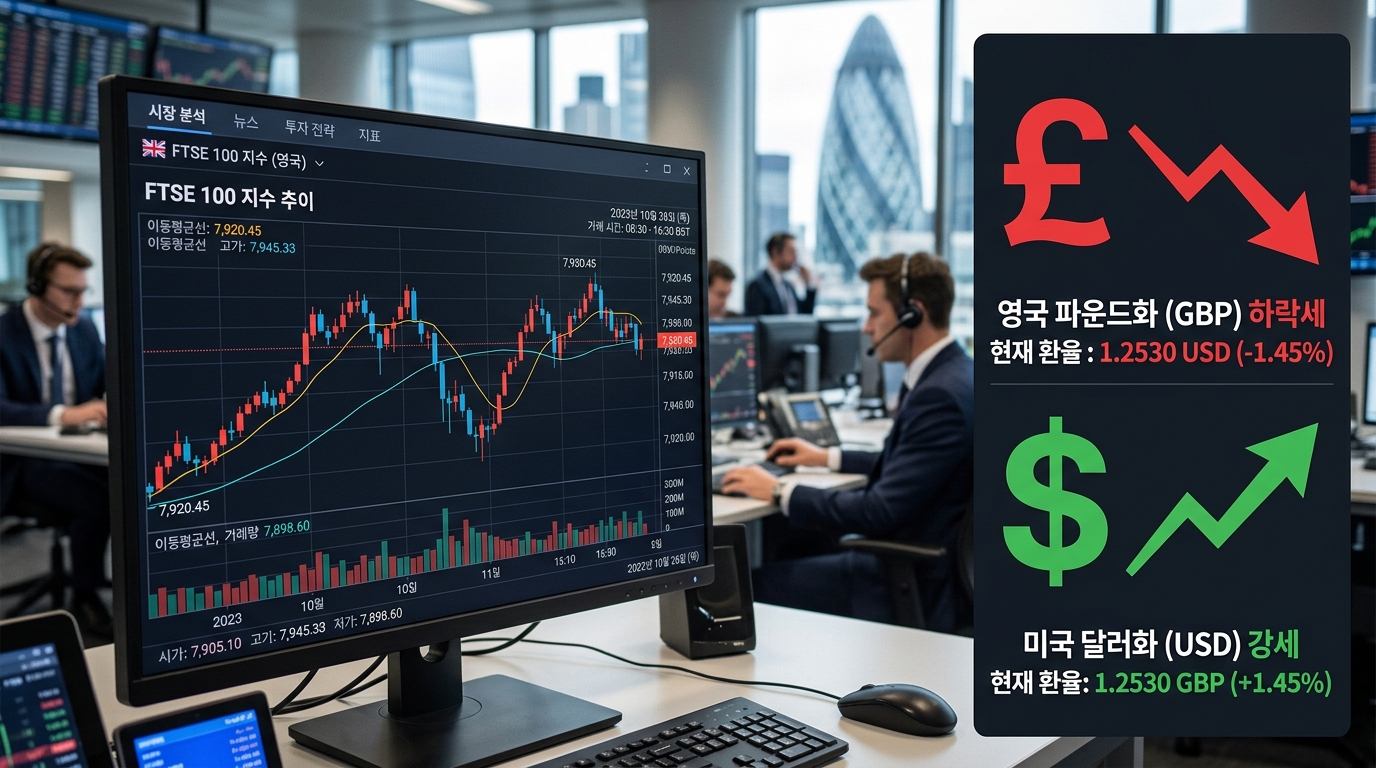
With the US Federal Reserve maintaining its hawkish stance of keeping interest rates unchanged and Treasury yields surging, the US dollar remains strong. Consequently, the GBP/USD exchange rate has retreated to the $1.31 level.
- **FTSE 100’s Counter-Intuitive Strength:**
Since multinational corporations in the UK's FTSE 100 index generate roughly 70% to 80% of their revenues overseas, a weaker pound translates into a financial boost from foreign exchange conversion gains.
- **Surge in M&A Activity and Undervaluation Appeal:**
As highlighted by real estate developer Segro's rejection of a £12.6 billion hostile takeover bid from US-based Prologis, the UK stock market presents highly attractive value investing opportunities due to its steep discount compared to US peers.
Current Market Overview
[Image: /stdaily/uploads/202606/gen_6a3c29edca66d2.21911277.png]
Recently, the global financial markets have seen an intensification of "three-polar decoupling," where the economic fundamentals of the US, Europe, and Asia diverge significantly.
This divergence has led to starkly contrasting investor sentiment across regions.
According to Daily Stock's proprietary Fear & Greed Index, the KOSPI Fear & Greed Index is currently in the "Neutral" stage (41.6), while the Nasdaq Fear & Greed Index has entered the "Fear" stage (27.4), reflecting a more conservative approach toward risk assets.
Compared to last week's readings (KOSPI Neutral at 54.5, Nasdaq Fear at 32.2), global market tension remains elevated.
While the US faces concerns over prolonged high interest rates due to the Fed's hawkish tone, the Bank of England (BoE) maintained a relatively moderate stance, freezing its benchmark policy rate at 3.75% during its Monetary Policy Committee meeting on June 18.
Although the UK's May Consumer Price Index (CPI) slowed to 2.8%, persistent service inflation has prolonged the policy deadlock.
Due to these policy differences, the GBP/USD rate has weakened to around $1.3171 (as of the latest verified data on June 24, 2026).
In contrast, the UK’s benchmark FTSE 100 index has shown remarkable resilience, holding firm at 10,461.63 points (as of the latest verified data on June 24, 2026).
Financial Analysis
The primary strength of the FTSE 100 index lies in its heavy concentration of world-class multinational corporations across global commodities, pharmaceuticals, banking, and consumer staples.
These firms generate the vast majority of their sales outside the domestic UK market, particularly in the US.
In fact, more than 75% of the total revenue generated by the companies in the index comes from abroad.
Therefore, when the pound falls to the $1.31 level against the dollar, these companies benefit from significant "FX tailwinds," which boost their book-value earnings per share (EPS) when converting US dollar revenues back into British pounds.
Although short-term corrections in crude oil and copper prices are squeezing the operating margins of energy giants like Shell and BP, foreign exchange benefits are actively functioning as a cushion supporting their financial balance sheets.
| Classification | Key Indicator / Figure | Characteristics & Market Impact |
|---|---|---|
| **FTSE 100 Index** | 10,461.63 points (As of June 24) | Stable consolidation within ~4% of historical highs |
| **GBP/USD Exchange Rate** | $1.3171 (As of June 24) | Remains weak amid a strong USD driven by rising US yields |
| **UK Policy Rate** | 3.75% per annum (BoE Hold) | Held steady with a 7:2 vote at the June MPC meeting |
| **UK CPI Inflation** | 2.8% (As of May) | Inflation slowed slightly, but wage and service pressures persist |
Valuation
The valuation of the UK's FTSE 100 index currently trades at a deep discount compared to indices in the US and core European countries.
While the US S&P 500 faces overvaluation concerns with a price-to-earnings (P/E) ratio exceeding 25x, the FTSE 100's 12-month forward P/E stands at a mere 13 to 14x.
This structural undervaluation makes UK companies primary targets for large-scale mergers and acquisitions (M&A) in global capital markets.
A prime example is Segro, a major real estate developer listed in London, which recently rejected an all-stock hostile takeover offer valued at £12.6 billion from Prologis, the largest logistics REIT in the US.
Segro's board of directors firmly rejected the bid, stating that UK equity asset values are unreasonably distorted compared to their US counterparts and describing the move as an opportunistic, low-ball attempt to buy assets on the cheap.
Paradoxically, such heavy discounts relative to physical asset values provide global investors with a strong margin of safety.
[Image: /stdaily/uploads/202606/gen_6a3c29fbbcf4d8.69296927.png]
Expert & Institutional Analysis
Major international institutions are focusing on the UK's potential for a soft landing and the robust fundamentals of its multinational enterprises.
Analysts at leading investment firms, including AJ Bell, predict that the BoE is highly likely to keep interest rates at 3.75% for an extended period to curb secondary inflation effects.
At the same time, they explain that while hawkish US monetary policies are absorbing global liquidity, this dynamic reinforces the weaker pound against the dollar, thereby enhancing the relative appeal of UK value stocks.
With the UK unemployment rate indicating a gentle soft landing at 4.9%, the prevailing view is that the risk of a sharp economic recession remains low.
Consequently, global funds seeking to hedge against market volatility are shifting away from over-concentration in US growth stocks and adding UK equities as a defensive hedge.
Risk Factors
The primary risk to watch is the geopolitical situation in the Middle East and the resulting volatility in commodity prices.
In making its decision to hold interest rates, the Bank of England pointed to energy supply chain disruptions caused by geopolitical instability as a key concern.
If crude oil and copper prices plunge unexpectedly due to a global economic slowdown, the margins of energy and materials multinationals—which make up a large portion of the index—could drop sharply, offsetting any currency-related benefits.
Additionally, political developments within the UK remain a potential source of market volatility.
Recent shifts in the political landscape, such as candidate Andy Burnham's victory in the Westminster by-election, could fuel concerns over changes in fiscal spending and pension policies, leading to fluctuations in the pound.
Investment Outlook
In summary, the UK's FTSE 100 index serves as a highly compelling basket of multinational assets capable of hedging volatility amid global three-polar decoupling.
The weak pound, driven by prolonged US monetary tightening, paradoxically acts as a safety net that boosts the FX-converted revenues of UK companies.
However, domestic investors entering the UK market must account for currency distortion risks, especially given the current high USD/KRW intraday exchange rate (approx. 1,544.00 KRW).
Investors are advised to carefully monitor global energy and materials demand while adopting a cautious, diversified approach toward UK value stocks and high-dividend assets.
[Image: /stdaily/uploads/202606/gen_6a3c2a071dbef5.58742636.png]
Investor Checklist Q&A
Q1. Why does the FTSE 100 defend its ground when the pound depreciates?
A1. This is because over 75% of the revenue generated by FTSE 100 companies comes from outside the UK. When the pound weakens, overseas revenues earned in dollars or euros yield higher financial gains when converted back into pounds, boosting corporate earnings on paper.
Q2. What was the background behind the Bank of England's (BoE) recent rate freeze?
A2. The BoE maintained its benchmark interest rate at 3.75% during its MPC meeting on June 18, 2026. Although May CPI slowed to 2.8%, the central bank opted for a defensive hold to fully control sticky wage growth and services inflation.
Q3. Why did Segro reject the acquisition proposal from the US company?
A3. Prologis, a US logistics REIT, made a hostile all-stock takeover bid valued at £12.6 billion. Segro's board unanimously rejected the offer, stating that prime UK and European physical assets are trading at an excessive discount compared to US valuations, making the price unacceptable.
Q4. What is the worst-case scenario for long-term investments in the FTSE 100?
A4. A simultaneous collapse in global manufacturing PMI alongside a sharp decline in global prices for energy and key mineral commodities. In this scenario, the actual decline in profits for large energy and materials companies could outweigh any currency-related cushions.
Q5. What should Korean domestic investors keep in mind in a high exchange-rate environment?
A5. With the USD/KRW intraday rate hovering around 1,544.00 KRW, any future strengthening of the Korean won could lead to currency translation losses that exceed local stock price gains. Careful asset allocation is highly recommended.