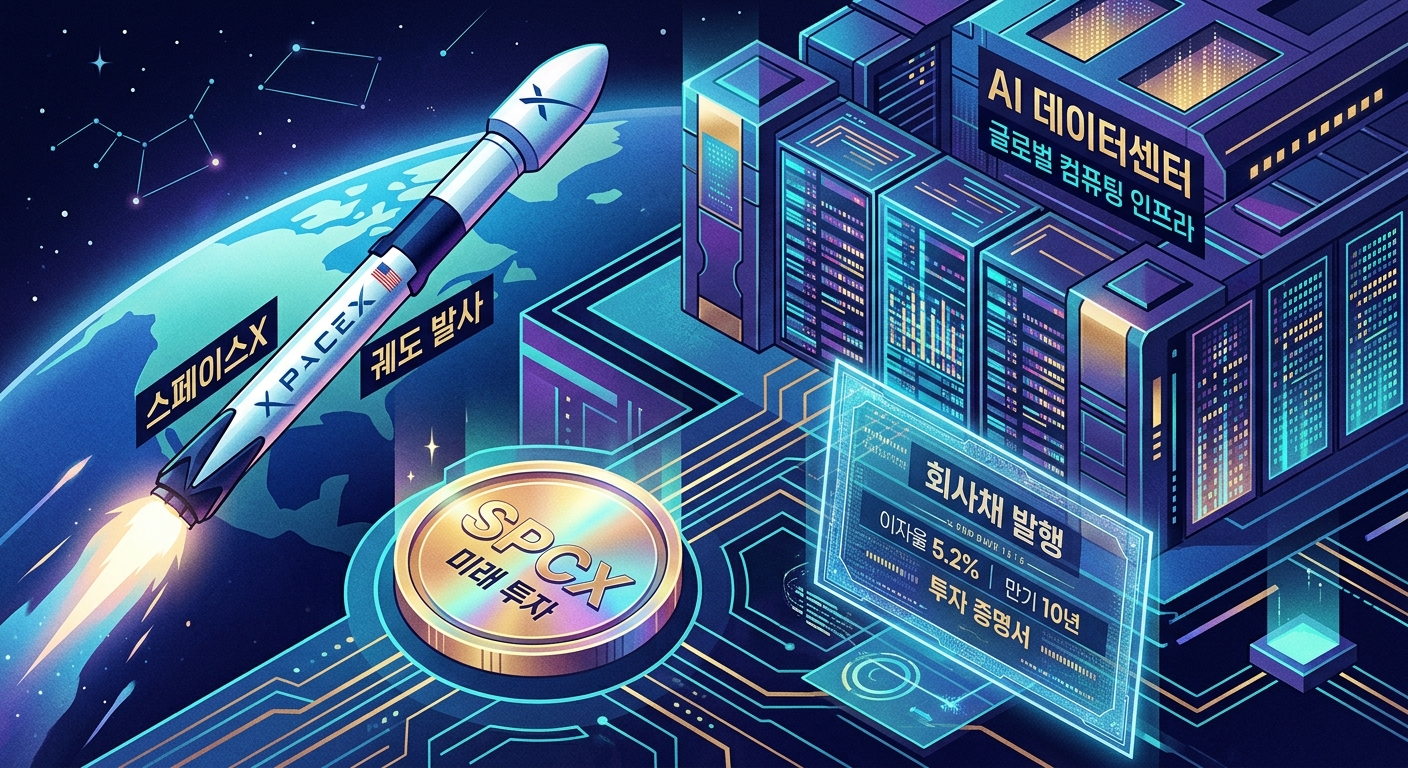
The unprecedented financial moves of SpaceX, one of the world's most innovative tech giants, are drawing global attention.
[Image: /stdaily/uploads/202606/gen_6a3ad867df3739.54971236.png]
Key Summary
- **First Knock on the Bond Market**: Just ten days after completing its historically largest initial public offering (IPO), SpaceX (SPCX) launched a senior unsecured bond issuance worth $20 billion (approx. KRW 31 trillion).
- **AI Infrastructure & Debt Refinancing**: The raised capital will be used to pay off high-interest short-term bridge loans raised during the acquisition of xAI in March, and will be directed toward large-scale infrastructure investments, including massive AI data centers.
- **Linked with Three-Way Decoupling**: The massive absorption of AI capital by the US is triggering an oversupply in global bond markets, pushing up treasury yields and deepening monetary and fiscal decoupling with European and Asian markets.
---
Current Market Overview
SpaceX, which successfully listed on the US Nasdaq market, has been shaking up global investor sentiment with severe volatility immediately following its debut.
Starting at an IPO price of $135, the stock initially surged to a high of $225.64, pushing its market cap close to $2.97 trillion. However, amid news of the massive bond issuance and concerns over cash burn, the price corrected during trading, falling below the $150 level.
This sentiment contraction centered around tech stocks is clearly reflected in Daily Stock's own Fear & Greed Index.
The Nasdaq Fear & Greed Index is currently in the "Fear" (33.6) stage, following last week's "Fear" (39.1) stage, indicating prolonged stagnant sentiment. The KOSPI Fear & Greed Index has also retreated to the "Fear" (28.8) stage.
In the global macroeconomy, a clear fundamental decoupling among the US, Europe, and Asia is emerging.
While the US leads the expansion of AI infrastructure and absorbs liquidity through large-scale bond issuances, Europe remains relatively stagnant due to delayed manufacturing recovery and a conservative monetary policy framework from the European Central Bank (ECB).
Asia is also bearing the brunt of prolonged high interest rates from the US, while navigating the People's Bank of China's (PBOC) independent liquidity defense and the Bank of Japan's (BOJ) efforts to control the yen.
---
Financial Analysis
SpaceX's consolidated financial statements reveal two contrasting realities: unrivaled dominance in space internet and massive expenditures on AI investment.
Starlink, the low-Earth orbit satellite internet service, acts as a solid cash cow, securing more than 12 million subscribers and generating approximately $4 billion in operating profit as of 2025.
However, the ultra-large AI infrastructure business driven by Elon Musk is burning cash at a rate that far outpaces Starlink's profitability.
SpaceX recorded an annual net loss of $4.9 billion in 2025, followed by another massive net loss of $4.28 billion in the first quarter of 2026.
| Category | FY 2025 Performance | Q1 2026 & Recent Indicators | Key Details & Characteristics |
|---|---|---|---|
| **Annual Revenue** | $18.7 Billion | Unconfirmed for today (Based on latest available data) | Rapid increase in space launches and Starlink subscribers |
| **Net Income/Loss** | -$4.9 Billion | -$4.28 Billion (Q1) | Concentrated investment in AI and data centers |
| **Starlink Operating Profit** | $4.0 Billion | Exceeded 12 million subscribers (As of June) | Serves as SpaceX's core cash cow |
| **Bond Issuance Size** | - | $20.0 Billion | Purpose: Refinancing bridge loans related to xAI acquisition |
| **Cash & Cash Equivalents** | - | $100.8 Billion (As of June 19) | Temporarily secured via IPO proceeds |
[Image: /stdaily/uploads/202606/gen_6a3ad871cc04b9.74070504.png]
---
Valuation
After a short-term surge, SpaceX's stock price has experienced a pullback of over 25%, finding a balance point around a $2 trillion market capitalization.
The practical support keeping this high valuation from collapsing lies in its dominant infrastructure contract structure that bridges earth and space.
"Colossus 1," the massive data center located in Memphis, is operating with over 300 megawatts (MW) of power capacity.
Competitor Anthropic has leased this entire facility, signing an agreement to pay approximately $1.25 billion monthly (equivalent to $15 billion annually) in usage fees.
In addition, with agreements such as a $30 billion cloud computing power supply contract with Google Alphabet running through mid-2029, the company's secured order backlog is close to $750 billion.
The combination of space communication monopoly power and ground-based AI computing infrastructure is the structure driving its long-term valuation.
---
Expert & Institutional Analysis
Global credit rating agencies assigned unexpectedly favorable investment-grade ratings to SpaceX ahead of its massive bond issuance.
Moody's rated it Baa1, Fitch assigned BBB+, and S&P Global gave it a BBB rating, securing bond stability.
Market analysts evaluate this senior bond issuance as a clever financing strategy by Elon Musk, who wishes to avoid equity dilution.
However, the sudden influx of such a massive volume of private bonds into the market created a butterfly effect, pushing the US 10-year Treasury yield back past the psychological resistance line of 4.5% to 4.51%.
This has intensified upward pressure on the US dollar, weighing heavily on emerging market currencies, including South Korea's won (which traded at 1,535.90 KRW/USD).
Experts note, "While even the bond market trusts Musk's AI growth story, this black hole phenomenon of absorbing massive market liquidity could persist."
---
Risk Factors
The most immediate risk is the concern over a prolonged payback period for the AI infrastructure business, which requires massive capital injection.
If synergy achievements fail to materialize quickly following major M&As—such as the recent $60 billion acquisition of Anysphere, the developer of the code-generating AI "Cursor"—cash burn could accelerate further.
From a macroeconomic standpoint, there is capital flight pressure stemming from the deepening decoupling between the US and regions choosing different monetary paths, such as Europe (ECB) and Asia (BOJ, PBOC).
Specifically, rising US bond yields could increase costs across the global value chain, potentially delaying the rollout of space communication terminals.
Geopolitical risks cannot be ignored either.
If disruptions occur in the supply chain for Taiwan-made semiconductors, which are essential for spacecraft components and advanced AI accelerators, a severe scenario where the Starship project and data center expansion plans physically grind to a halt could become reality.
---
Investment Perspective Summary
In conclusion, SpaceX's $20 billion bond issuance acts as a mechanism to secure financial health by replacing high-interest short-term debt with stable, long-term corporate bonds.
While it spooked shareholders in the short term and triggered a stock price drop, it could serve as an opportunity to solidify its foundations in the long run by reducing interest expenses and building on guaranteed high-margin AI contract revenues.
With both the Nasdaq and KOSPI currently entering the Fear stage, growth stock volatility is bound to be maximized during periods of macroeconomic liquidity contraction.
Therefore, for long-term investors who believe in the grand scenario of merging Elon Musk's monopolistic space infrastructure with AI infrastructure, a rational strategy would be to approach through long-term dollar-cost averaging rather than being shaken by short-term shocks.
---
FAQ
Q1. Why is SpaceX issuing a massive amount of corporate bonds even after raising enormous funds through its IPO?
A1. To secure financial stability by refinancing the $20 billion high-interest short-term bridge loans—temporarily raised during the xAI acquisition in March—into long-term, fixed-rate bonds.
Q2. What was the direct reason why this bond issuance news caused a sharp drop in the stock price?
A2. The news of massive debt financing right after going public triggered financial fears in the market that the company's cash burn rate might be faster than expected.
Q3. What are SpaceX's bond credit ratings?
A3. It received investment-grade ratings including Moody's Baa1, Fitch's BBB+, and S&P Global's BBB, meeting safety standards that allow global institutional investors and pension funds to stably purchase them.
Q4. What is Elon Musk's ultimate goal in making such astronomical investments in AI infrastructure?
A4. To construct a massive artificial intelligence computing empire bridging earth and space by combining Starlink's global communication network with high-performance AI (xAI), and to build a monopolistic platform that leases cloud services to other Big Tech companies.
Q5. Can the profits earned by Starlink offset the losses from AI infrastructure?
A5. Currently, Starlink's operating profit (approx. $4 billion) alone is insufficient to fully cover the AI CAPEX and M&A expenses that easily exceed $10 billion annually. Because of this, a conditional growth scenario requiring continuous funding from capital markets remains in place.
---