Hello, this is Daily Stock, tracking daily capital market movements and corporate value in depth.
[이미지: /stdaily/uploads/202609/gen_6aaf849d349f11.16209753.png]
Executive Summary
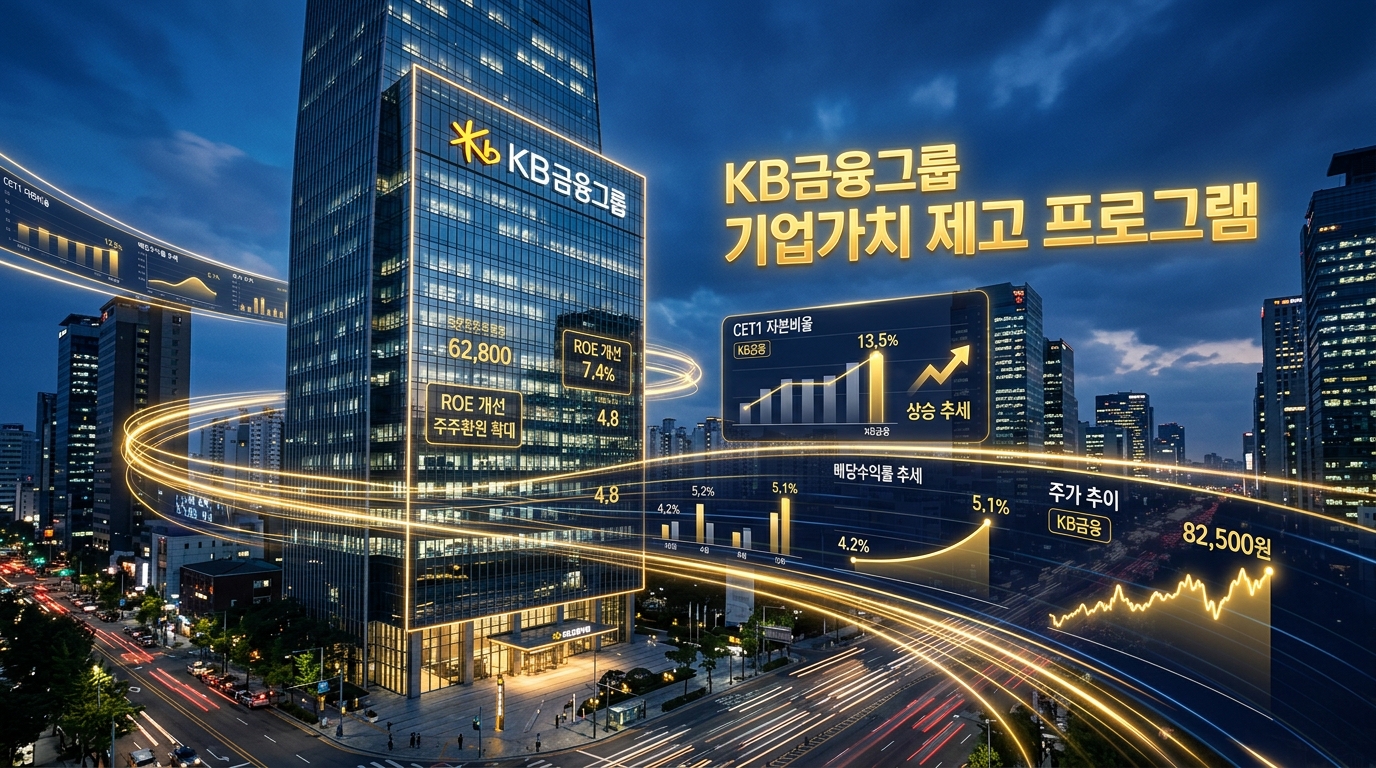
KB Financial Group (105560) is meticulously executing a shareholder return program linked to its Common Equity Tier 1 (CET1) ratio, anchored in the capital allocation framework presented in its official Corporate Value-up disclosure.
The group has established a systematic mechanism that allocates capital in excess of a 13% CET1 ratio toward dividends and share buybacks and cancellations, while returning additional capital exceeding 13.5% throughout the year.
As of the first half of 2026, the company's CET1 ratio stands at 13.74%, defending the highest level among the four major domestic financial holding companies.
Its total annual shareholder return for this year is expected to reach approximately KRW 3.7 trillion to KRW 4.0 trillion, materializing a scenario to firmly establish a total shareholder return rate around 50%.
Amid the ongoing re-rating of capital efficiency across KOSPI large-cap sectors, managing the Return on Risk-Weighted Assets (RoRWA) and reducing circulating share counts are serving as key drivers in resolving the corporate valuation discount.
Current Market Snapshot
As of September 20, 2026, the domestic stock market closed with the KOSPI at 6,894.23 and the KOSDAQ at 827.12.
The KRW/USD exchange rate stood at 1,390.00, keeping investor supply and demand sensitive to foreign exchange market volatility.
Daily Stock's proprietary Fear & Greed Index shows the KOSPI currently in Neutral territory (40.9), rebounding from Fear (28.2) one week ago, though cautious sentiment lingers compared to Neutral (49.6) one month ago and Neutral (53.8) three months ago.
The US Nasdaq index stands at 26,522.55, with its Fear & Greed Index currently in Fear territory (29.1), steadily contracting from 32.7 one week ago, Neutral (54.6) one month ago, and Greed (66.5) three months ago.
In the KOSPI market, while semiconductor and automotive export stocks react sensitively to global economic cycles and FX movements, large-cap financials are acting as a stable buffer for foreign capital inflows on the back of clear Value-up visibility.
Although KB Financial's same-day market quote on September 20, 2026, was not confirmed (based on the latest verified data), it continues its Book Value Per Share (BPS) expansion momentum through the execution of its primary and secondary large-scale share repurchase and cancellation disclosures.
[이미지: /stdaily/uploads/202609/gen_6aaf84a9228570.09933136.png]
Financial Analysis
KB Financial's solid funding capacity for shareholder returns stems from its earnings power underpinned by sound asset quality and portfolio diversification.
As of 1H 2026, the group's Return on Equity (ROE) recorded 14.09%, demonstrating top-tier profitability among major financial holding companies.
It was structured to outpace capital accumulation relative to loan asset growth by curbing Risk-Weighted Asset (RWA) growth within a controlled range of around 6%.
Despite compression pressure on won-denominated net interest margins (NIM), healthy surplus capital flow continues thanks to diversification in non-interest income and contributions from non-banking subsidiaries.
| Key Financial & Soundness Indicators | FY2024 Confirmed | FY2025 Annual Estimate | 1H 2026 Baseline |
|---|---|---|---|
| Common Equity Tier 1 (CET1) Ratio | 13.53% | Upper 13% range | 13.74% |
| Return on Equity (ROE) | Around 10.0% | Around 11.5% | 14.09% |
| Annual Total Shareholder Return Rate | Mid-39% range | Around 52.4% | Target to maintain in 50% range |
| Total Annual Shareholder Return Amount | Approx. KRW 3.058T | Approx. KRW 3.5T | Projected KRW 3.7T–4.0T annually |
As the management of excess return over capital (RoRWA) has become institutionalized across all business units—including the group's banking, securities, non-life insurance, and credit card divisions—the pace of surplus capital accumulation has accelerated.
With the preliminary first-half CET1 ratio calculated at 13.74%, capital resources for second-half shareholder return execution, such as KRW 700 billion in share buybacks and cancellations, are operating steadily.
Valuation
As a flagship representative of the KOSPI financial sector, KB Financial is breaking out of the chronic 'Korea Discount' territory, where it previously hovered at a PBR (Price-to-Book Ratio) range of 0.4x to 0.6x.
By delivering an ROE in the 14% range—surpassing the market's Cost of Equity (COE)—it is approaching a normalization path for its book value per share (BPS).
Leading global bank holding companies such as JPMorgan Chase and Wells Fargo have historically commanded PBR multiples of 1.2x to 1.8x through strict capital ratio management and aggressive share cancellations.
KB Financial's framework is seen as an adoption of this global capital allocation model within the KOSPI market.
Even within the KOSPI 200 large-cap value cohort, divergence is intensifying as foreign passive and active capital concentrates on stocks offering high shareholder return predictability.
Going forward, the reduction in circulating shares resulting from share retirements can drive simultaneous growth in both Earnings Per Share (EPS) and Dividend Per Share (DPS), establishing a foundation for an upward re-rating of valuation multiples.
Expert & Institutional Analysis
Securities analysts and financial investment professionals regard KB Financial's Value-up policy as one of the most shareholder-friendly frameworks with concrete execution capability among Korean listed companies.
Confidence has increased because the framework mechanically calculates capital return resources based on clear CET1 thresholds of 13% and 13.5%, rather than merely listing target figures.
Foreign investors continue to increase their weighting in financial holding companies even as the KRW/USD exchange rate remains in the elevated zone of 1,390.00.
Analysts evaluate that an effective dividend yield capable of offsetting foreign exchange loss risks and downside support from share cancellations are attracting institutional inflows.
However, experts point out that investors must monitor variables impacting credit loss provisioning, including second-half aggregate household debt quotas and the workout costs of remaining troubled real estate project financing (PF) exposures.
This is because asset quality metrics must be stably maintained for the CET1 ratio to consistently remain above 13.5%.
[이미지: /stdaily/uploads/202609/gen_6aaf84b5087429.30399462.png]
Risk Factors
First, the direction of the Bank of Korea's benchmark interest rate and the pace of net interest margin (NIM) contraction following declines in market interest rates.
Entering a rate-cutting cycle could slow core interest income growth, making the establishment of a defensive perimeter around non-interest income essential.
Second, rapid exchange rate volatility and risks of domestic and global economic slowdowns.
A further spike in the KRW/USD exchange rate could negatively affect CET1 calculations through foreign currency translation losses and increases in foreign-currency risk-weighted assets.
Third, government macroprudential regulations and the possibility of dividend restrictions.
Depending on the level of additional capital requirements imposed by financial authorities—such as stress capital buffers designed to ensure shock absorption capacity during economic downturns—the scale of surplus capital allocated to shareholder returns could face limitations.
Investment Takeaway
When approaching an investment in KB Financial, it is rational to focus on 'whether the structural, ongoing return of capital exceeding 13.5% CET1 can be sustained,' rather than short-term fluctuations in interest income.
In 2026, the predictability of shareholder returns has risen significantly due to the large-scale retirement of treasury shares held and the expansion of quarterly dividends.
In an environment where the KOSPI remains in Neutral territory (40.9) and overall index momentum remains balanced, dividend-growth stocks with secured downside support can offer relative defensiveness.
A long-term approach is warranted while confirming whether macroeconomic rate-cut cycles harmonize effectively with risk-weighted asset management capabilities.
FAQ
Q1. Why is the Common Equity Tier 1 (CET1) ratio critical for shareholder returns?
The CET1 ratio reflects the purest form of common equity available to absorb losses in a financial institution.
KB Financial has formalized a policy to allocate all surplus capital exceeding 13% and 13.5% toward dividends or share repurchases and cancellations.
Q2. What is the estimated total shareholder return volume for 2026?
Combining the primary shareholder return resolution at the beginning of the year with the additional KRW 700 billion in share buybacks and cancellations decided in July, total annual returns are projected to reach between KRW 3.7 trillion and approximately KRW 4.0 trillion.
This represents an all-time record scale of shareholder returns.
Q3. Won't a benchmark rate cut reduce dividend resources for bank holding companies?
A benchmark rate cut may exert short-term compression pressure on net interest margins (NIM).
However, as long as asset quality is well-managed and non-interest income portfolios like securities and insurance provide a buffer, return capacity anchored to the CET1 ratio can remain robust.
Q4. What is the specific effect of share buybacks and cancellations on stock prices?
Retiring shares completely rather than merely repurchasing them permanently reduces the total number of outstanding shares.
As a result, EPS and BPS rise mechanically, directly enhancing shareholder value.
Q5. What short-term metrics should investors monitor most closely?
Quarterly shifts in the CET1 ratio and the growth rate of Risk-Weighted Assets (RWA) reported in quarterly earnings.
If RWA surges due to an exchange rate spike or a sharp increase in non-performing loans, the CET1 ratio could decline, which may reduce the pool of capital available for shareholder returns.