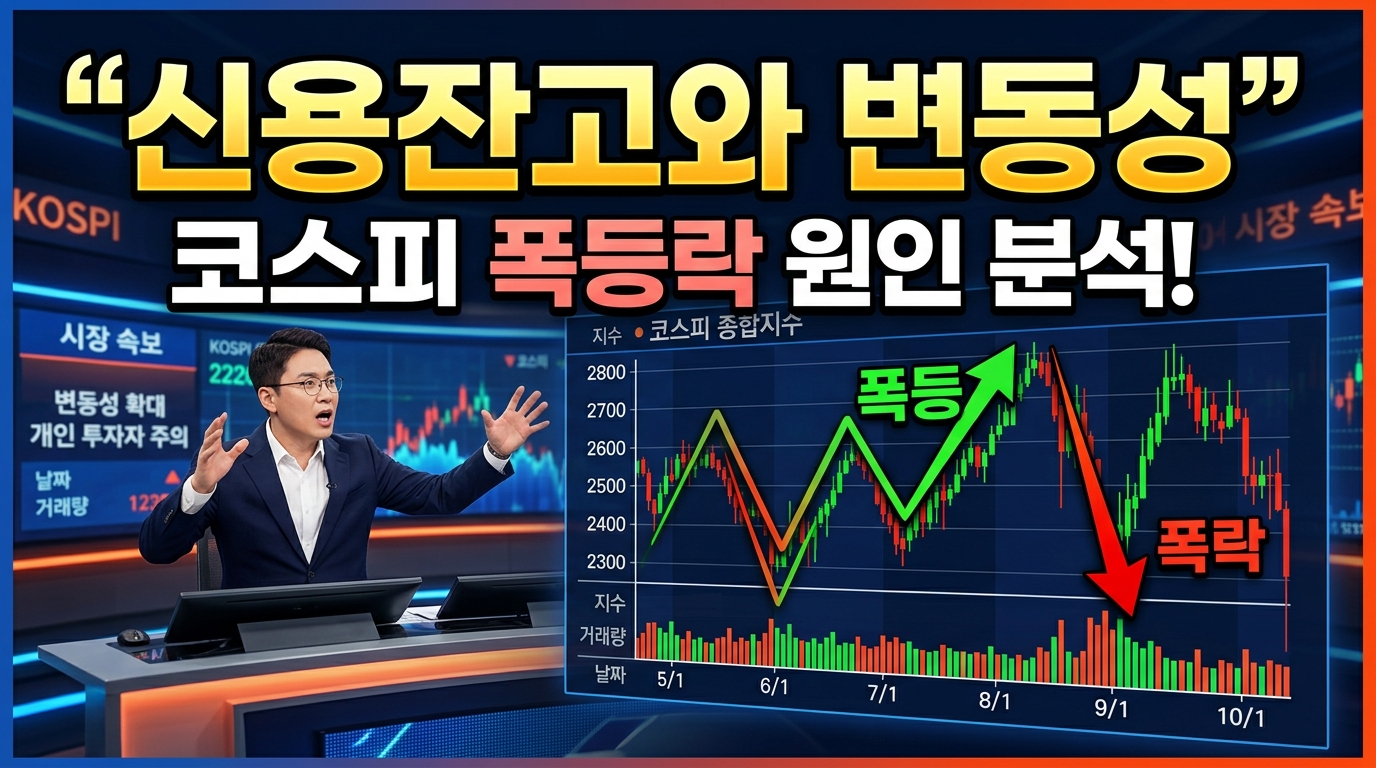
Hello, this is Daily Stock.
With the KOSPI closing at 8639.41 on June 4, 2026, the margin trading loan balance reaching an all-time high and the resulting volatility management have emerged as key market topics.
Summary
The margin trading loan balance has surpassed 38 trillion won for the first time in history, showing that individual investors' leveraged investment has reached an extreme.
On the other hand, the volume of forced liquidations due to short-term fluctuations has surged nearly threefold compared to the previous month, reaching approximately 794.6 billion won.
With the KOSPI 200 Volatility Index (VKOSPI) surpassing 75 during intraday trading and sidecars being activated 20 times this year, the market's short-term turbulence is intensifying.
The Bank of Korea is more concerned about short-term corrective volatility caused by retail investors chasing rallies rather than systemic risks to the financial system itself.
[Image: /stdaily/uploads/202606/gen_6a2122d7bf53a1.44993833.png]
Market Overview
As of today's close on June 4, 2026, the KOSPI closed at 8,639.41 points and the KOSDAQ closed at 1,049.73 points.
At the same time, the USD/KRW exchange rate stood at 1,529.90 won, and the NASDAQ index was at 26,853.98 points, continuing a strong dollar trend.
According to Daily Stock's proprietary Fear & Greed Index, the KOSPI Fear & Greed Index currently points to 'Neutral (56.6)'.
This contrasts with Neutral (57.1) a week ago, Greed (65.7) a month ago, and Fear (37.4) three months ago.
The NASDAQ Fear & Greed Index is also currently 'Neutral (54)', stepping down from Greed (60.1) a week ago, Greed (66.9) a month ago, and Neutral (54.9) three months ago.
In terms of supply and demand, KOSPI margin loans reached approximately 28 trillion won, while KOSDAQ stayed at around 10 trillion won, showing an 18 trillion won gap between the two markets.
During May, personal credit loans from the top five commercial banks surged by more than 2.6 trillion won, driven by overdraft lines (minus bankbooks), fueling fund inflows into the stock market.
Much of this capital is interpreted to have flowed into mega-cap tech stocks and the semiconductor sector.
[Image: /stdaily/uploads/202606/gen_6a2122e5f09197.54517587.png]
Financial Analysis
As of June 1, Samsung Electronics' margin loan balance was 4.2552 trillion won, and SK Hynix recorded 3.53 trillion won, overwhelmingly ranking at the top among individual stocks.
Along with this, massive margin debt has accumulated in single-stock leveraged ETFs and semiconductor-themed products based on these underlying assets.
In contrast, the forced liquidation amount in May was 794.6 billion won, an approximate threefold increase compared to the previous month (264.2 billion won).
This proves that as the index fluctuated heavily near its peak, many sell orders were executed mechanically due to the failure to meet the margin maintenance ratio.
| Item | Recent Figure (As of early June 2026) | Previous Figure (MoM, etc.) | Features & Interpretation |
|---|---|---|---|
| Total Margin Loan Balance | 38.0227T won (May 29) | 37.6812T won (June 1) | Maintains historic high after breaking 38T won for the first time |
| KOSPI Margin Loan Balance | Approx. 28.0245T won | 25T won range (Sharp MoM increase) | Concentration in semiconductors and large IT blue chips |
| KOSDAQ Margin Loan Balance | Approx. 10T won | 11T won range (~10% decrease in May) | Clearing of debt-financed positions completed amid market divergence |
| Forced Liquidation in May | 794.6B won | 264.2B won (3x increase vs. April) | Surge in mechanical liquidation due to short-term index swings |
| Credit Loan Increase in 5 Major Banks | 2.6496T won | Largest monthly jump vs. April in 5 years and 1 month | Powerful movement of household cash reserves into the stock market |
Valuation
With the USD/KRW exchange rate soaring to the 1,529.90 won level, foreign investors' incentive for spot buying has somewhat weakened.
As a result, retail leveraged capital is filling the gap for the KOSPI's further upward momentum, accumulating valuation pressure.
The KOSPI 200 Volatility Index (VKOSPI) recently surged to 75.42 intraday, showing that the market's psychological anxiety indicator has reached an extreme.
While the overseas NASDAQ index is searching for direction at the 26,853.98 level, the domestic stock market faces high downward vulnerability relative to global indices due to excessive debt-financed trading.
Expert & Institutional Analysis
In its report titled "Current Status and Evaluation of Retail Leveraged Stock Investment" released on June 4, the Bank of Korea examined recent borrowing investment trends from various angles.
The report analyzed that the possibility of a financial system collapse is very low because the margin lending limits of securities firms are strictly restricted under the Capital Markets Act.
However, it strongly warned that latecomer investors who entered the market late and chased buying out of FOMO (Fear Of Missing Out) have high leverage ratios.
The financial investment industry also points to the surge in short-term leveraged trading as one of the reasons why sidecars were activated a total of 20 times (11 buy, 9 sell) in the KOSPI market this year.
[Image: /stdaily/uploads/202606/gen_6a2122f4804887.01980162.png]
Risk Factors
The most concerning part is the "domino effect of forced liquidations" that could occur when the index enters a downward correction period.
When falling stock prices trigger margin calls, and forced liquidations drag stock prices down further, a vicious cycle maximizes volatility.
From a macroeconomic perspective, foreign exchange pressure at 1,529.90 won and delayed interest rate cuts increase household loan interest burdens, compounding payment pressures.
If a slowdown in export indicators or global economic headwinds materialize, the high margin debt could instantly act as a market detonator.
Investment Outlook
At this point, the KOSPI is recording historic high debt-financed trading volume and volatility indicators, so chasing with additional leverage may carry high risks.
Instead, investors should consider the possibility of capital shifting to the KOSDAQ market, where debt-financed positions have been significantly digested, or to value stocks with relatively low debt-to-equity ratios.
Until the exchange rate trend and foreign supply/demand stabilize, defensive portfolio management is required.
In a market where volatility has reached its peak, it seems necessary to refrain from unreasonable leverage and maintain a certain cash proportion under scenario-specific planning.
Investor Checklist Q&A
Q1. What risk does the margin trading loan balance exceeding 38 trillion won pose to the market?
A1. It suggests that individual investors' fund-raising capabilities have reached their limit. At the same time, it poses a significant risk as potential forced liquidation supply if stock prices decline.
Q2. Why is there such a large difference between KOSPI and KOSDAQ margin balances?
A2. This is because aggressive capital has concentrated heavily on large-cap stocks amid the unilateral strength of the KOSPI market recently. Consequently, the debt-financed trading burden on the KOSDAQ has become relatively lower.
Q3. Why did forced liquidations increase nearly threefold compared to the previous month?
A3. It is because the index showed a highly volatile market, surging and plunging by hundreds of points a day near historical highs. Short-term volatility broke margin maintenance ratios, triggering forced liquidations.
Q4. Why did the Bank of Korea view the possibility of household debt trading spreading to systemic risk as low?
A4. Under capital market regulations, securities firms can preserve losses through collateral disposal mechanisms. Additionally, institutional safety nets are in place to prevent it from leading to the insolvency of the entire financial sector.
Q5. How should investors respond in an extreme volatility market where the VKOSPI exceeds 75?
A5. When the volatility index surges like this, investors should avoid using new leverage. Instead, it is advisable to increase the cash proportion within portfolios and wait until the market stabilizes to some extent.