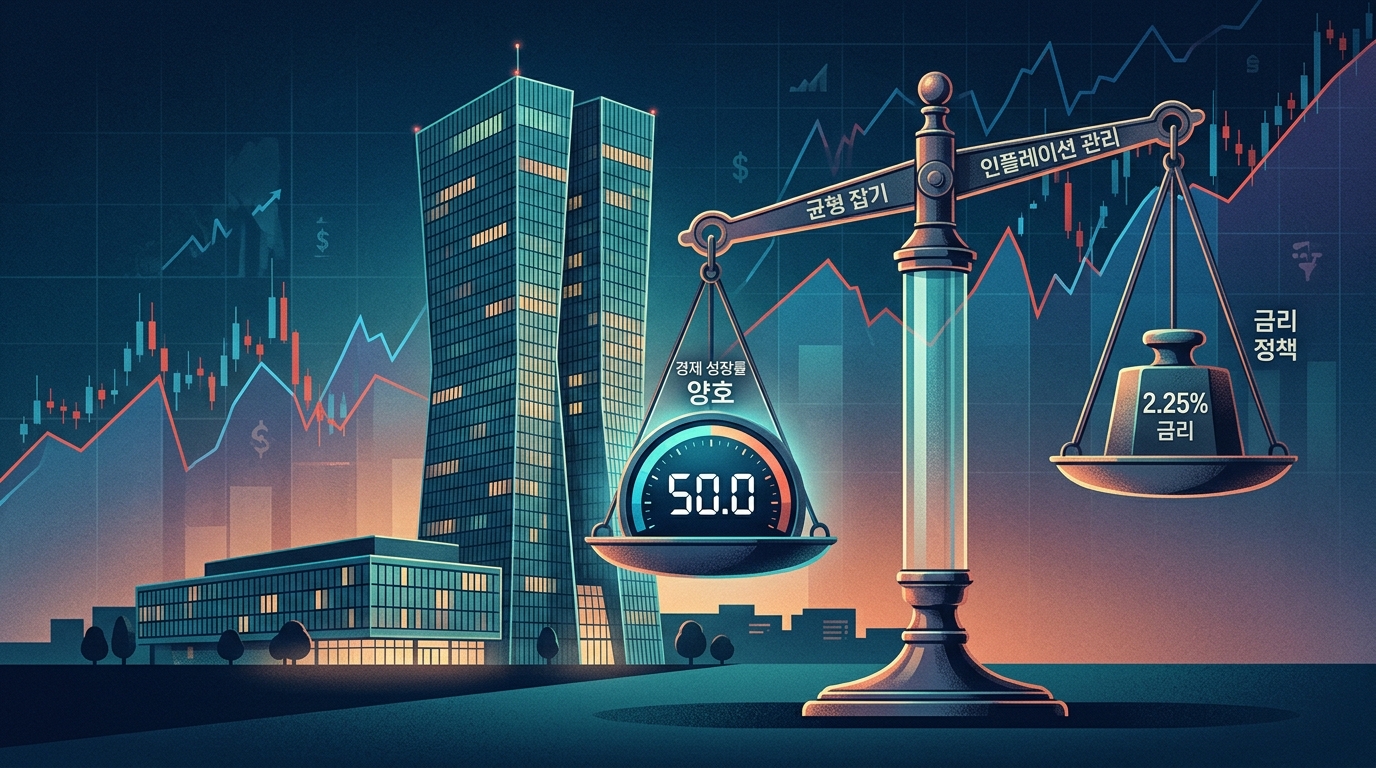
This is Daily Stock, tracking the core pulse of the market amid global macro volatility and regional policy divergence.
Key Summary
- **Eurozone Economy Stabilizes**: The final Eurozone Composite PMI for June was recorded at 50.0, escaping contraction territory to stand flat.
- **Rate Freeze Outlook Dominates**: After raising its deposit rate to 2.25% in June, the European Central Bank (ECB) has a 93% probability of freezing rates at its upcoming meeting on July 23.
- **Deepening Global Decoupling**: There is a stark divergence between the US maintaining a tight hold, the Eurozone undergoing moderate adjustments, and Asia responding to monetary easing and yen depreciation.
[Image: /stdaily/uploads/202607/gen_6a5bd5d8087d03.74890125.png]
Current Situation Summary
The recently released S&P Global Eurozone Composite Purchasing Managers' Index (PMI) registered a final June reading of 50.0, beating both the previous month's level (48.5) and the preliminary estimate (49.5).
A minor improvement in manufacturing production offset a mild slowdown in services, allowing the Eurozone private economy to halt its two-month contraction and return to a flat level.
In terms of monetary policy, the ECB raised all three policy rates by 25 basis points on June 11, pushing the deposit rate up to 2.25%.
The market strongly expects the ECB to freeze its key interest rate at 2.25% at the upcoming monetary policy meeting on July 23 (latest schedule).
The probability of a freeze priced into the interest rate futures market reaches a whopping 93.0%.
This supports the view that the central bank will take a breather given the weak economic growth in the Eurozone.
Financial Analysis
The Eurozone's economic fundamentals remain on thin ice.
According to Eurostat, the Eurozone's real gross domestic product (GDP) growth rate for Q1 2026 recorded -0.2% quarter-on-quarter, turning negative for the first time since Q3 2023.
The annual growth rate was also sluggish at 0.3%, significantly missing previous market forecasts.
Consequently, the European Commission (EC) revised down its 2026 annual growth projection for the Eurozone from 1.2% to 0.9%.
This downgrade stems from a persistent bottleneck where energy supply instability, driven by prolonged Middle East tensions, drives import prices higher and constrains domestic demand.
On a brighter note, the Eurozone's annual Consumer Price Index (CPI) inflation for June slowed to 2.8%, showing signs of gradual stabilization.
| Key Indicators (As of June–July 2026) | Value | Notes |
|---|---|---|
| Eurozone Composite PMI (June Final) | 50.0 | Settled on the baseline (50.0), showing flat growth |
| Q1 GDP Growth Rate (QoQ) | -0.2% | Swung to negative growth |
| 2026 Annual Growth Forecast | 0.9% | Downgraded by the European Commission (EC) |
| Eurozone CPI Inflation | 2.8% | Undergoing gradual stabilization |
| ECB Deposit Rate (Current) | 2.25% | 25 bps hike completed in June |
Valuation
Global financial markets are witnessing a clear decoupling of fundamentals among the US, Europe, and Asia.
The US stock market, driven by robust employment and the AI investment boom, has seen the Nasdaq index reach the 25,520.24 level, though market sentiment sits in the "Fear (37.1)" zone.
In contrast, South Korea's KOSPI has corrected down to the 6,820.60 level amid a rising exchange rate (KRW/USD at 1,490.00) and volatile foreign flows, lingering in the "Extreme Fear (12.4)" zone.
In the Eurozone, gas prices remain about 43% higher than pre-crisis levels due to a heavy reliance on energy imports, piling on stagflationary pressures.
[Image: /stdaily/uploads/202607/gen_6a5bd5dfb4c9f7.13840317.png]
As a result, European equity valuations are trading at a significant discount compared to the US, and their relative index strength remains weaker than that of emerging Asian economies.
Caught between the Bank of Japan's (BOJ) response to yen depreciation and the People's Bank of China's (PBOC) structural economic stimulus, the Eurozone is walking a tightrope between high interest rates and economic fragility.
Expert & Institutional Analysis
Global investment banks agree that the July meeting will merely be a "pause" in rate hikes rather than the absolute end of the tightening cycle.
Henry Cook, an economist at MUFG, noted, "The ECB will not rush additional hikes at the July meeting. However, the market sees an approximately 79.2% probability of a 25 bp hike to 2.50% at the September 9 meeting."
Michael Field, senior European market strategist at Morningstar, also commented, "Having taken decisive action last month (the June hike), they can afford to hold rates steady this month."
However, he added, "There is very low visibility on when Middle East tensions might resolve and how energy prices will impact Eurozone inflation going forward."
In its annual Eurozone consultation report, the International Monetary Fund (IMF) recommended that establishing a Capital Markets Union (CMU) through the integration of banking and venture capital markets would act as a powerful growth engine.
At the same time, the IMF stressed that prompt, visible action from Eurozone policymakers is crucial as stagflation risks could become structural.
Risk Factors
The most severe threat is the potential resurgence of geopolitical risks and energy supply volatility.
Despite temporary signs of easing, such as diplomatic talks between the US and Iran, uncertainty around the Strait of Hormuz persists, which could lead to natural gas supply disruptions and dent Eurozone manufacturing activity.
[Image: /stdaily/uploads/202607/gen_6a5bd5e8638549.50861079.png]
Secondly, there is the risk of worsening stagflation.
With GDP growth already in negative territory, any flare-up in inflation driven by wage growth or energy volatility would force the ECB to hike rates further, choking economic growth.
Thirdly, there is economic divergence within the Eurozone.
While manufacturing-heavy Germany (2026 growth forecast: 0.6%) and France (0.8%) suffer severe stagnation, tourism- and service-oriented Spain (2.4%) is outperforming, making unified monetary policy decisions highly complex.
Investment Perspective Summary
Investors are advised to maintain a conservative stance on Eurozone markets for now.
Although the PMI managed to hold the 50.0 line, the impact of negative Q1 growth and energy supply chain risks have not been fully resolved.
If Eurozone gas prices continue to stabilize downward and rate-hike worries fade after the September decision, a recovery scenario focused on undervalued value stocks may become attractive.
Conversely, if supply chain shocks from the Middle East trigger back-to-back rate hikes extending past September into the year-end, the probability of a Eurozone hard landing will surge.
Therefore, investors should adopt a cautious, diversified strategy while comparing the relative strength of US tech stocks (Nasdaq fear index at 37.1) and the domestic market (KOSPI extreme fear at 12.4).
Investor Checklist Q&A
Q1. What does it mean that the Eurozone June Composite PMI hit 50.0?
A1. It means the economy has barely crawled out of contraction to flatline. This provides relief that immediate recession risks have been staved off.
Q2. Will the ECB really hold rates at the July 23 meeting?
A2. The market-implied probability of a freeze is overwhelming at approximately 93.0%. Since the ECB raised rates in June, a July pause is highly likely.
Q3. How high is the chance of a September rate hike?
A3. The market currently prices in an 80% chance of a 25 bp rate hike in September, though this remains highly dependent on oil and gas price trends.
Q4. How does the Eurozone slowdown affect the Korean stock market?
A4. A drop in Eurozone import demand could dent earnings for Korean export manufacturers, weighing down flows into the KOSPI (currently in the Extreme Fear zone at 12.4).
Q5. Which macro indicators should investors watch closely?
A5. Tracking Germany's monthly ZEW Economic Sentiment Index, the Eurozone preliminary Composite PMI, and natural gas futures prices will serve as the most reliable gauges.