Hello, I am a professional writer for Daily Stock.
Today, based on the closing data of May 26, 2026, we will examine the actual revenue growth and valuation status of KOSDAQ AI software SaaS companies.
Core Summary
[Image: /stdaily/uploads/202605/gen_6a155399f0b7b9.16269714.png]
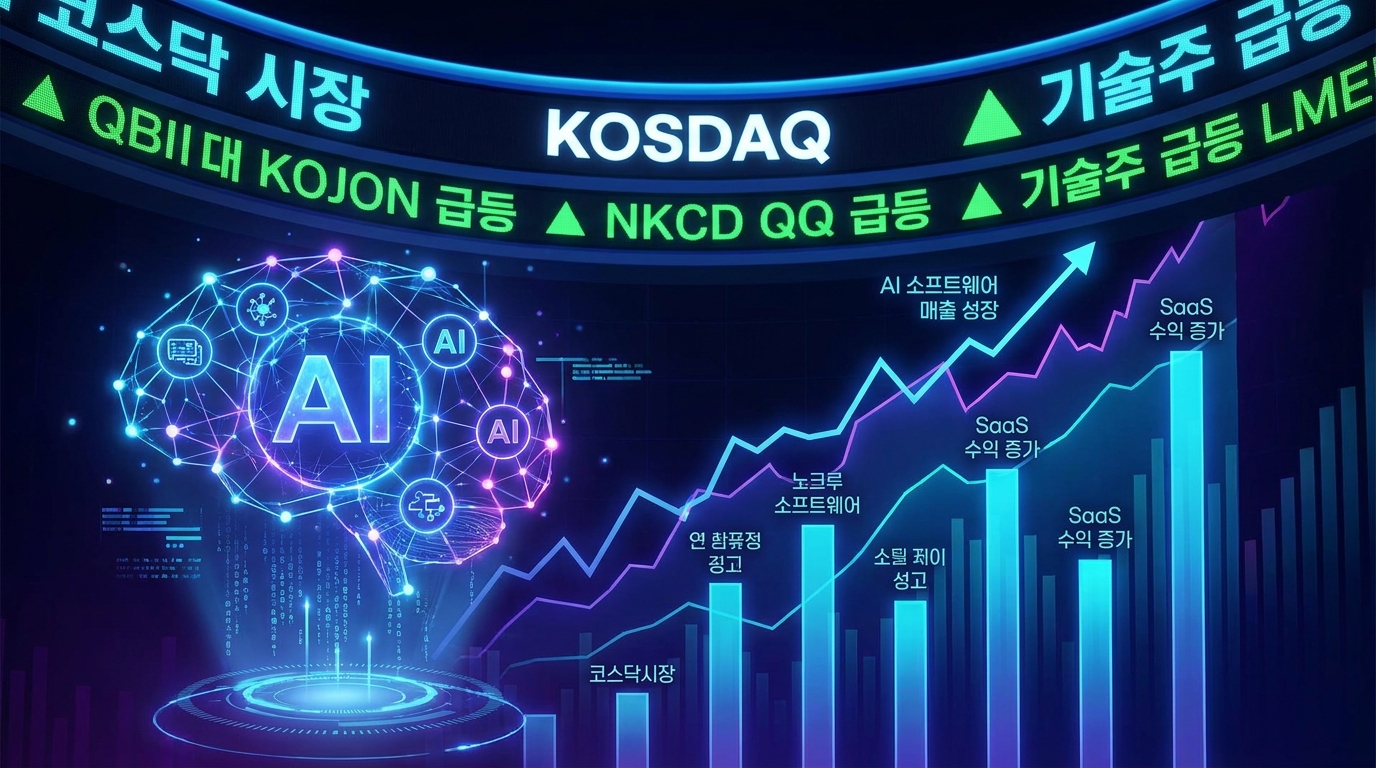
With the KOSDAQ closing at 1,172.52 on the 26th and continuing its growth stock rally, the AI theme is shifting from simple expectations to a 'SaaS-based performance market.'
Leading stocks such as Saltlux, Hancom (Hangul and Computer), and ESTsoft are noticeably boosting their recurring revenue (ARR) through AI agents and vertical SaaS.
In a high exchange rate environment (1,502.50 KRW), the margin defense capabilities of software companies with low dependence on hardware imports are being highlighted.
Coupled with the synchronization of enterprise AI monetization on the US NASDAQ, this is acting as strong supply and demand momentum in the domestic market as well.
Current Situation Summary
As of the close on May 26, 2026, the KOSDAQ index recorded 1,172.52 and the KOSPI recorded 8,047.51, with strong liquidity flowing into the domestic stock market overall.
With the KRW/USD exchange rate staying at an unusually strong dollar level of 1,502.50 KRW, the market is focusing on SaaS (Software as a Service) companies that have low exchange rate sensitivity and generate profits with their own technology.
The NASDAQ index is also continuing its high march at 26,343.97, and the full-scale monetization of AI workloads has become a key topic in the US market.
In the domestic KOSDAQ market, polarization between large-cap software stocks included in the KOSDAQ 150 and small-to-mid-cap theme stocks is becoming clear, with buying pressure concentrated on leading companies that demonstrate actual revenue.
According to Daily Stock's proprietary Fear & Greed Index, the KOSPI is currently Neutral (58.1), somewhat calmed down compared to Neutral (58.9) 1 week ago, Greed (64.8) 1 month ago, and Greed (63.4) 3 months ago.
The NASDAQ Fear & Greed Index also currently records Neutral (58.6), stepping down from Greed (63.2) 1 week ago, Greed (68.5) 1 month ago, and Greed (66.8) 3 months ago, entering a calm stock-picking phase.
Financial Analysis
[Image: /stdaily/uploads/202605/gen_6a1553b05b04c0.53406876.png]
In the past, AI theme stocks had to endure deficits due to massive R&D expenses, but recently, leading companies are achieving structural revenue growth by winning public sector (B2G) and enterprise (B2B) projects.
Hancom is proving consecutive quarterly upward trends in revenue and operating profit (based on the latest confirmed values), driven by the high growth of its non-installation cloud product lineup, such as 'Hancom Assistant.'
Saltlux has driven explosive subscriber growth for its global AI agent 'Goover,' based on its Large Language Model (LLM) 'LUXIA.'
Through this, it is operating an extensive sales pipeline of 50-60 billion KRW in 2026 alone, earning the evaluation that it has equipped itself with a powerful growth engine.
ESTsoft is expanding into the global media market and exporting AI human kiosks featuring its global SaaS product 'PERSO.ai'.
Although temporary cost burdens have arisen from aggressive overseas marketing, the Monthly Recurring Revenue (MRR) indicator, which is the foundation of long-term profit, is drawing a stable upward curve.
Valuation
When evaluating KOSDAQ AI software stocks, the market utilizes PSR (Price-to-Sales Ratio) and EV/EBITDA as major indicators rather than the traditional PER (Price-to-Earnings Ratio).
Due to the nature of SaaS businesses that generate recurring cash flow, EV/EBITDA—excluding amortization costs for initial data center infrastructure investments—more accurately reflects the company's actual profit generation capacity.
| Company Name | Core SaaS Product | 2026 Performance Momentum | Key Valuation Indicator (Estimated) |
|---|---|---|---|
| Saltlux | LUXIA, Goover | Global subscriber growth and 50 billion KRW pipeline operation | Application of high-growth premium based on PSR |
| Hancom | Hancom Assistant | Public B2G cloud transition and high growth of non-installation products | Highlighted EV/EBITDA attractiveness |
| ESTsoft | PERSO.ai | Global AI human export and MRR growth | Reflection of new business investments and turnaround expectations |
As Saltlux and ESTsoft are in a high-growth phase, they are testing premiums at the top of their PSR bands, similarly to their global peer groups.
Hancom, which has proven relatively stable and continuous cash flow, has high attractiveness in terms of EV/EBITDA, making it a likely target for program trading that aims for both value and growth stocks.
Expert & Institutional Analysis
As global stock markets enter the 'first year of AI monetization' in 2026, institutional investors are restructuring their portfolios around stocks with upward-revised earnings estimates rather than theme-driven surges.
While retail deposits and margin loan balances in the KOSDAQ market are abundant, analysis shows that institutional and foreign funds are concentrating on blue-chip software stocks within the KOSDAQ 150 supported by strong fundamentals.
Securities circles predict that the Korean government's full-scale execution of data, cloud, and AI-related budgets will act as strong policy momentum for second-half 2026 earnings.
Furthermore, the dominance over cloud-based AI ecosystems shown by Microsoft and Amazon in the global market is expected to serve as a major benchmark indicator in the domestic market as well.
Risk Factors
If the high-interest-rate environment is prolonged, the fundamental and financial burdens on small and mid-sized AI software companies that must cover cloud infrastructure maintenance and massive marketing budgets could increase.
When profit-taking selling occurs after a stock price surge, combined with the low liquidity phenomenon unique to the KOSDAQ market, there is a risk that valuation volatility, such as gap downs, will sharply increase.
Global big tech companies like OpenAI are expanding into the B2B market by directly implementing AI within corporate workflow systems, posing a significant threat to the survival and economic moats of domestic homegrown SaaS companies.
Warnings are being raised that companies merely integrating global AI engine APIs without independent data defense barriers could be weeded out amidst fierce unit price competition.
Investment Perspective Summary
Ultimately, the 2026 KOSDAQ AI software ecosystem is on a harsh testing ground transitioning 'from dreams to profits,' and it is time to avoid vague theme-based investments lacking concrete numbers.
There is a need to focus on companies with a high proportion of 'recurring revenue (ARR)' generating predictable cash flows every month, and those that have pre-empted certain captive demand in the public and financial sectors.
Investors must carefully distinguish whether a drop in operating margin during quarterly earnings announcements is a strategic preemptive investment (CapEx) for market pioneering, or SG&A expense leakage due to declining competitiveness.
It is advisable to consider a defensive approach focused on stocks with clear earnings visibility while concurrently checking the flow of the US NASDAQ software value chain and domestic institutional program trading trends.
Investor Checkpoint Q&A
Q1. What is the most important financial indicator when viewing the performance of AI SaaS companies?
A1. Rather than short-term damage to operating margins, the growth rate of monthly/annual recurring revenue (MRR/ARR) generated stably every month and the existing customer retention rate should be checked first and foremost.
Q2. Why are AI software stocks advantageous in an era of a 1,500 KRW exchange rate?
A2. They have low reliance on imports of tangible raw materials or parts, avoiding the direct hit of cost increases due to surging exchange rates, and can expect favorable foreign exchange gains if dollar revenue is generated through overseas service expansion.
Q3. Why is inclusion in the KOSDAQ 150 index important?
A3. If included in the KOSDAQ 150 index, passive funds and program trading capital from institutions and foreigners mechanically flow in, showing better supply and demand defense compared to small-to-mid-cap stocks even in a bearish market with lacking liquidity.
Q4. What is the recently spotlighted enterprise AI Agent technology?
A4. Going beyond the level of chatbots that simply answer user questions with text, it is an action-oriented AI technology where the software recognizes situations on its own and automatically performs practical tasks like writing emails, generating reports, and scheduling.
Q5. What is the biggest risk to watch out for before investing?
A5. The most caution should be paid to the possibility of cutthroat competition due to market penetration by global big tech companies with strong capital, such as Microsoft, and the valuation discount applied to growth stocks if high interest rates are prolonged.