Hello, here are today's global macro and market trends from the perspective of Daily Stock.
Key Summary
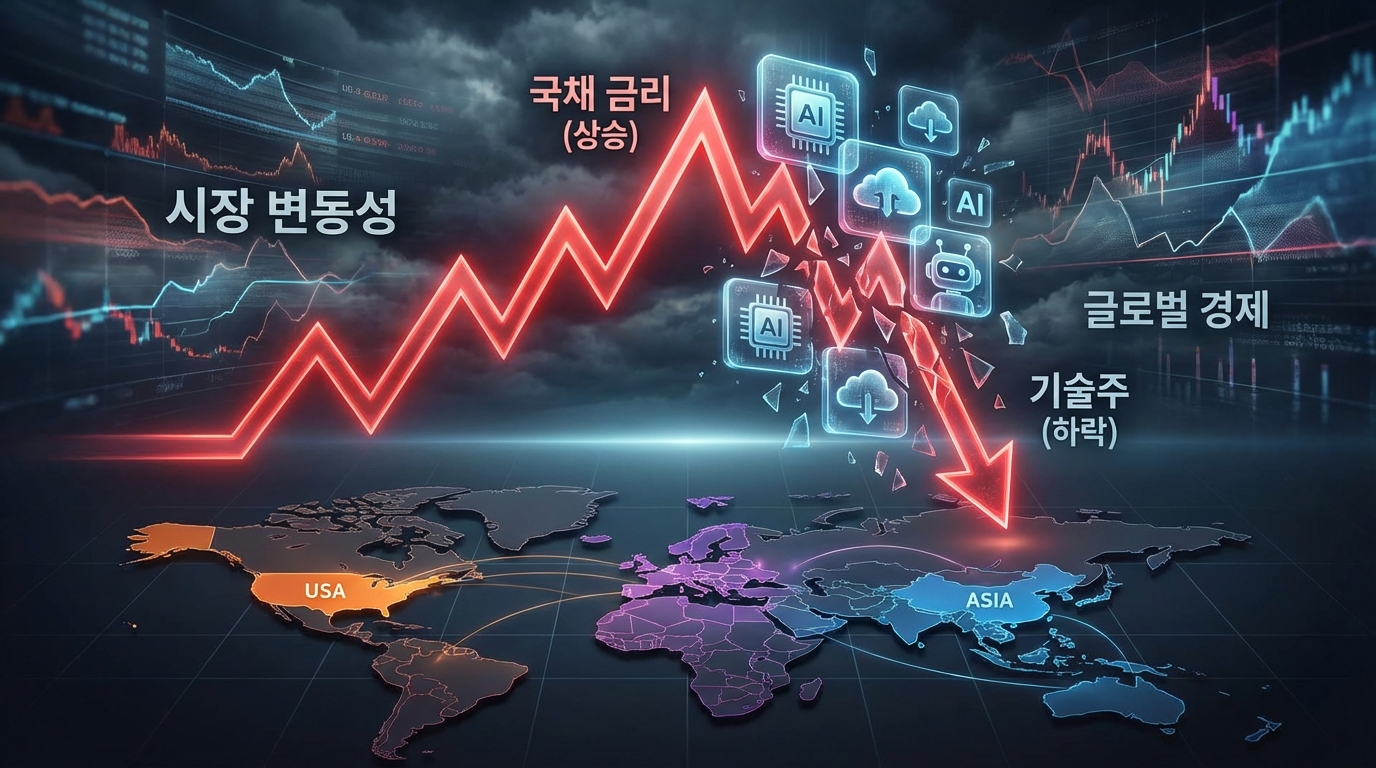
As the US 10-year Treasury yield enters the 4.28% range, valuation re-evaluation pressure is mounting across global tech stocks.
In a situation where astronomical capital expenditures (CAPEX) are required to build artificial intelligence (AI) infrastructure, rising capital procurement costs are testing corporate profitability expectations.
Consequently, while growth stocks in the US market are undergoing corrections, there is a possibility that European and Asian stock markets will show decoupling patterns based on their respective domestic fundamentals and policy differentiation.
Investors are now in a challenging environment where they must thoroughly verify the macro indicators and corporate earnings strength of each region, moving beyond simple index betting.
[이미지: /stdaily/uploads/202604/gen_69d554f05197e2.01008922.png]
Current Situation Summary
As of 04:01 on April 8, 2026 (provisional intraday), the Nasdaq index recorded 21,933.83, reflecting the market's caution over high interest rate levels.
The KOSPI stood at 5,494.78, and the KOSDAQ at 1,036.73, while the USD/KRW exchange rate remained at 1,501.30, indicating a sustained strong dollar trend.
According to Daily Stock's proprietary Fear & Greed Index, the Nasdaq is currently in the Fear (23.3) zone; although recovered from Extreme Fear (4) three months ago, investor sentiment remains subdued.
The KOSPI is also currently in a state of Fear (33.5), with market warmth significantly cooled compared to the Greed (73.5) zone three months prior.
As geopolitical instability in the Middle East stimulates concerns over energy supply surrounding the Strait of Hormuz, a scenario of prolonged inflation is emerging across the macroeconomy.
Such concerns about liquidity crunches serve as the key background restricting investment limits across all risk assets.
Financial Analysis
The prolongation of a high-interest-rate environment could cause extreme earnings polarization even within tech stocks, depending on a company's interest coverage ratio and cash flow generation ability.
While giant tech companies (Big Tech) continue their AI investments based on abundant free cash flows, small-to-mid-cap tech stocks face the risk of hitting financial limits due to elevated interest expenses.
In Europe, the Eurozone Manufacturing PMI rebounded to 51.6 as of March 2026, with signs of fundamental recovery observed in some traditional industries and energy-related stocks.
This implies that export-oriented companies are preparing for an earnings turnaround in their financial statements as they welcome new orders following inventory depletion.
In the Asian region, the rise in prices of key raw materials like copper may act as a cost burden for companies related to semiconductors and power grid infrastructure.
Therefore, corporate financial health may be thoroughly reassessed based on cash flows in the US, earnings turnarounds in Europe, and raw material cost control in Asia.
Valuation
The US 10-year Treasury yield reaching 4.28% narrows the gap between the stock market's earnings yield and the government bond yield, namely the Equity Risk Premium (ERP).
US tech stocks are exposed to the gravity of valuation, needing to prove much stronger earnings growth than before to justify their high Price-to-Earnings Ratios (PER).
On the other hand, European stock markets have a relatively high proportion of value stocks such as defense, green energy, and consumer staples, potentially standing out for their defense against valuation declines in a rising interest rate phase.
Asian stock markets are showing a mix of risks of falling Price-to-Book Ratios (PBR) due to domestic currency weakness and the effect of improved export competitiveness as the strong dollar overlaps with rising raw material prices.
[이미지: /stdaily/uploads/202604/gen_69d5550797ea87.53606399.png]
| Region | Key Valuation Variable | Relative Strength Factor | Risk Factor |
|---|---|---|---|
| **US** | 10-year yield and AI CAPEX ROI | Massive cash flow of Big Tech | ERP reduction due to sustained high valuations |
| **Europe** | Cyclical stock earnings and ECB policy shift | Manufacturing PMI rebound (51.6) | Increased energy costs from geopolitical tensions |
| **Asia** | USD exchange rate and BOJ/PBOC policy gap | Price competitiveness of export companies | Inflation pressure triggered by rising raw materials (copper/oil) |
Expert & Institutional Analysis
Major Wall Street institutions forecast that global stock markets in 2026 will play a tug-of-war between 'rising interest rates' in the US and 'fundamental turnarounds' in Europe and Asia.
BNP Paribas and others analyzed that the European Central Bank's (ECB) monetary policy flexibility could positively impact the market as the Eurozone economy shows robust growth.
Institutions like Jefferies warned that US AI-related capital expenditures could peak in 2026, and if doubts about the Return on Investment (ROI) grow, funds could migrate to other regions.
This implies that blind adherence to Big Tech may no longer be a safe haven.
Meanwhile, some opine that while copper prices are expected to be bullish in the long term due to surging demand from data centers and power grids, short-term downward volatility may appear if the global macroeconomy slows down.
Therefore, rather than being concentrated in a specific country, global capital is highly likely to fragment into regional blue-chip stocks with clear earnings visibility.
Risk Factors
The biggest risk is the potential surge in energy prices and subsequent rebound in global inflation caused by escalating tensions in the Middle East, including the Strait of Hormuz.
This could derail the monetary policy paths of central banks worldwide (such as the ECB, BOJ, and PBOC), maximizing volatility in global foreign exchange markets.
In particular, if the Bank of Japan (BOJ) signals additional rate hikes or if the People's Bank of China's (PBOC) stimulus measures fall short of expectations, there is a risk of deepened fundamental decoupling within Asian stock markets.
Mismatched monetary policies could trigger capital outflows from emerging markets, demanding careful monitoring.
If US Big Tech companies' earnings reports reveal poor profit recovery rates relative to infrastructure investments, the concern of a rapid capital exodus centered on the Nasdaq cannot be ruled out.
This is because the higher the interest rates, the more the market fixates on proving immediate profits over a company's distant future growth.
Investment Perspective Summary
In the current phase of high interest rates and geopolitical uncertainty, investments relying solely on vague growth expectations may yield a low risk-to-reward ratio.
In the US stock market, it may be necessary to narrow down focus to high-quality companies capable of generating ample surplus even after covering interest expenses, rather than highly leveraged companies.
When approaching European and Asian markets, traditional industrials and raw material-related stocks benefiting from differentiated domestic stimulus policies or global supply chain restructuring could be considered as portfolio hedging tools.
Investors may find it advantageous to check their tolerance for interest rate volatility and devise flexible asset allocation strategies aligned with macro indicator changes in each region.
Investor Checkpoints Q&A
Q1. What is the core reason for the US 10-year Treasury yield rising to 4.28%?
It is because expectations for an early rate cut by the Fed have retreated, combining robust US economic indicators, sticky inflation, and concerns over rising oil prices due to the Middle East geopolitical crisis.
Q2. Why does a rising interest rate disproportionately disadvantage tech stocks?
Tech stocks are granted high valuations based on expectations of future cash flows; when the benchmark discount rate (government bond yield) rises, the present value equivalent of that future value significantly decreases.
Q3. What implications does the Eurozone PMI rebound hold for global stock markets?
It is a signal that the European manufacturing sector is passing its bottom, suggesting that the global economy may move away from being solely US-centric and exhibit a multipolar fundamental recovery.
Q4. How does the price increase of raw materials like copper impact Asian stock markets?
For Asian manufacturing countries that import, process, and export raw materials, it can increase cost burdens and damage corporate profit margins; however, it can conversely be a boon for resource-rich countries or power grid infrastructure export companies.
Q5. What exactly does the concern over an 'AI CAPEX Peak-Out' mean?
It refers to the market's anxiety that while giant tech companies are pouring astronomical costs (CAPEX) into AI infrastructure, if they fail to prove a powerful revenue model to offset this in the near future, investments could peak and subsequently scale back.