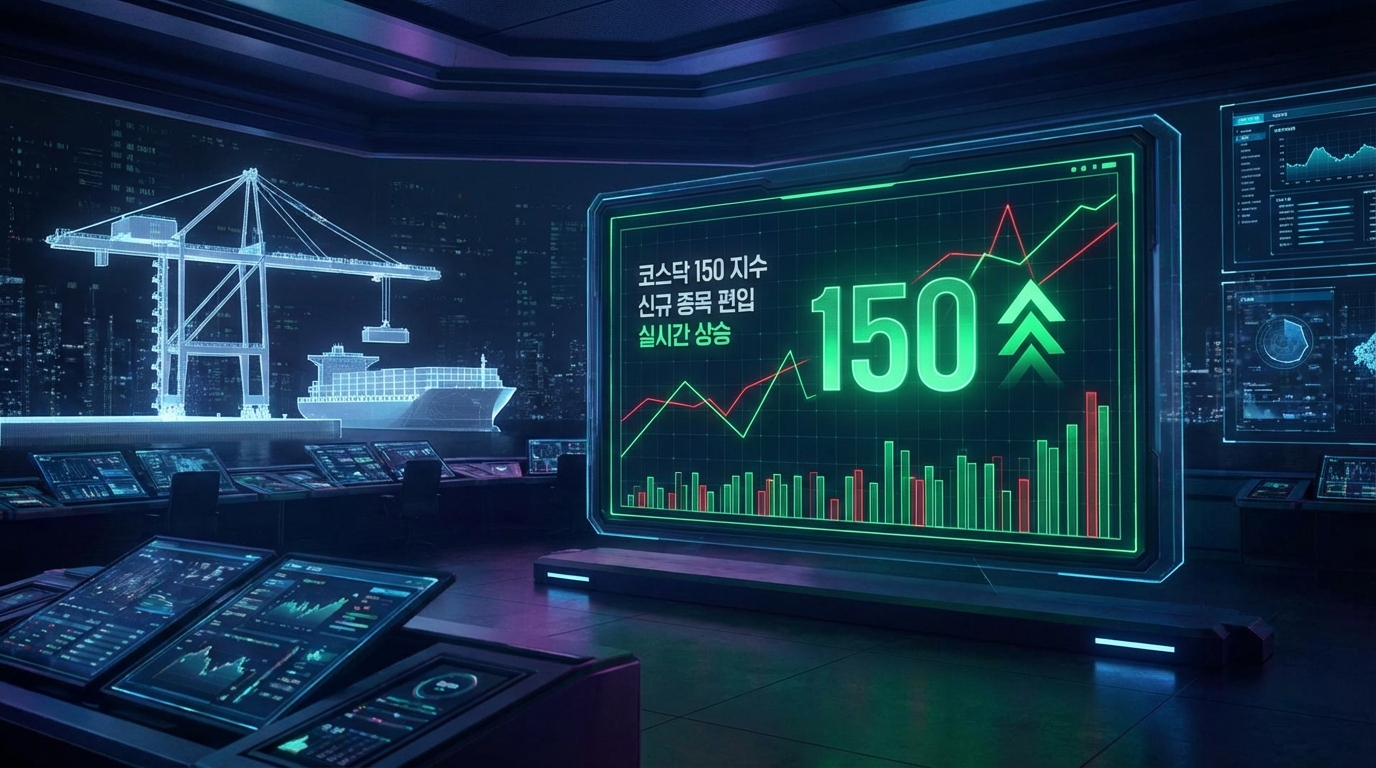
Dear DailyStock blog readers, today we will conduct an in-depth analysis of the earnings and valuation of Hyundai Hyms (460930), which has become the center of supply and demand following its new inclusion in the KOSDAQ 150 index.
[Image: /stdaily/uploads/202604/gen_69cf74b24853f8.94146575.png]
Key Summary
Hyundai Hyms was newly included in the KOSDAQ 150 index in March 2026, benefiting from the inflow of passive funds.
This is a replacement due to an existing constituent being designated as an investment alert issue, and it is highly likely to serve as valuable supply-demand momentum in the KOSDAQ market, where liquidity is drying up.
In 2025, the company achieved record-high performance, posting sales of 248.2 billion won and an operating profit of 28.8 billion won.
It is analyzed that the shipbuilding supercycle and robust sales in the new port crane (DTQC) business drove distinct top-line growth.
In the current high exchange rate environment, with the KRW/USD rate reaching 1,507.30 won, the export-based shipbuilding equipment business can enjoy currency defense effects.
Even as the NASDAQ market is extremely contracted, there is room for the company to serve as a defensive alternative as an earnings stock with solid fundamentals within the KOSDAQ.
Current Situation Summary
As of the market close on April 3, 2026, the KOSDAQ index recorded 1,063.75, continuing a market trend without a clear direction.
According to DailyStock's proprietary Fear & Greed Index, NASDAQ Fear/Greed is currently at Extreme Fear (15.3), Extreme Fear 1 week ago (14.5), Fear 1 month ago (31.6), and Extreme Fear 3 months ago (12.1).
Furthermore, KOSPI Fear/Greed is currently at Fear (26.5), Fear 1 week ago (27.1), Fear 1 month ago (37.4), and Greed 3 months ago (60.1), showing that investor sentiment is deeply frozen.
The KOSPI index remains at 5,377.30, and domestic growth stock sentiment is constrained due to macroeconomic concerns originating from the US.
Despite these adverse conditions, Hyundai Hyms has maintained relative strength around the 18,700 won level since its inclusion in the KOSDAQ 150 on March 24.
While the KOSDAQ Small index struggles, the inflow of foreign and institutional program buying driven by the index inclusion has allowed it to show a robust trend compared to its benchmark.
Financial Analysis
[Image: /stdaily/uploads/202604/gen_69cf74c9c303c7.75579767.png]
According to Hyundai Hyms' preliminary 2025 results, consolidated sales reached 248.2 billion won, up 11.2% year-over-year.
During the same period, operating profit surged by a staggering 33.4% year-over-year to 28.8 billion won, simultaneously achieving top-line growth and profitability improvement.
Proactive facility investments and cost-reduction activities in the core ship block and shipbuilding equipment sectors translated directly into a dramatic rise in profit margins.
Additionally, the port crane (DTQC) division, which it entered leveraging the government's localization policy benefits, has newly settled in, adding the role of a stable cash cow.
In terms of shareholder returns, the company resolved to pay a cash dividend of 130 won per share, announcing plans to return approximately 4.6 billion won to shareholders.
This translates to a dividend payout ratio of around 22%, which is evaluated as an indicator showing its shareholder-friendly policy maintained since its IPO and confidence in its cash flows.
Valuation
Currently, Hyundai Hyms' Price-to-Book Ratio (PBR) is formed in the range of roughly 2.5 to 2.7 times, while its Price-to-Earnings Ratio (PER) is around 30 times.
Considering that the average PER for the same shipbuilding sector exceeds 50 times, it can be viewed as possessing relative valuation merit compared to its industry peers.
Especially when evaluated in terms of PSR (Price-to-Sales Ratio) and EV/EBITDA, a gradual valuation rerating is expected following the achievement of record-high earnings.
Compared to expectation-driven growth stocks in the KOSDAQ, such as AI software or biotech, it generates visible profits, giving it a different weight in fundamentals.
| Key Indicators | 2024 (Actual) | 2025 (Actual) | 2026 (Current Estimate Based) |
|---|---|---|---|
| Sales (100M KRW) | 2,231 | 2,482 | Stable order volume secured |
| Operating Profit (100M KRW) | 215 | 288 | Expansion of high value-added block portion |
| Cash Dividend (KRW) | - | 130 | Maintenance of shareholder return policy stance |
| PBR (x) | - | 2.50 | Around 2.70 |
Expert & Institutional Analysis
The financial investment industry analyzes that Hyundai Hyms' KOSDAQ 150 inclusion will go beyond a simple short-term event and serve as a primer for mid-to-long-term passive funds.
Since pension funds and index funds execute funds mechanically according to inclusion weightings, the stock's downward rigidity may be strengthened in a market lacking liquidity.
[Image: /stdaily/uploads/202604/gen_69cf74dfd73cc1.53444414.png]
The possibility of foreign program buying linked to KOSDAQ 150 futures flowing into the broader shipbuilding sector recently is also positive.
Scenarios are being proposed regarding the movement of smart money toward sectors that demonstrate relative margin defense in a high exchange rate environment that has breached the 1,500 won mark.
However, it is pointed out that concentrated supply and demand in a specific stock can be a double-edged sword under the circumstance where the overall market margin balance fluctuates and trading value shrinks.
Caution is needed as institutional profit-taking may emerge due to a supply-demand vacuum once the passive fund inclusion procedures are completed.
Risk Factors
The biggest risk is the overall contraction of global stock market investment sentiment and interest rate uncertainties.
With the NASDAQ market's Fear & Greed index showing an Extreme Fear level of 15.3, the scenario of an ebb-like outflow of foreign passive funds, mainly from large-cap KOSDAQ stocks, during macroeconomic shocks cannot be ruled out.
Furthermore, while the high KRW/USD exchange rate of 1,507.30 won is positive in the short term, there are concerns of facing headwinds from increased raw material import costs if prolonged.
Volatility in prices of steel raw materials, such as thick plates for shipbuilding, can act as a key threat to defending profit margins.
Lastly, KOSDAQ 150 index-included stocks may become primary targets if short-selling is resumed following future policy changes by financial authorities.
Preparations are required for low-liquidity gap-down volatility that occurs when trading volume plummets after a concentration of supply and demand.
Investment Perspective Summary
Hyundai Hyms has successfully caught two rabbits: solid core performance in shipbuilding equipment and the successful settling of its new port crane business.
Added to this is the strong supply-demand momentum from its new KOSDAQ 150 inclusion, equipping it with the foundation to show notable performance even in an unstable market.
However, after the current expectations for index inclusion are pre-reflected in the stock price, a price trend strictly linked to quarterly earnings growth is anticipated.
Therefore, rather than chasing purchases on short-term supply-demand events, a strategy of partial approaches while monitoring valuation indicators and foreign program trends may be reasonable.
In periods dominated by overall market fear, companies with solid fundamentals and cash flows can become key defensive alternatives in a declining market.
It is recommended to maintain a flexible investment perspective while continuously monitoring the concentration of supply and demand in Hyundai Hyms and changes in shipbuilding industry conditions.
DailyStock Q&A
Q1. What is the specific reason Hyundai Hyms was included in the KOSDAQ 150 index in March 2026?
'Higen RNM,' an existing index constituent, was excluded from the index after being designated as an investment alert issue.
Through an ad-hoc change by the Korea Exchange to fill the vacancy, Hyundai Hyms, which met the requirements for market capitalization and trading value, was added as a replacement effective March 24.
Q2. What is the mechanism by which KOSDAQ 150 inclusion affects stock supply and demand?
Passive funds, such as Exchange-Traded Funds (ETFs) or pension funds that track the KOSDAQ 150 index as a benchmark, must mechanically purchase shares according to the weight of the index constituents.
This triggers foreign and institutional program buying, creating the effect of supporting the downside of the stock price and supplying liquidity within the market.
Q3. Which sector was the core driving force behind the record-high earnings growth in 2025?
Increased demand for ship blocks driven by the shipbuilding supercycle and production efficiency maximized the core business profits.
Additionally, full-scale sales generated from the new port crane (DTQC) business, which benefited from government localization policies, drove a company-wide rise in profit margins.
Q4. What is the current status of DailyStock's Fear & Greed Index, and how is investor sentiment?
Currently, the NASDAQ Fear & Greed Index is at 15.3, indicating 'Extreme Fear,' and KOSPI is at 26.5, in a 'Fear' phase.
Because investor sentiment is extremely contracted, it is highly likely that funds will shift away from high-valuation and uncertain growth stocks toward stocks backed by dividends and actual earnings.
Q5. How should the impact of the high exchange rate in the 1,500 won range on Hyundai Hyms be interpreted?
The high exchange rate reaching 1,507.30 won enhances the price competitiveness of large shipbuilding companies with high export ratios, leading to anticipated positive trickle-down effects for equipment companies as well.
However, if the exchange rate uptrend is prolonged, it is a double-edged sword that could erode operating profit margins by driving up the import unit costs of essential raw materials like steel.