Hello, I am an expert writer for Daily Stock.
Today, we will conduct an in-depth analysis of the causes behind the extreme price volatility of secondary battery material stocks heating up the Kosdaq market, as well as the structural changes hidden beneath the surface.
Core Summary
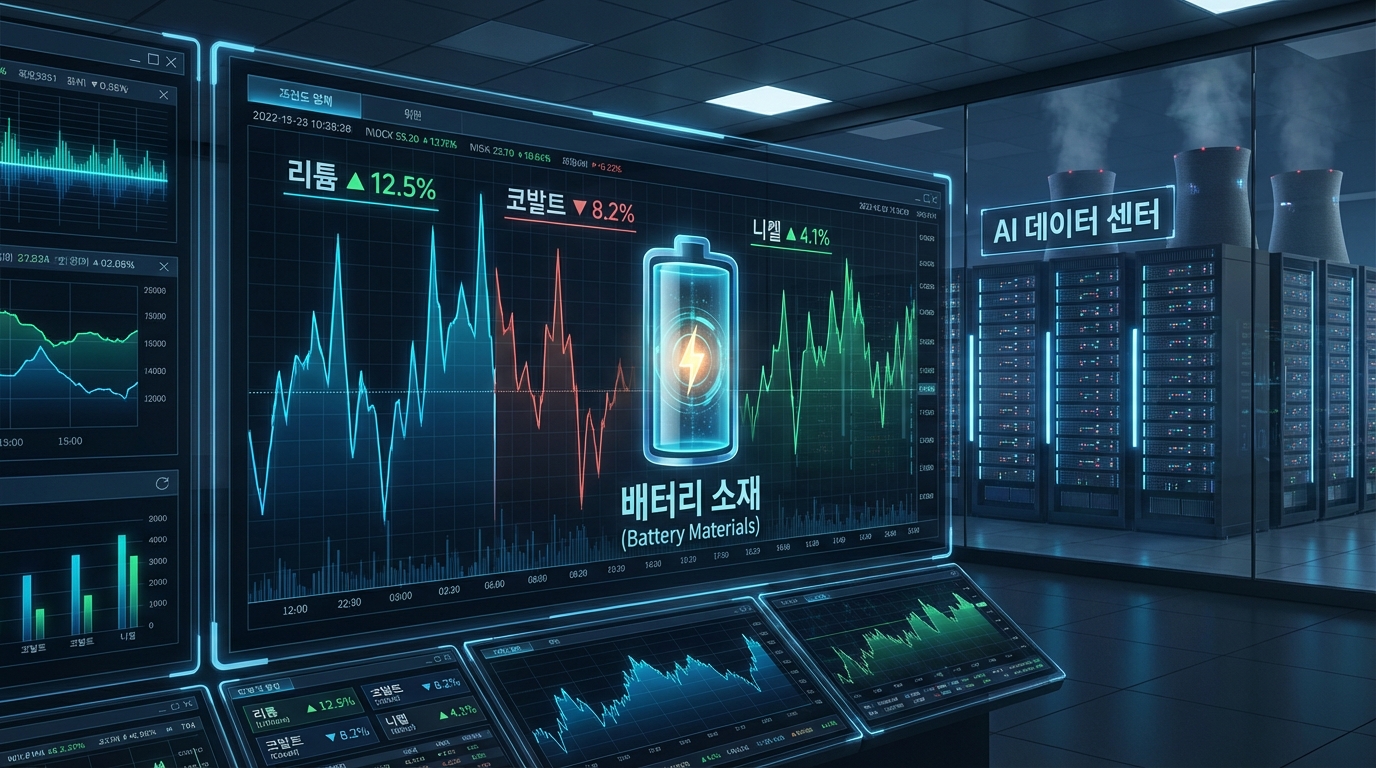
The extreme volatility in secondary battery material stocks is caused by a collision of conflicting momentums: fears of an electric vehicle (EV) chasm and explosive demand for Energy Storage Systems (ESS) triggered by artificial intelligence (AI) data centers.
Moreover, as part of a 'de-risking from China' supply chain restructuring, large-scale LFP cathode material orders by domestic companies have overlapped, prompting a full-scale separation of the wheat from the chaff among individual stocks.
[Image: /stdaily/uploads/202603/gen_69c245127d2259.99685681.png]
Current Situation Summary
As of the Korean market close on March 24, 2026, the Kosdaq index recorded 1,121.44, while a differentiated trend was captured within the secondary battery material sector.
Unlike in the past when the entire theme rose simultaneously, foreign program trading is now concentrated only on companies with a high proportion of ESS exposure or next-generation portfolios such as silicon anodes.
The current macroeconomic environment is causing somewhat of a confusion in the investment sentiment toward Kosdaq growth stocks.
Based on today's market data, the Kospi closed at 5,553.92, the Nasdaq at 21,946.76, and the USD/KRW exchange rate at 1,493.90 won, indicating a significant currency burden.
According to Daily Stock's proprietary Fear & Greed Index, Kospi sentiment currently indicates Fear (31.9), compared to Fear (32) one week ago, Neutral (57.3) one month ago, and Neutral (49.2) three months ago.
The Nasdaq Fear & Greed Index also records Extreme Fear (16.2) currently, compared to Fear (21.7) one week ago, Neutral (43.3) one month ago, and Fear (25.4) three months ago, showing that global investment sentiment is deeply contracted.
The fact that certain Kosdaq material stocks are experiencing extreme volatility despite this extreme fear in the Nasdaq can be interpreted as a 'Kosdaq-specific concentration phenomenon' relying strictly on domestic policies and order momentums, breaking away from index coupling.
Financial Analysis
Looking at the recent financial indicators of major secondary battery material stocks, the high-nickel cathode sector, which took a direct hit from the slowdown in EV demand, is experiencing stagnant profitability.
On the other hand, companies that preemptively expanded their ESS revenue proportion in line with the strengthening of anti-China policies in the U.S. are raising the possibility of a turnaround in operating profit in the first quarter of 2026.
Whether the prices of key minerals like lithium, which have been falling for a long time, have passed the bottom is also an important variable in defending against the deterioration of material stocks' financial statements.
The key to future earnings will be whether conditions are formed to reduce inventory valuation losses and improve margin spreads.
| Category | Key Momentum | Earnings Forecast Variables | Supply/Demand Characteristics (Based on KOSDAQ 150) |
|---|---|---|---|
| General Cathodes (LFP, etc.) | Large-scale non-China LFP orders | Speed of breaking through EV chasm and shifting to ESS sales | Inflow of foreign short covering and program buying |
| Next-Gen Materials (Silicon/Solid-state) | Benefiting from AI power shortages, commercialization of next-gen batteries | Visibility of new revenue relative to R&D costs | Concentration of short-term thematic trading centered on retail deposits |
| Electrolyte/Separator | U.S. IRA subsidies and windfall from graphite tariffs | North American plant utilization rates and pricing power | Limited buying influx due to institutional rebalancing |
Valuation
Currently, Kosdaq secondary battery material stocks are still receiving a significant valuation premium within the KOSDAQ 150 index.
However, the era of uniformly assigning high PERs by dragging in vague future capacities has passed, and the deviation in EV/EBITDA and PSR among individual stocks has widened extremely.
The market is now applying a strict standard, permitting a high PSR (Price-to-Sales Ratio) only to companies with technological capabilities that have 'proven actual delivery feasibility.'
In the case of small and medium-sized material stocks belonging to the KOSDAQ Small Index, their valuation stamina is thin, exposing them to the risk of large stock price gap fluctuations even with slight liquidations of margin loan balances.
[Image: /stdaily/uploads/202603/gen_69c2452cbdf107.24845653.png]
Expert & Institutional Analysis
Securities experts diagnose that the growth leadership of secondary batteries in 2026 has shifted from pure electric vehicles to Uninterruptible Power Supplies (UPS) and ESS infrastructure for AI data centers.
One securities firm researcher positively projected that the market share of domestic cell and material companies in the entry-level battery market could rather expand due to the U.S. and European supply chain policies moving away from China.
Conversely, some institutional managers warn that the current extreme price volatility has a strong nature of a temporary short squeeze following an excessive decline.
Cautious views are also being raised that without resolving the fundamental issue of sluggish EV sales, it will be difficult to recover past peak valuations in a single breath relying solely on ESS momentum.
Risk Factors
The most concerning risk is the ultra-high exchange rate environment, with the USD/KRW exchange rate threatening the 1,490 won level.
While this provides expectations for export exchange gains, it is highly likely to damage profit margins by aggravating the cost burden of material companies that rely on imports for key minerals.
On the supply and demand side, the margin loan balance of retail investors supporting the Kosdaq market remains at a burdensome level.
As the high-interest-rate environment prolongs, profit-taking sell-offs can emerge at any time, and the less liquid a stock is, the more meticulously investors must check the risk of sudden crash volatility triggered by forced liquidation.
Investment Perspective Summary
The current sharp fluctuations in secondary battery material stocks should be interpreted not merely as a speculative concentration, but as transitional labor pains of industrial fundamentals: the 'EV slowdown and ESS growth.'
As it moves decoupled from the fear sentiment of the Nasdaq market, a market environment extremely sensitive to domestic policy momentums and individual order disclosures may continue for the time being.
[Image: /stdaily/uploads/202603/gen_69c24545a59f45.94984841.png]
Since the bubble has popped and we have thoroughly entered a phase of 'proving profits,' an approach from a conservative perspective seems necessary.
A strategy of compressing portfolios into blue-chip turnaround material stocks—where North American local utilization rates are rising and Free Cash Flow (FCF) is tangibly improving—could be rational.
Investor Checkpoints Q&A
Q1. What is the biggest reason for the sudden extreme volatility in secondary battery material stocks again?
A1. It is because a strong negative factor, the sluggish demand for electric vehicles (EVs), is colliding with a powerful positive factor, the explosive demand for ESS to solve AI power shortages.
Adding to this are large-scale new order issues stemming from the restructuring of supply chains away from China, which is amplifying volatility.
Q2. What is the investment sentiment state of the Kospi and Nasdaq?
A2. Currently, the Nasdaq is in a phase of Extreme Fear (16.2), and the Kospi is in Fear (31.9), indicating a highly contracted global investment sentiment.
This unstable macroeconomic environment is ironically causing short-term liquidity to concentrate on specific growth stock themes within the Kosdaq.
Q3. What impact does the soaring USD/KRW exchange rate (1,493.90 won) have on material stocks?
A3. In the short term, export exchange gains due to dollar settlements can be expected.
However, as the cost of importing key raw materials rises, the risk of cost deterioration increases, which can be negative for profit margins in the long run.
Q4. Will there be a market where all secondary battery material stocks soar together like in the past?
A4. The possibility is not high.
From now on, a strict separation of the wheat from the chaff will proceed, focusing on companies that have proven their technological capabilities, such as solid-state batteries or silicon anodes, or those that have preemptively secured ESS-oriented portfolios.
Q5. How should retail investors respond to the current volatile market?
A5. Because the risk of profit-taking sell-offs due to high interest rates and low liquidity is high, utilizing debt investment (margin loans) can be very dangerous.
It is advantageous to select undervalued companies through objective indicators like EV/EBITDA and to approach only conditionally those stocks where an earnings turnaround has been confirmed.