Hello, this is Daily Stock, providing insights by analyzing the hidden trends of the global stock market.
[Image: /stdaily/uploads/202603/gen_69c03dd8c9f174.17211482.png]
Core Summary
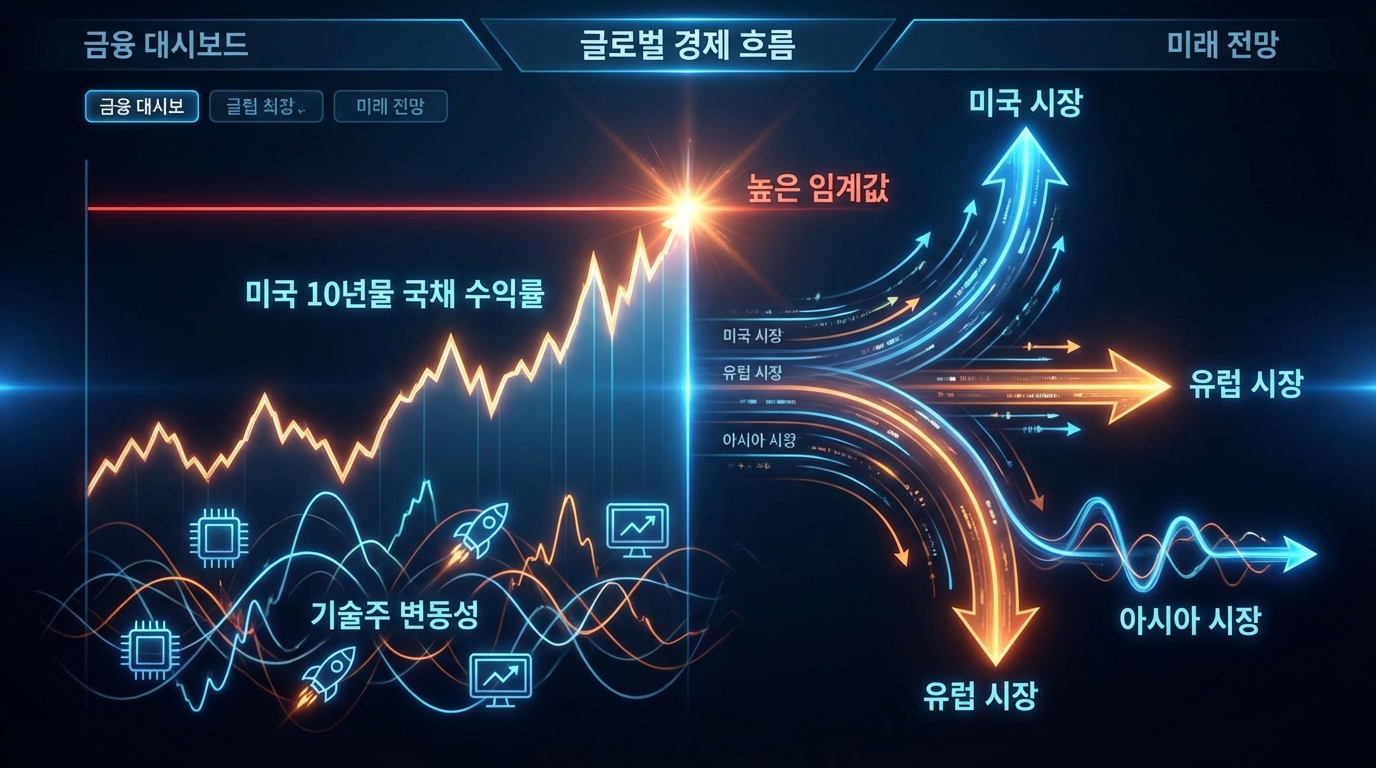
As the US 10-year Treasury yield breaks through the 4.3% level again, a rigorous stress test is underway across tech stocks burdened by high valuations.
Market capital is highly likely to be restructured around "quality tech stocks" that have proven actual cash-generating capabilities, rather than simple growth expectations.
Simultaneously, global liquidity is showing a severe decoupling trend due to the divergence in monetary policies across the three major regions: the US, Europe, and Asia.
The ripple effect of volatility in key commodity prices, such as oil and copper, on the global PMI is also manifesting differently depending on each country's fundamentals.
Current Situation Summary
As of intraday (provisional) on March 23, 2026, the KOSPI is recording 5781.20, KOSDAQ 1161.52, and NASDAQ 21647.61.
The USD/KRW exchange rate is hovering at an intraday (provisional) 1506.50 won, maintaining a high level driven by a strong global dollar and geopolitical tensions.
According to Daily Stock's own Fear & Greed Index, the KOSPI is currently in the Fear (39.1) stage, indicating contracted investor sentiment compared to Fear (28.2) 1 week ago, Neutral (57.3) 1 month ago, and Neutral (46.1) 3 months ago.
The NASDAQ Fear & Greed Index currently stands at Extreme Fear (14.6), suggesting a sharply dominant selling environment compared to Fear (22.6) 1 week ago, Neutral (44.4) 1 month ago, and Fear (21.7) 3 months ago.
Financial Analysis
The rise in the US 10-year yield increases the risk-free rate of return, drastically expanding the financial discount rate for deficit-running tech stocks that rely on future earnings.
Conversely, AI infrastructure companies with solid free cash flow (FCF) and massive order backlogs can exhibit robust defensive capabilities despite increased capital financing costs.
Large European multinational corporations are focusing on managing financial soundness amid slowing demand in China and regional recessionary pressures.
Asia's export-driven manufacturing companies are stepping up to defend their profit margins backed by the high exchange rate environment exceeding the 1,500 won level, though the burden of commodity import prices persists.
[Image: /stdaily/uploads/202603/gen_69c03ded6c3f07.69347157.png]
Valuation
Despite entering an extreme fear zone, the NASDAQ market continues to command a high price-to-earnings (P/E) premium compared to its historical average.
Under the DCF (Discounted Cash Flow) model, stocks with high interest rate sensitivity are structurally bound to face intense valuation compression.
The European stock market has relative valuation downside protection due to a high proportion of cyclical and value stocks, but doubts about structural growth potential act as a discount factor.
The Japanese stock market stands at an inflection point where valuation reassessment will take place depending on the speed of the BOJ's policy pivot, while expectations for governance reform are already priced in.
| Region | Fundamental Characteristics | Key Monetary Policy Stance (As of March 2026) | Valuation Attractiveness & Risks |
|---|---|---|---|
| US | AI-driven growth, concerns over gradual consumption slowdown | Fed's 'Higher-for-longer' vigilance | Premium maintained, correction risk during interest rate tantrums |
| Europe | Sluggish manufacturing PMI, delayed domestic demand recovery | ECB weighing preemptive cuts | Relative undervaluation, limited by lack of growth drivers |
| Asia | Mixed benefits and blows from US-China supply chain realignment | BOJ pursuing normalization vs. PBOC supplying liquidity | Short-term earnings improvement via FX effects, high volatility |
Expert/Institutional Analysis
Major global investment banks diagnose that the recent sell-off in the bond market has dealt an unexpected blow to long-duration equity portfolios.
This signifies the end of the low-inflation, low-interest-rate era formula and marks the beginning of a sorting process where only companies that can afford structurally higher capital costs will survive.
Experts evaluate that while the ECB aims to inject liquidity in response to the sluggish global PMI, concerns over recurrent inflation triggered by high oil prices are holding it back.
Consequently, the prevailing analysis is that the difficulty of global asset allocation has risen extremely as the monetary policies of the US, Europe, and Asia become fragmented according to their respective economic situations.
[Image: /stdaily/uploads/202603/gen_69c03e02ad1462.45338637.png]
Risk Factors
The biggest short-term risk is the potential surge in prices of key commodities, such as Brent crude and copper, due to geopolitical conflicts.
If the commodity supercycle resumes, there is a risk that inflationary pressures will remain sticky, further opening up the upside for US Treasury yields.
Additionally, the possibility of recurring supply chain disruptions causing bottlenecks in advanced tech hardware, such as semiconductors, must be closely monitored.
Coupled with policy uncertainties in major countries, if trade barriers rise, the relative strength of Asian emerging market equities could be severely compromised.
Investment Perspective
Under a prolonged high-interest-rate scenario, it is necessary to be wary of blindly following growth stocks and to compress the portfolio into quality tech stocks with clear earnings visibility.
During periods of heightened volatility in the US stock market, tactical weight adjustments towards defensive value stocks in Europe or specific sectors in Asia expected to benefit from policies can serve as alternatives.
A macro-driven market continues where exchange rate and interest rate movements overwhelm the direction of the stock market.
Therefore, it is a time that demands a conservative and selective approach, prioritizing the assessment of a company's intrinsic fundamentals and cash flow generation capabilities.
Investor Checkpoints Q&A
Q1. Why is the rise in the US 10-year Treasury yield bad news for tech stocks?
Tech stocks, which place heavy weight on future value, see their fair value decline as interest rates rise because the discount rate used to convert future earnings into present value increases. However, quality tech stocks that are already generating massive cash can be relatively immune to such shocks.
Q2. Why are the policies of the ECB, BOJ, and PBOC different from each other?
Europe (ECB) needs an accommodative stance to prevent an economic slowdown, while Japan (BOJ) is attempting to normalize interest rates after escaping deflation. China (PBOC) remains focused on injecting liquidity to overcome a real estate slump and sluggish domestic demand, illustrating the three distinct macroeconomic environments of these three regions.
Q3. What is the impact of rising commodity prices on global stock markets?
Rising oil or copper prices increase corporate production costs and stimulate inflation, reducing central banks' room for interest rate cuts. This restricts the valuation expansion of the broader stock market and serves as a core medium that deepens decoupling depending on country-specific fundamentals.
Q4. The NASDAQ Fear & Greed Index is at 14.6 (Extreme Fear). Is this a buying timing?
An extreme fear reading on the Fear & Greed Index does not guarantee an immediate trend reversal. However, since it implies entering a psychological oversold territory, it can serve as a useful reference indicator from the perspective of accumulating structurally sound companies in installments.
Q5. With the USD/KRW exchange rate in the 1500 won range, how should I strategize my KOSPI investments?
A high exchange rate exacerbates foreign investors' concerns about FX losses, which is disadvantageous for supply and demand. However, it acts favorably in defending the profit margins of export-oriented companies such as automobiles and machinery. Therefore, rather than betting on the broader index, a selective approach focusing on export stocks equipped with global competitiveness while directly enjoying the FX effect is advisable.