Hello, this is Daily Stock.
[Image: /stdaily/uploads/202610/gen_6ac73fc31eb8d3.25304172.png]
Key Summary
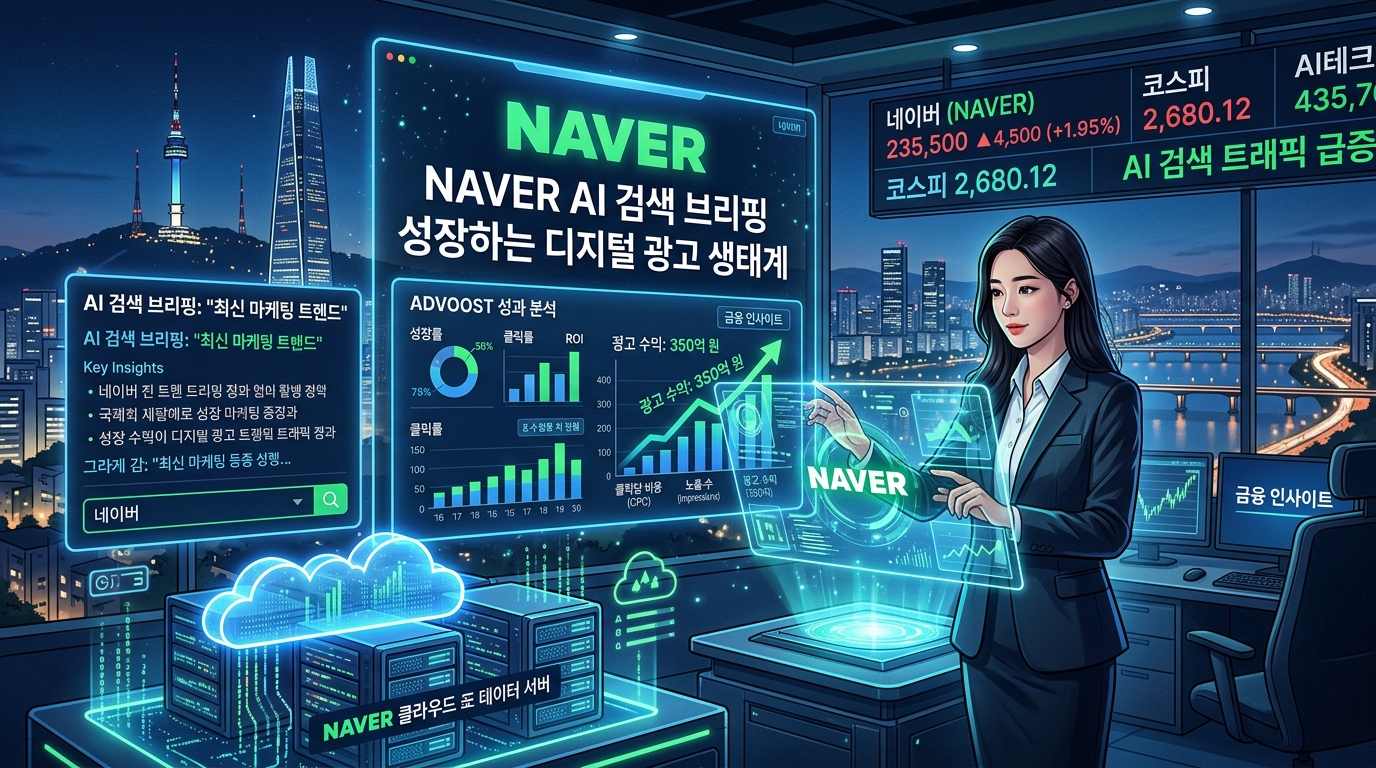
NAVER's (035420) core cash cow, the Search Platform, is demonstrating robust earnings resilience by integrating generative AI search and "ADVoost" precision targeting.
Third-quarter advertising revenue is estimated to maintain solid mid-6% year-over-year growth despite fewer operating days due to the September Chuseok holiday.
Conversely, near-term operating profit expectations are projected to slightly miss consensus due to GPU expansion for AI infrastructure and rising depreciation expenses.
Over the medium to long term, the 200MW Neo Cloud AI Factory partnership and overseas sovereign AI project wins are seen as primary drivers for multiple expansion.
Current Market Context
On October 8, 2026, the domestic stock market closed with the KOSPI at 6,625.93 and the KOSDAQ at 892.27, showing a breather phase amid economic slowdown concerns and heightened volatility in large-cap exporters.
With the USD/KRW exchange rate fluctuating around 1,339.60, foreign institutional investors took profits in cyclical mega-caps like Samsung Electronics and Hyundai Motor, shifting selective attention to large-cap platform names with defensive cash generation capabilities.
According to Daily Stock's proprietary Fear & Greed Index, the KOSPI Fear & Greed Index currently sits in "Fear" at 25, continuing the trend from Fear (34.6) a week ago, Neutral (49.8) a month ago, and Extreme Fear (12.8) three months ago.
The global benchmark Nasdaq is at 27,538.69, with its Fear & Greed Index registering "Neutral" at 44.5—gradually recovering compared to Fear (29) a week ago, Fear (39.1) a month ago, and Neutral (52.9) three months ago.
Against this macroeconomic backdrop, NAVER closed in the low 190,000 KRW range (based on the latest verified figure), testing downside rigidity near its 52-week lows.
Recently, NAVER's Search Platform has continued expanding its "AI Briefing" rollout while establishing a virtuous cycle of feed consumption tailored to user search context.
Even amid competitive search share pressures from global big tech peers, NAVER is executing a structural transition that defends portal dwell time while lifting search ad cost-per-click (CPC) and conversion rates.
[Image: /stdaily/uploads/202610/gen_6ac73fceaf9539.81265896.png]
Financial Analysis
NAVER's Q3 2026 results are expected to reflect two contrasting trends: sustained top-line growth coupled with concentrated short-term cost pressures.
Major domestic brokerage estimates put consolidated Q3 revenue at KRW 3.48 trillion to 3.53 trillion, up approximately 11% year-over-year.
Operating profit is projected between KRW 450 billion and 490 billion, down roughly 14% to 16% year-over-year, which may come in slightly below market consensus (KRW 520 billion to 550 billion).
| Financial Metric | Q3 2025 (Actual) | Q3 2026 (Consensus Estimate) | Estimated YoY Change |
|---|---|---|---|
| **Consolidated Revenue** | KRW 3.1381 trillion | KRW 3.4857T – 3.5300T | +11.1% to +12.5% |
| **Consolidated Operating Profit** | KRW 570.6 billion | KRW 450.4B – 492.5B | -13.7% to -21.1% |
| **Advertising (Search Platform, etc.)** | ~KRW 1.4000 trillion | KRW 1.4866T – 1.4921T | +6.3% to +6.7% |
| **Operating Expenses** | ~KRW 2.5675 trillion | KRW 2.9965T – 3.0190T | +16.7% to +17.6% |
Despite seasonal headwinds and fewer operating days from the Chuseok holiday, the advertising segment is expected to defend a 6% growth rate, powered by its AI-driven ad solution, ADVoost.
The main driver behind the softer operating profit is increased depreciation from forward-looking investments in AI data centers and high-performance GPU acquisitions.
Additionally, one-off and front-loaded second-half marketing expenditures—including offline Npay payment terminal rollouts and sports broadcasting licensing fees—have peaked the expense curve.
Crucially, these cost increases represent tangible upfront investments required to commercialize upcoming AI services, rather than disposable operational burn.
Valuation
NAVER is currently trading near the bottom of its historical band, at roughly 15x 12-month forward price-to-earnings (P/E).
Compared to global tech counterparts like Meta and Alphabet, which trade in the low-to-mid 20x range, NAVER faces a steep discount fueled by weak domestic consumer spending and concerns over AI monetization timelines.
Within the KOSPI 200, multiple rerating for platform growth names has lagged behind semiconductors and financials.
However, once the Bank of Korea's benchmark rate-cutting cycle gains full traction, cash-rich tech growth stocks often lead multiple recoveries.
With domestic trade data indicating a rebound in IT hardware and software demand, signs increasingly point to NAVER finding a firm valuation floor in the second half.
Expert & Institutional Perspectives
Domestic brokerages emphasize that the Q3 profit slowdown has already been well telegraphed to the market.
Hana Securities raised its target price on NAVER from KRW 350,000 to KRW 400,000, arguing that pessimistic concerns are fully priced in.
The firm noted that operating costs will peak in Q3, setting the stage for meaningful synergies as B2C AI agent services integrate with commerce and local ecosystems.
Eugene Investment & Securities maintained a 'Buy' rating and a KRW 320,000 target price, advising investors to look beyond near-term Q3 soft spots and focus on momentum heading into Q4 and beyond.
In particular, the brokerage highlighted the planned 200MW Phase 1 AI factory in partnership with global infrastructure manager Brookfield and Nvidia as a major upside catalyst.
Institutional investors anticipate that interface redesigns centered around AI Briefings will start driving notable search ad CPC gains around 2027, maintaining a long-term accumulation posture.
[Image: /stdaily/uploads/202610/gen_6ac73fda82db41.99752321.png]
Risk Factors
The primary headwind is prolonged weakness in domestic private consumption, which could dampen display ad (DA) demand and e-commerce gross merchandise value (GMV) growth.
While search advertising (SA) remains resilient due to clear purchase intent, sluggish brand advertising could cap top-line momentum.
Second, sustained high USD/KRW levels around 1,339 elevate import costs for foreign cloud solutions and enterprise GPU servers in the short term.
Third, competition from conversational search platforms like OpenAI and Google alongside domestic platform regulatory developments warrant close monitoring.
Investors must also track whether early traffic to AI Briefings effectively expands total surface engagement rather than cannibalizing existing user-generated content (UGC) like Blogs and Cafes.
Investment Takeaway
NAVER is navigating a transitional phase, transforming from a traditional portal search engine into an integrated AI agent and AI factory infrastructure player.
The projected decline in Q3 operating profit stems from a temporary phase of concentrated capital deployment, rather than structural impairment to its underlying fundamentals.
With the KOSPI Fear & Greed Index lingering at 25 in "Fear" territory, current market sentiment offers a contrarian window to evaluate high-quality large caps establishing an earnings trough.
As consensus revisions normalize around the Q3 earnings release, this should help cement a medium-term price floor.
Rather than reacting to short-term earnings pressure, a phased, long-term accumulation strategy appears reasonable given incoming AI data center contracts and projected ad operating leverage into 2027.
FAQ
Q1. What drove the resilient performance in NAVER's Q3 advertising revenue?
The rollout of ADVoost, an AI-powered ad targeting solution, combined with increased personalized feed placements, helped defend revenue against seasonal headwinds by attracting high-converting performance shopping advertisers.
Q2. Why is Q3 operating profit expected to come in below market consensus?
Increased depreciation from GPU investments for AI infrastructure, coupled with marketing costs and expenses related to offline payment terminal rollouts, concentrated heavily in the second half.
Q3. When is generative AI search (AI Briefing) expected to contribute meaningfully to earnings?
The feature is currently focused on summarizing user intent and expanding coverage. Direct commercial monetization via high-intent ad placements within AI search results is expected to ramp up around 2027.
Q4. What is the significance of the Neo Cloud AI Factory partnership?
Through collaborations with Nvidia and capital commitments from global asset manager Brookfield, NAVER plans to commercialize large-scale AI data center infrastructure, accelerating its expansion from a consumer portal into a B2B cloud infrastructure provider.
Q5. How do foreign exchange rates and interest rates impact NAVER's stock?
A high USD/KRW rate increases GPU procurement costs. However, potential Bank of Korea rate cuts could compress the discount rate for high-cash-flow platform growth stocks, driving valuation multiple expansion.