Hello, this is Daily Stock.
[이미지: /stdaily/uploads/202609/gen_6aac38eeda7080.09947323.png]
Executive Summary
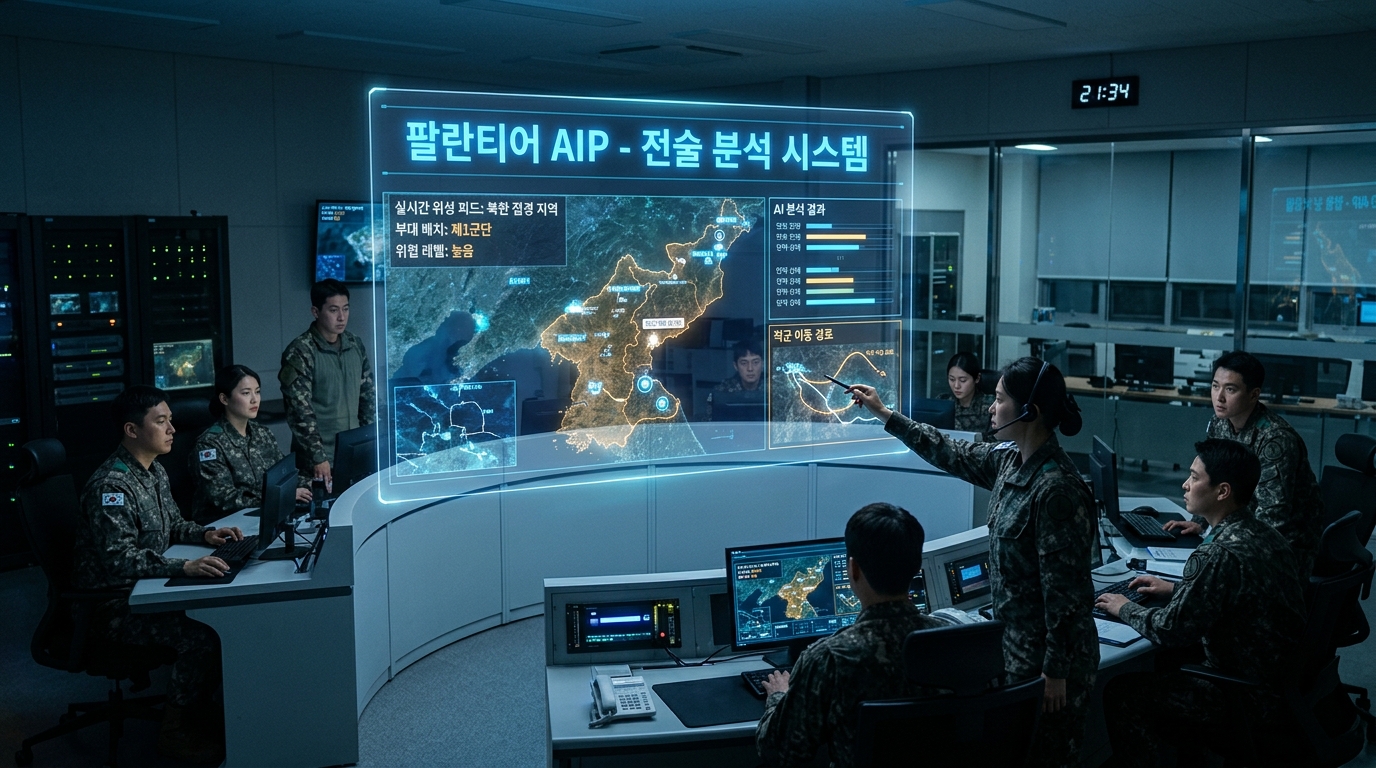
Palantir (PLTR) is accelerating government sector contract wins by deeply integrating its Artificial Intelligence Platform (AIP) into the U.S. Department of Defense's core battlefield command and control architecture.
The transition of the Maven Smart System (MSS) into a formal Program of Record and the move of the TITAN (Tactical Intelligence Targeting Access Node) tactical ground system into mass production provide robust backing for long-term revenue visibility.
Global capital markets are displaying an intensifying tri-regional decoupling: hyper-scale growth among U.S. Big Tech firms tied to national security, Europe defending against economic stagnation amid expanding defense spending, and Asia navigating monetary policy divergences and domestic demand recovery.
As of September 18, 2026, market sentiment has contracted into Fear territory—Nasdaq Fear (26.1) and KOSPI Fear (30.6)—calling for a balanced assessment between proprietary pipeline strength and valuation burdens.
Current Market Overview
Looking at intraday market indicators (provisional) as of September 18, 2026, the KOSPI stands at 6,715.41, the KOSDAQ at 822.18, and the KRW/USD exchange rate is at 1,379.80 KRW.
The U.S. Nasdaq index is currently unconfirmed for intraday quotes (based on the latest confirmed reading).
According to Daily Stock's proprietary Fear & Greed Index, the KOSPI is currently in Fear (30.6), showing heightened caution compared to Neutral (42.5) one week ago, Neutral (52.1) one month ago, and Neutral (40.2) three months ago.
The Nasdaq Fear & Greed Index is also in Fear (26.1), reflecting a sharp cooldown from Fear (32.2) one week ago, Neutral (59.1) one month ago, and Greed (63.8) three months ago.
[이미지: /stdaily/uploads/202609/gen_6aac38f97a82d9.77492876.png]
Palantir has solidified its position as a non-traditional defense IT player by advancing the U.S. Army's TITAN program from prototype evaluation into full-scale mass production.
In particular, a multi-year enterprise framework consolidating more than 75 legacy contracts, coupled with the expansion of the Maven system, serves as a primary pillar of stable cash flows.
Financial Analysis
Following annual revenue of $4.475 billion in FY2025, Palantir has issued FY2026 annual revenue guidance of approximately $8.15 billion, signaling steep top-line expansion.
With the full-scale deployment of AIP—battlefield intelligence fusion software—the government sector's revenue growth rate continues to post robust year-over-year gains of 60% to 80%.
| Metric | 2024 (Confirmed) | 2025 (Confirmed) | 2026 (Annual Guidance/Estimate) | Notes |
|---|---|---|---|---|
| **Annual Revenue** | $2.865B | $4.475B | $8.150B–$8.158B | Reflects upward revision in 2026 guidance |
| **U.S. Gov. Revenue Share** | ~55% | ~54% | ~50%–52% | Driven by parallel rapid commercial growth |
| **GAAP Operating Margin** | Under 1% (Impacted by SARs) | 41% (Q4 basis) | Projected to sustain over 40% | Maximized operating leverage |
| **Free Cash Flow (FCF)** | $517M (Q4) | $791M (Q4 adj.) | Estimated over $800M per quarter | High-margin software licensing |
| **Rule of 40 Score** | 81% | 127% | Sustaining above 100% | Combined sum of growth rate and margin |
As military operational templates and sensor fusion technologies integrate into a single unified solution, post-deployment maintenance margins have scaled dramatically.
Consequently, the operational leverage of an exclusive defense software supplier—rather than a simple outsourced developer—is directly reflected across its financial statements.
Valuation
Palantir's forward 12-month price-to-sales (Forward P/S) multiple sits between 35x and 40x, commanding a steep premium compared to traditional defense contractors and general SaaS peers.
This premium is underpinned by the lock-in effect stemming from its inclusion in the U.S. Department of Defense's formal Program of Record budget lines, along with annual revenue growth guidance exceeding 80%.
Comparing cross-regional valuations, the U.S. S&P 500 and core AI players are attempting to justify elevated multiples through overwhelming capital concentration.
In contrast, Europe's aerospace and defense sector, despite rising NATO budgets, sees its broader equity index capped at a 12-month forward P/E of 13x to 14x due to manufacturing PMI weakness.
In Asia, domestic deflationary pressures persist despite liquidity easing from China, while Korean and Japanese markets face constraints in valuation re-rating amid semiconductor supply dynamics and the strengthening Japanese yen, reflecting divergent regional patterns.
Expert & Institutional Analysis
Major Wall Street research institutions praise Palantir's dominance over defense AI infrastructure, but they also highlight short-term share price volatility stemming from valuation sensitivity.
Firms such as Morgan Stanley and Goldman Sachs have noted that while the pace of government contract awards outstrips standard procurement cycles, performance volatility could widen depending on quarterly revenue recognition timing.
On the global macro front, monetary policy decoupling is exerting a multifaceted impact.
While the European Central Bank (ECB) maintains an accommodative stance to defend against recession, the Bank of Japan (BOJ) continues to contemplate rate hikes, stirring caution around yen carry trade unwinds.
Despite liquidity easing by the People's Bank of China (PBOC), key commodity prices such as copper and crude oil remain range-bound on global demand slowdown concerns, further concentrating liquidity into ultra-safe assets and U.S. defense-tech equities.
Risk Factors
The primary internal risk involves friction in U.S. congressional budget negotiations and delays in defense appropriations fiscal-year approvals.
Even with tactical AI platforms holding high priority, a prolonged Continuing Resolution (CR) environment poses the risk of delays in new contract outlays.
[이미지: /stdaily/uploads/202609/gen_6aac3904a70518.75541382.png]
Geopolitical risks and hardware supply chain disruptions cannot be ruled out.
Scaling production for integrated tactical hardware such as the TITAN system directly depends on the availability of high-performance defense-grade semiconductors and edge computing hardware.
Should global supply chain bottlenecks re-emerge, system delivery delays and cost increases could follow.
Investment Perspective
Palantir is a leading enterprise demonstrating the most visible cash-flow generation capability in this structural transition where national security intersects with AI.
However, the current macroeconomic environment exhibits risk-off sentiment, evidenced by KOSPI Fear (30.6) and Nasdaq Fear (26.1).
Accordingly, rather than chasing short-term momentum, a phased approach tracking quarterly DoD budget execution figures and commercial AIP penetration rates is advisable.
Even for an enterprise with proprietary moats and robust cash flows, taking a measured approach by monitoring technical support levels during periods of multiple contraction remains prudent.
Frequently Asked Questions
Q1. How does Palantir's Maven Smart System (MSS) differ from conventional military systems?
It is a next-generation tactical operating system that leverages AI to fuse distributed sensor data from satellites, drones, and radars in real time, identifying enemy targets and instantly recommending strike priorities to battlefield commanders.
Q2. What financial significance does a U.S. Department of Defense 'Program of Record' designation hold?
Unlike one-off experimental R&D initiatives, it elevates the program into a permanent procurement line item formally mandated in the DoD's annual base budget, ensuring stable and recurring multi-year contract payments.
Q3. What synergies exist between commercial (AIP) growth and the government sector?
Large Language Model (LLM) orchestration capabilities proven in commercial enterprises are rapidly ported into defense-grade security environments, while clearance across stringent defense security standards builds institutional trust for commercial enterprise adoption, creating a virtuous cycle.
Q4. Why do U.S. defense-tech companies hold a relative advantage in a tri-regional decoupled market?
Compared to Europe's fiscal constraints and low growth, alongside Asia's currency and economic uncertainties, the U.S. commands unmatched fiscal and technological dominance, enabling sustained, massive capital deployment into national security infrastructure.
Q5. What volatility factors should be monitored under the current Fear & Greed levels?
In a Nasdaq Fear (26.1) regime, profit-taking can occur even on strong earnings beats due to high multiple expansion. Investors should closely track U.S. congressional budget deliberation schedules and the stabilization of global liquidity metrics.