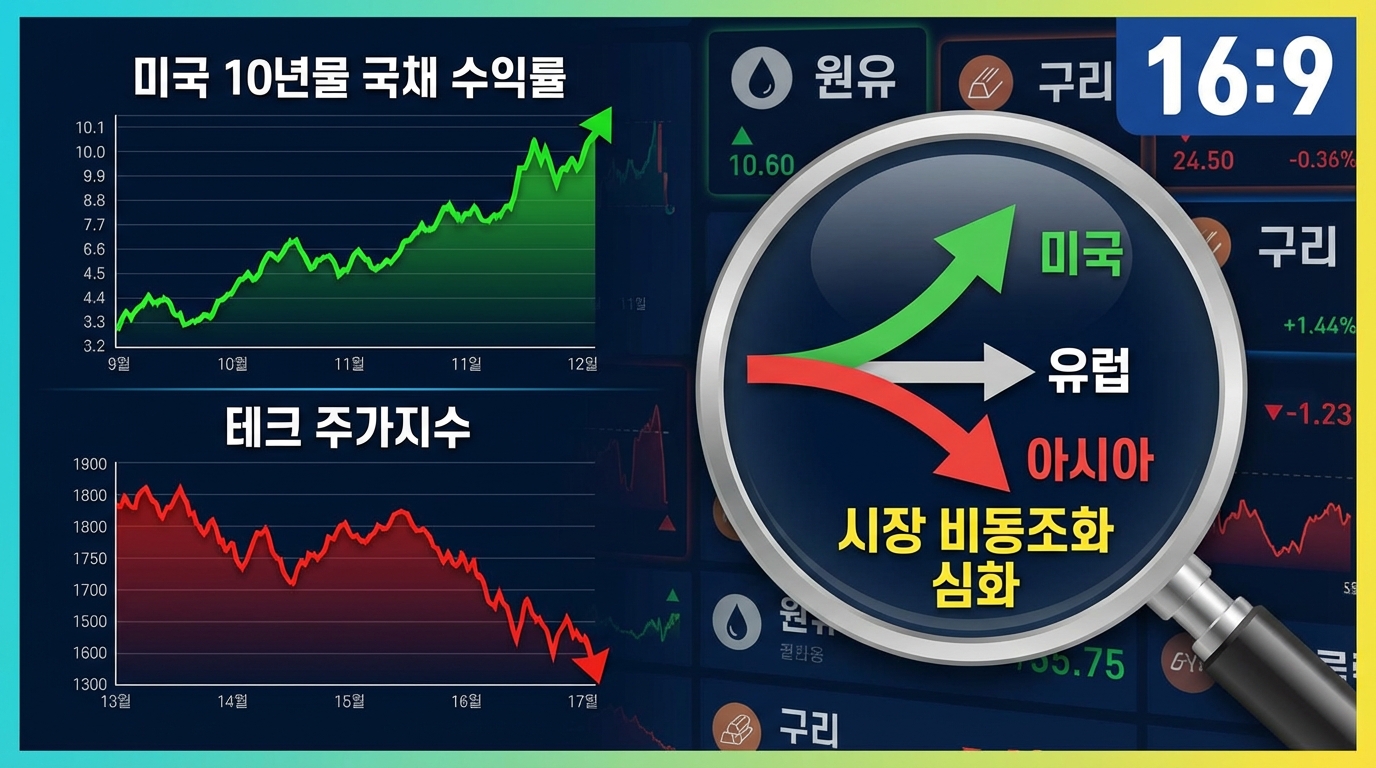
Today, the US 10-year Treasury yield is shaking up tech stock valuations amid overlapping global geopolitical tensions and raw material supply chain instability.
Key Summary
Valuation pressure is intensifying across global tech stocks, including the NASDAQ, as the US 10-year Treasury yield rises due to concerns over sticky inflation.
Supply chain disruptions in key raw materials like oil and copper act as inflation catalysts, while the fundamental decoupling trend among the US, Europe, and Asia is becoming more pronounced.
Current Situation Summary
[Image: /stdaily/uploads/202603/gen_69beec29a23d62.35310883.png]
As of intraday trading on the Korean market on March 22, 2026 (provisional), the KOSPI is recording 5,781.20, and the KOSDAQ is at 1,161.52.
The NASDAQ index stands at 21,647.61, and the USD/KRW exchange rate is showing high volatility at 1,506.50.
According to our proprietary Fear & Greed Index, the KOSPI is currently in Fear (39.1), 1 week ago Fear (28.2), 1 month ago Neutral (57.3), and 3 months ago Neutral (46.1).
The NASDAQ Fear & Greed Index is currently at Extreme Fear (14.6), 1 week ago Fear (22.6), 1 month ago Neutral (44.4), and 3 months ago Fear (21.7), indicating a rapid cooling of investor sentiment.
Financial Analysis
US tech stocks face a double whammy of high borrowing dependency and burdensome future cash flow discount rates, raising possibilities of a slowdown in earnings growth.
In contrast, major European defensive and financial stocks possess financial structures relatively resilient to interest rate hikes, showing stable margin defenses compared to US tech stocks.
In the Asian market, infrastructure stimulus measures centered on China are expected, but rising oil and copper prices are exacerbating the cost burden for manufacturing-based companies.
For copper, declining grades and geopolitical issues have driven up production costs, which could increase the capital expenditure burden on global AI data centers and hardware companies that consume it in large quantities.
Valuation
[Image: /stdaily/uploads/202603/gen_69beec3f405451.90852227.png]
The US stock market, led by the NASDAQ, still maintains high P/E ratios compared to historical averages, posing the greatest risk of valuation contraction when Treasury yields rise.
Despite the sluggish recovery of the global manufacturing PMI, the European stock market is defending its relative undervaluation appeal through a value stock-oriented composition.
Advanced Asian stock markets, such as Japan, are narrowing their valuation discount gap against the US, driven by corporate governance improvement effects amid a gradual interest rate normalization stance.
| Region | Valuation Characteristics | Macro Correlated Variables | Central Bank Policy Stance (Latest) |
|---|---|---|---|
| US | Intensifying overvaluation pressure centered on tech stocks | 10-year Treasury yield, global liquidity contraction | Prolonged tightening due to high inflation |
| Europe | Defensive resilience centered on value/financial stocks | Energy price volatility (e.g., oil) | Cautious approach balancing inflation and growth |
| Asia | Intersecting manufacturing cost burdens and policy expectations | Copper prices, global supply chain recovery | BOJ gradual normalization vs. PBOC liquidity provision |
Expert & Institutional Analysis
Major global investment institutions assess that the US Federal Reserve's prolonged high-interest rate stance will create downward rigidity for 10-year yields, placing continuous pressure on tech stocks.
The dominant analysis is that the European Central Bank (ECB) is taking a cautious stance between economic growth slowdown and inflation, while the Bank of Japan (BOJ) attempts to defend against yen weakness through gradual monetary policy normalization.
Meanwhile, the People's Bank of China (PBOC) continues its accommodative liquidity provision to boost domestic demand, leading to assessments that a clear policy decoupling among global central banks is deepening.
Wall Street experts warn that geopolitical risks originating from the Middle East could push up prices of key raw materials like international oil and copper, stimulating concerns about global stagflation.
Risk Factors
[Image: /stdaily/uploads/202603/gen_69beec549a0c70.93816633.png]
If geopolitical instabilities, such as military tensions in the Middle East and the Strait of Hormuz crisis, cause oil prices to spike, controlling global inflation could become even more difficult.
Supply chain disruptions of critical minerals, including copper, represent significant risk factors that could slow the pace of the energy transition and AI infrastructure buildout, compressing tech companies' margins.
If the monetary policy decoupling among the US, Europe, and Asia triggers herd behavior in the foreign exchange market, the possibility of capital outflows from emerging markets cannot be ruled out.
Investment Perspective Summary
During a period of rising US 10-year Treasury yields, it may be rational to adopt a strategy of condensing portfolios into companies with high earnings visibility and abundant free cash flow.
In light of the global policy decoupling trend, regional diversification into European defensive stocks with low interest rate sensitivity or Asian value-up related stocks benefiting from policies is discussed as an alternative.
As raw material price volatility increases, thorough risk management is required by adjusting the weighting of consumer staples or raw material-related assets capable of hedging against inflation.
Investor Checkpoint Q&A
Q1. What is the specific impact of the US 10-year Treasury yield on tech stocks?
The 10-year yield serves as the benchmark for the discount rate used to convert a company's future earnings into present value.
Therefore, as interest rates rise, the fair value of tech stocks with high future growth value mechanically declines.
Q2. How is the rise in copper and oil prices related to the decoupling of the tri-region stock markets?
The US has high energy independence, so the impact may be limited; however, Europe, which imports energy, and Asian countries with manufacturing bases and high raw material demand, face immediate cost increases.
This causes the degree of fundamental and corporate earnings damage to vary by country, resulting in regional stock price differentiation.
Q3. Why is the US NASDAQ market currently in an 'Extreme Fear' phase?
Amid accumulated valuation burdens, unexpected macro shocks—such as a spike in the 10-year yield and raw material supply chain disruptions—have overlapped.
The rapid freezing of investor sentiment occurred because these adverse events were concentrated in a short period.
Q4. Why are the policy directions of major central banks different from one another?
While the US maintains tightening in response to robust employment and sticky inflation, Europe is in a situation where it must defend against recession risks.
In addition, countries have completely different fundamental situations, such as China needing to supply liquidity to overcome domestic demand stagnation.
Q5. What are the key indicators investors should pay the closest attention to at this point?
The US 10-year Treasury yield, which dictates global liquidity flows, and oil and copper prices, which act as leading indicators of inflation, can be highlighted.
Furthermore, portfolios should be adjusted while closely monitoring changes in the manufacturing PMI, which reflects the real economy of each country.