Hello, this is Daily Stock, analyzing market macro contexts and structural corporate transformations.
[Image: /stdaily/uploads/202609/gen_6aace197490841.39047768.png]
Key Takeaways
SK Innovation has officially launched a horizontally integrated corporation with its lucrative unlisted affiliate SK E&S, completing its reorganization into a mega energy holding company with 100 trillion won in assets.
This merger is interpreted as a core rebalancing strategy designed to alleviate the prolonged capital expenditure (CAPEX) burden of its battery subsidiary SK On and address structural funding thirst.
With the steady earnings before interest, taxes, depreciation, and amortization (EBITDA) generation from SK E&S's LNG power generation and city gas businesses now consolidated, the downside support line for consolidated cash flow has become clearer.
Furthermore, subsequent corporate restructuring involving SK On and SK Enmove alongside preemptive capital expansion are mitigating debt levels and liquidity risks.
Current Market Context
On September 18, 2026, domestic equity markets concluded regular trading at 6,894.23 for KOSPI and 827.12 for KOSDAQ amid caution over internal and external monetary policies and exchange rate volatility.
As the USD/KRW exchange rate maintained an elevated level at 1,383.30 won, foreign institutional flows remained selective, predominantly focusing on semiconductors and financials.
According to the Daily Stock Fear & Greed Index, KOSPI Fear & Greed currently sits at Neutral (41.7), maintaining a wait-and-see stance without clear directional momentum compared to 1 week ago (42.5), 1 month ago (52.1), and 3 months ago (40.2).
The Nasdaq Fear & Greed Index, a barometer for global markets, currently hovers in Fear (28.5) territory, reflecting prevailing conservative investor sentiment across large-scale capital-intensive process industries.
SK Innovation's market price is currently unconfirmed for the day (based on latest verified prints), but corporate valuation reassessments are progressing according to post-merger earnings trends.
Fluctuations in oil prices and refining margins in the petroleum division, combined with the sustainability of operating turnarounds in the battery division, are jointly shaping share price volatility.
[Image: /stdaily/uploads/202609/gen_6aace1a2038291.69202313.png]
Financial Analysis
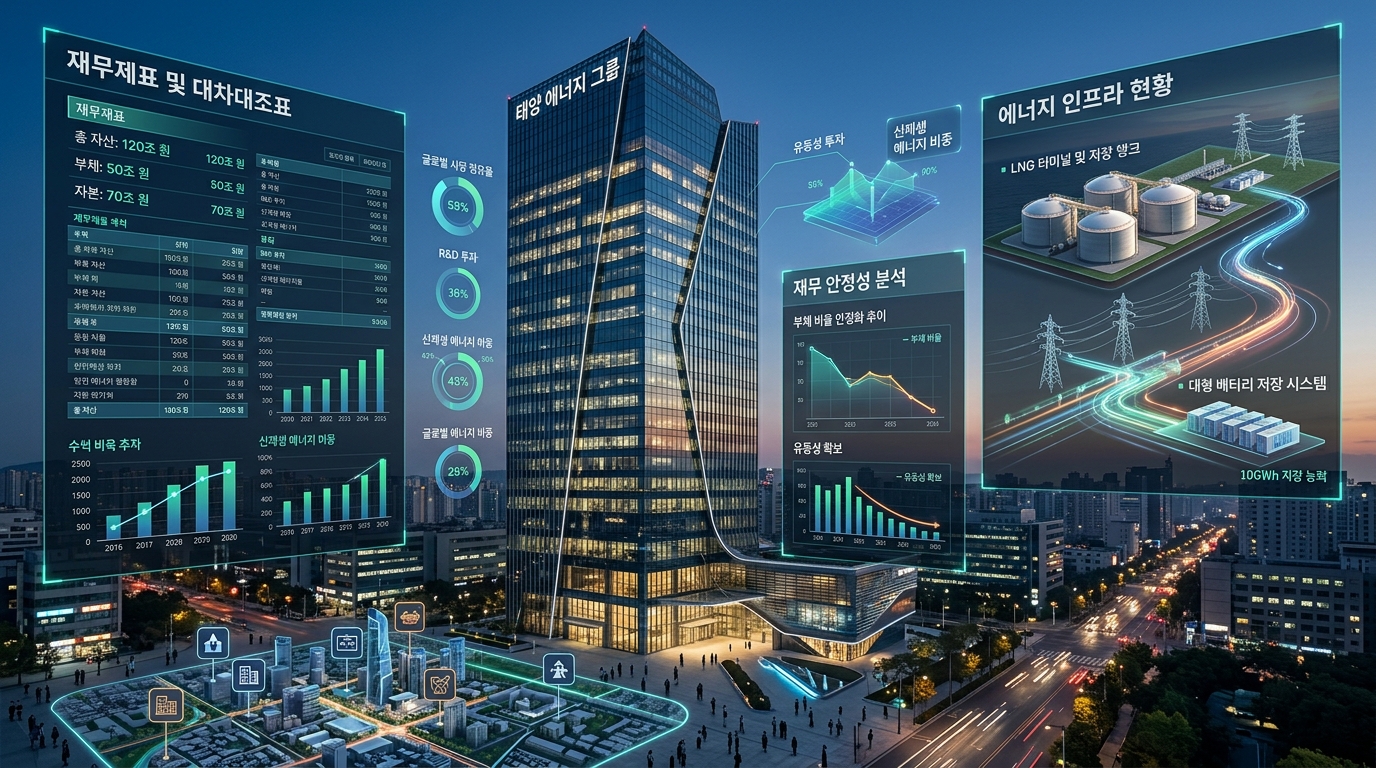
The most significant financial change for the combined entity is that over 1 trillion won in recurring annual EBITDA has reinforced a cash flow historically vulnerable to cyclical refining and chemical market swings.
SK E&S's business structure, centered on city gas and power generation, functions as a buffer guaranteeing resilient operating cash generation even during macro economic slowdowns.
Moreover, the integration of lubricants affiliate SK Enmove and non-core asset disposals pursued to secure liquidity for SK On are contributing to reduced debt obligations.
By gradually lowering leverage ratios and bolstering equity capital, the company has preemptively protected itself against credit rating downgrade pressures that had been spilling across group entities.
| Business Segment / Category | Pre-Merger Characteristics | Post-Merger & Rebalancing Changes |
|---|---|---|
| Legacy SK Innovation | High refining/petrochemical cyclicality, rising SK On CAPEX load | Secured dividend and cash buffer at holding level |
| SK E&S Integration Impact | Unlisted energy affiliate, ~1 trillion won operating profit | Immediate consolidated EBITDA boost, reached 100T won assets |
| Battery Axis (SK On) | EV chasm headwinds and surging accumulated debt | Reinforced standalone viability via SK Enmove merger & capital raise |
| Medium/Long-Term Financial Target | Persistent credit concerns from expanding net debt | Established target for 20T won EBITDA by 2030 and managed debt |
This portfolio restructuring may trigger an inflection toward net debt reduction as major capital expenditures pass their peak.
Assessments indicate the inflection point where operating cash flows can organically cover CAPEX requirements is drawing nearer.
Valuation
Historically, SK Innovation traded in a deep discount range near 0.5x PBR, weighed down by holding company discounts and deficits at operating subsidiaries.
Compared to peer large-cap energy and chemical constituents in the KOSPI 200, financial risks stemming from battery CAPEX outlays served as the primary driver of this discount.
However, the transition into an integrated energy conglomerate with 100 trillion won in assets offers grounds for a utility premium beyond a traditional refiner classification.
Valuation multiples, which trail major global integrated energy peers (global oil majors and integrated utilities), possess room for rerating alongside improved cash flow stability.
Nevertheless, equity dilution from new merger shares and financial costs associated with preferred share redemptions remain variables constraining the expansion of book value per share (BPS).
Consequently, key prerequisites for valuation rerating rely on normalized net income via subsidiary turnaround and the resumption of sustainable dividend distributions.
Expert & Institutional Analysis
Securities analysts and credit rating agencies predominantly view this transaction not merely as temporary liquidity relief, but as a long-term cash flow redesign.
Stable cash generation from the E&S unit has severed the conduit through which SK On's debt repayment and capital procurement burdens excessively spilled over to the parent.
Conversely, market experts warn that capital financing mechanisms utilizing Price Return Swaps (PRS) and mezzanine structures could present potential overhang risks.
Institutional flows point to the entity's enhanced defensive profile relative to pure-play secondary battery cell makers within KOSPI's mega-cap space.
Foreign investors remain prudent about scaling up allocations to heavy capital-goods industries due to currency depreciation risks amid the elevated USD/KRW 1,380 range.
Whether borrowing costs stabilize downward in step with Bank of Korea monetary policy directions will serve as a key yardstick for institutional long-term allocation decisions.
[Image: /stdaily/uploads/202609/gen_6aace1ad3c9036.03410909.png]
Risk Factors
Potential declines in crude oil prices and refining margins triggered by global economic deceleration and contracting trade volumes remain the primary operational risks.
Weak demand for intermediate goods in Korea's export-import data would inevitably suppress petrochemical utilization rates and compress crack spreads.
A prolonged chasm (temporary demand plateau) in the electric vehicle market also represents a critical variable that could delay the recovery of battery plant operating rates.
Even with cash generation from SK E&S supporting the base, delayed turnaround in batteries carries the risk of prolonged earnings erosion.
Foreign exchange volatility impacting raw material import costs and mark-to-market translation losses on substantial foreign currency-denominated debt also pose balance sheet risks.
If financial costs stay elevated longer than expected amid domestic and external monetary policy uncertainty, the pace of cash flow recovery could decelerate.
Investment Perspective
Through the SK E&S merger, SK Innovation has established a near-term liquidity firewall and completed an extensive portfolio spanning the energy value chain.
The ultimate success of this financial rebalancing is now transitioning from external support mechanisms to proving the core operational competitiveness of each business unit.
With KOSPI sentiment remaining in neutral territory and liquidity narrowing into select large caps, sustained earnings defensiveness is likely to support downside share price stability.
A gradual valuation recovery appears viable under scenarios where refining margins stage a mild recovery and the battery segment firms up sustained quarterly operating profitability.
FAQ
Q1. What was the main objective of the merger between SK Innovation and SK E&S?
A. The transaction aims to alleviate the heavy CAPEX burden of battery subsidiary SK On and bolster the consolidated financial soundness of the group's broader energy business by combining with cash-generative SK E&S.
Q2. Are there lingering concerns regarding shareholder value dilution from this merger?
A. Because new shares were issued during the merger, initial concerns existed regarding short-term dilution of earnings per share (EPS) and book value per share. However, the immediate consolidation of over 1 trillion won in recurring annual operating profit provides a cash flow boost that structurally offsets this impact.
Q3. How is the financial restructuring of subsidiary SK On progressing?
A. SK On is pursuing balance sheet reinforcement and EBITDA enhancement simultaneously by resolving to merge with profitable affiliate SK Enmove and executing extensive capital expansion initiatives.
Q4. How do macro environments (FX rates and oil prices) affect financial performance?
A. A higher USD/KRW rate increases raw crude import cost burdens, though it can partially benefit KRW-converted revenues for export-heavy product lines. Falling oil prices may incur temporary inventory valuation losses, but if refining margins hold firm, underlying refining fundamentals can remain intact.
Q5. What are the key metrics investors should monitor moving forward?
A. Key indicators include consolidated net debt reduction trends, the resilience of refining margins, and the battery division's ability to maintain sustainable quarterly operating profitability.