Hello, this is Daily Stock, delivering sharp analysis on key trends and supply-demand dynamics in domestic and global financial markets.
Summary
[Image: /stdaily/uploads/202606/gen_6a1fd157344102.21984185.png]
Driven by tailwinds in the global AI semiconductor industry and expectations for robust earnings, Samsung Electronics' stock price has broken its all-time high, settling comfortably in the 360,000 won range.
However, foreign investors are showing a contrasting trend, posting an 18-day consecutive net selling streak to adjust portfolio weights and secure capital ahead of major U.S. IPOs.
Current Situation Overview
On Wednesday, June 3, 2026, the South Korean stock market is closed for local elections. However, on the preceding trading day of June 2, the KOSPI index closed at 8,801.49, up 0.15% from the previous day, breaking its all-time closing high for the third consecutive trading session.
On this day in the KOSPI market, foreigners dumped a massive 6.5555 trillion won worth of shares, extending their net selling streak that began on May 7 to 18 consecutive trading days.
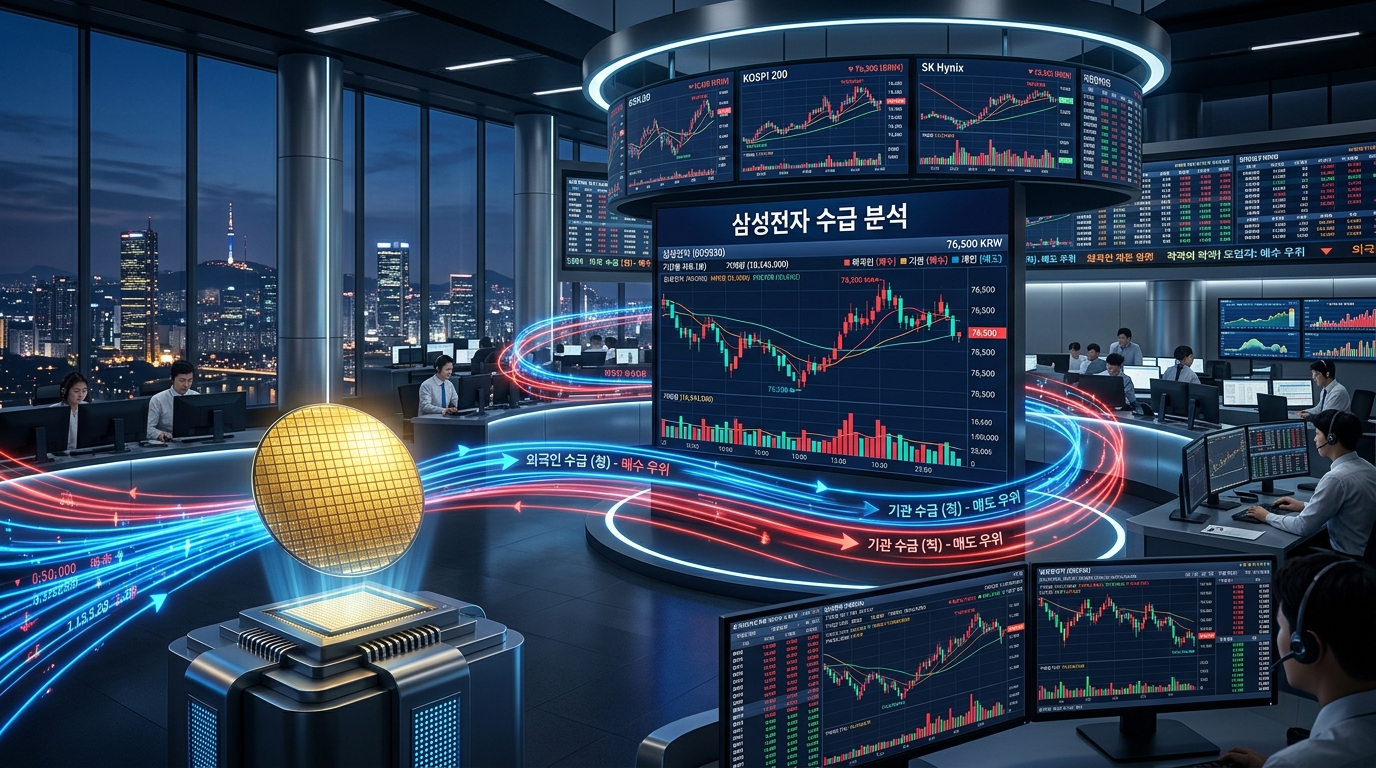
Despite the heavy foreign selling, Samsung Electronics—the focal point of this supply-demand concentration—closed at 360,500 won, up 3.30% from the previous day, bolstered by strong buying from retail and institutional investors.
Analysts suggest that the foreign selling is not a reflection of deteriorating fundamentals in the Korean economy, but rather a technical rebalancing act to mechanically trim Korean exposure after semiconductor stock prices surged.
In particular, ahead of the $1.8 trillion initial public offering (IPO) of SpaceX, the world's largest space enterprise scheduled for June 12, global mega-funds are believed to be prioritizing profit-taking on major domestic semiconductor stocks to raise investment capital.
Amid this supply-demand gap, the domestic market is displaying a unique pattern where the index floor is supported by a debt-driven investing boom—primarily led by wealthy investors in their 40s—flocking into the recently launched 2x single-stock leverage ETFs of Samsung Electronics and SK Hynix.
Financial Analysis
Regardless of foreign capital outflows, the securities industry evaluates Samsung Electronics' intrinsic fundamentals and earnings power to have reached historic highs.
Driven by an unprecedented surge in global memory semiconductor prices, optimistic forecasts suggest that Samsung Electronics' Q2 2026 operating profit could surge by 74% quarter-on-quarter, nearing 100 trillion won.
This is attributed to explosive demand for enterprise solid-state drives (eSSDs) and sharp increases of 50% to over 70% in the fixed transaction prices of legacy DRAM and NAND flash, respectively.
| Category | Q1 2026 (Actual) | Q2 2026 (Forecast) | Change (QoQ) | Key Drivers |
|---|---|---|---|---|
| Samsung Electronics Operating Profit | Approx. 57.5T KRW | Approx. 100T KRW | +74.0% | Sharp rise in legacy DRAM/NAND prices & strong eSSD performance |
| SK Hynix Operating Profit | Approx. 37.4T KRW | Approx. 71T KRW | +90.0% | Early capture of HBM4 market & explosive enterprise SSD demand |
| Legacy DRAM Price Increase | - | +55% ~ +58% | - | Global data center and AI server expansions |
| NAND Flash Price Increase | - | +70% ~ +73% | - | Price hikes driven by persistent eSSD supply shortages |
Valuation
On June 1, Samsung Electronics' market capitalization surpassed the milestone of 2,000 trillion won for the first time in domestic stock market history, with its stock price establishing a new range at the 360,000 won level.
While absolute figures for the Price-to-Earnings Ratio (PER) and Price-to-Book Ratio (PBR) have risen compared to historical averages, the consensus remains that the stock is undervalued compared to global peers, considering its astronomical quarterly earnings capacity of nearly 100 trillion won.
Some major brokerages have significantly raised their target price for Samsung Electronics from 500,000 won to a market-high of 610,000 won, signaling ample room for further upside.
Currently, the average target price consensus for Samsung Electronics among major domestic brokerages stands at approximately 401,250 won, indicating further upside from the current share price.
Expert & Institutional Analysis
Financial investment experts are focusing on Nvidia CEO Jensen Huang's keynote speech at 'GTC Taipei 2026', where he formalized the integration of Samsung Electronics' HBM4.
Analysts point out that Samsung Electronics' early reclamation of technological leadership—such as supplying 12-layer samples of its 7th-generation HBM, 'HBM4E', to global customers—acted as a decisive momentum booster for its stock re-rating.
[Image: /stdaily/uploads/202606/gen_6a1fd1639aee01.80290910.png]
However, experts advise caution regarding whether the current 'solo rally', where the KOSPI index rises despite record foreign selling, is a healthy trend that strengthens the market's overall foundation.
The Daily Stock Fear & Greed Index currently marks 'Neutral (58.3)', indicating that despite the index surge, market participants' sentiment remains a cool, wait-and-see attitude rather than overheating.
This is due to an extreme decoupling effect where the tech-heavy rally has completely isolated the KOSDAQ index (1026.03), where many small- and mid-cap stocks are concentrated.
Risk Factors
The most immediate risk is the upcoming SpaceX listing scheduled for June 12, creating a persistent 'liquidity black hole' scenario that could trigger additional selling and capital outflows from Korea by global mega-funds.
In addition, the stubbornly high USD/KRW exchange rate (1,526.00 won) raises concerns over foreign exchange losses for foreign investors, acting as a major hurdle to their return to net buying.
On the domestic front, prolonged labor-management conflicts regarding performance bonuses and wage structures, along with the potential for production disruptions, continue to trigger short-term volatility.
Lastly, Chinese semiconductor firms such as ChangXin Memory Technologies (CXMT) and Yangtze Memory Technologies (YMTC) are accelerating facility expansions backed by government subsidies, which could revive oversupply concerns in the legacy memory market in the second half of this year.
Investment Perspective Summary
In conclusion, Samsung Electronics possesses robust earnings power backed by an overwhelming semiconductor upcycle and early positioning in the next-generation HBM market, significantly reducing doubts about its long-term growth.
However, a conditional approach is required, which includes closely monitoring where global funds will rebalance before and after the SpaceX listing, and when foreign capital might turn back to net buying amid the strong greenback hovering in the 1,500 won range.
In the short term, liquidity inflows from retail investors via single-stock leverage ETFs will support the downside, but a complete structural uptrend will ultimately require a turn to net buying by foreign investors.
Investor Checklist Q&A
Q1. What is the primary reason behind the massive, consecutive selling of Samsung Electronics by foreigners?
A1. Rather than a decline in the fundamentals of the Korean market, it is driven by technical rebalancing to trim exposure after the sharp stock surge and to secure cash ahead of the SpaceX IPO scheduled for June 12.
Q2. Is the drop in foreign ownership to the 48% range critical for the stock price?
A2. Although the ownership rate fell to a yearly low of 48.42%, strong institutional and retail demand, along with optimistic earnings forecasts, has supported the downside, creating a unique market dynamic that has pushed the stock to record highs.
Q3. What is the Q2 2026 earnings forecast for Samsung Electronics?
A3. Driven by the broad surge in DRAM and NAND flash prices, securities firms estimate that quarterly operating profit will see an astronomical jump of about 74% quarter-on-quarter to around 100 trillion won.
Q4. Why is the news of Nvidia's next-generation accelerator production positive for Samsung Electronics?
A4. At GTC Taipei 2026, CEO Jensen Huang officially declared the integration of Samsung Electronics' HBM4 in Nvidia's next-generation AI accelerators, completely resolving long-standing market concerns over Samsung's high-bandwidth memory technology.
Q5. Is it safe for retail investors to invest in single-stock leverage ETFs of Samsung Electronics?
A5. Although a large amount of leverage-driven capital, particularly from investors in their 40s, has flowed into the recently launched 2x leverage products, investors must carefully consider short-term tracking errors and volatility risks, especially with the USD/KRW exchange rate remaining high at 1,526.00 won.