Welcome to Daily Stock, providing key market trends with verified data and deep insights.
Core Summary
[Image: /stdaily/uploads/202605/gen_6a13f3d2a6c6c9.56403385.png]
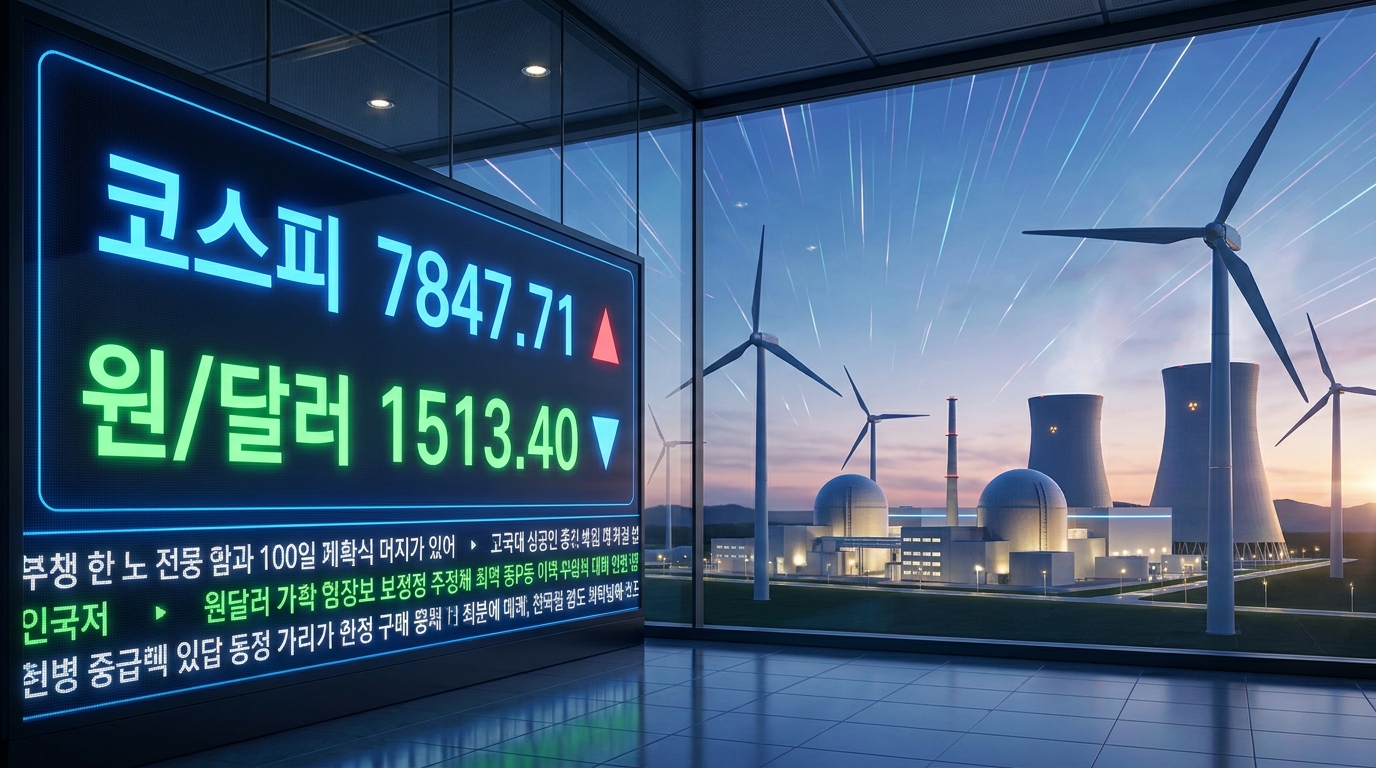
As of the market close on May 25, 2026, despite the burden of the exchange rate surpassing 1,510 KRW, the KOSPI index recorded 7,847.71, showing a solid trend centered on large-cap stocks.
In particular, large construction companies, traditionally classified as domestic demand industries, are leaping forward as global energy platform companies focusing on SMRs (Small Modular Reactors) and inducing new supply and demand within the KOSPI 200.
Current Situation Summary
As of today's closing price on May 25, 2026, the KOSPI closed at 7,847.71 and the KOSDAQ at 1,161.13.
Due to the aftermath of rising US Treasury yields, the KRW/USD exchange rate soared to 1,513.40 KRW, increasing the selling pressure from foreign investors in both the spot and futures markets.
As this ultra-strong dollar phenomenon coincides with solid Korean export trends, the Bank of Korea is highly likely to delay the timing of interest rate cuts and maintain a hawkish freezing stance.
As a result, construction companies heavily reliant on the domestic housing market are experiencing difficulties in raising funds. In contrast, large-cap construction stocks in the KOSPI 200 equipped with strong capital power are turning their eyes overseas, showing relative strength compared to small and medium-sized stocks.
According to the proprietary Daily Stock Fear & Greed Index, market sentiment has entered a somewhat cautious phase.
The KOSPI Fear & Greed Index is currently Neutral (57.3), slowing down from Neutral (58.9) a week ago, Greed (64.8) a month ago, and Greed (63.4) three months ago.
The NASDAQ Fear & Greed Index is also currently recording Neutral (58.6), indicating lowered volatility compared to Greed (63.2) a week ago, Greed (68.5) a month ago, and Greed (66.8) three months ago.
Financial Analysis
[Image: /stdaily/uploads/202605/gen_6a13f3e9588609.70161929.png]
Hyundai E&C is rapidly restructuring its profit structure beyond simple housing construction into an energy infrastructure platform.
This year, targeting the North American market, the company is expected to drive external growth by activating an order pipeline worth up to 24 trillion KRW, including the Palisades SMR and the Fermi large nuclear power plant.
GS E&C recorded 2.4005 trillion KRW in revenue and 73.5 billion KRW in operating profit as of the first quarter of this year, demonstrating stable performance that slightly exceeds market consensus.
Although revenue in the housing sector has shrunk, the company is solidly building its fundamental strength by securing 6.3105 trillion KRW in new orders from core domestic urban renewal projects in areas like Seongsu and Seongbuk from January to April.
| Company Name | 2026 Key Financial & Order Momentum | Core Fundamental Change Factors |
|---|---|---|
| Hyundai E&C | Standby for up to 24 trillion KRW order pipeline for North American nuclear plants | Full-scale two-track strategy for large nuclear power plants (FEED) and SMRs |
| GS E&C | Q1 2026 Operating Profit of 73.5 billion KRW (YoY increase) | Exploring opportunities to participate in large-scale overseas nuclear EPCs like Vietnam |
Valuation
The current record-breaking exchange rate environment of 1,513.40 KRW highlights the profit stamina of large construction companies with a high proportion of dollar-based overseas orders.
In the case of Hyundai E&C, as its dominance in the nuclear-based energy value chain is highlighted, discussions are underway to upgrade its multiple to the level of an energy infrastructure company rather than a simple construction industry P/E (Price-to-Earnings) ratio.
GS E&C is also showing signs of revaluation, with some institutions raising its target Price-to-Book (P/B) ratio from the previous 0.43x to 0.80x as the possibility of participating in large nuclear power plant projects is raised.
This remains in the undervalued territory compared to the average valuation of KOSPI large-cap stocks, indicating the possibility of a strong P/B rerating depending on future global nuclear order performance.
Expert & Institutional Analysis
The financial investment industry diagnoses that the direction of the KOSPI market in the second half of 2026 will depend on whether foreign supply and demand return amid the high exchange rate in the 1,500 KRW range.
In a situation where overall supply and demand in the stock market have thinned due to exchange rate instability, institutions and foreigners tend to compress their funds into stocks with clear profit visibility.
Amid this macro-linked market, it is analyzed that the stock price differentiation in the construction sector will become extreme depending on the 'presence or absence of nuclear power momentum.'
In particular, Hyundai E&C's investment in US nuclear power plants and GS E&C's Southeast Asian EPC business are evaluated as the most rational survival strategies to overcome the slump in the domestic real estate market.
Risk Factors
By far, the biggest short-term risk is the strong dollar exceeding 1,513 KRW and the resulting upward pressure on raw material import prices.
If the Bank of Korea's interest rate cut is delayed, the project financing (PF) interest burden, centered on small and medium-sized construction companies, may resurface and suppress investment sentiment across the industry.
Additionally, if geopolitical risks such as local conflicts in the Middle East intensify, the possibility of unexpected losses such as procurement disruptions or construction delays at overseas plant construction sites cannot be ruled out.
Therefore, the ability to defend the cost ratio of overseas projects and local risk management capabilities have become more important than ever.
Investment Perspective Summary
[Image: /stdaily/uploads/202605/gen_6a13f402eac176.01942637.png]
Currently, the KOSPI 7,800 level is a fierce battleground where the outflow of foreign funds and the valuation burden of IT/export stocks intersect.
In this situation, it is necessary to pay attention to global order momentum that can defend against the rising exchange rate and companies with 'improved energy infrastructure fundamentals' that prove growth even in a rate-freeze phase.
Both Hyundai E&C and GS E&C have acknowledged the limitations of their existing housing businesses and are rapidly building new portfolios centered on nuclear power.
Rather than being swayed by short-term stock price fluctuations, a conditional approach strategy seems valid, keeping an eye on news of major nuclear power plant contracts being signed in North America and Europe, which will materialize from the second half of this year.
Core Keywords at a Glance
- **1,513 KRW Ultra-Strong Dollar**: A core macro indicator that stimulates foreign selling of KOSPI spot and futures while affecting the margin rates of export/overseas order companies.
- **Bank of Korea Rate Freeze**: The possibility that domestic housing PF risks will be prolonged as interest rate cuts are delayed to defend against inflation pressure and the exchange rate.
- **Energy Infrastructure Platform**: The new growth vision for 2026 of large construction companies, encompassing nuclear power, SMRs, and hydrogen beyond simple construction (EPC).
- **SMR Two-Track Strategy**: Hyundai E&C's strategy to diversify its pipeline by simultaneously targeting large nuclear power plant orders and the next-generation Small Modular Reactor business.
- **P/B Rerating**: The construction industry's move to re-evaluate enterprise value and escape chronic undervaluation (P/B under 0.5x) through inclusion in the nuclear power theme and portfolio diversification.