Hello, this is Daily Stock, delivering sharp daily insights into market trends.
[Image: /stdaily/uploads/202609/gen_6aa79b974607a5.83771720.png]
Executive Summary
NAVER (035420) is aggressively deploying its generative AI search feature, "AI Briefing," aiming to both defend profitability and expand its core platform operations.
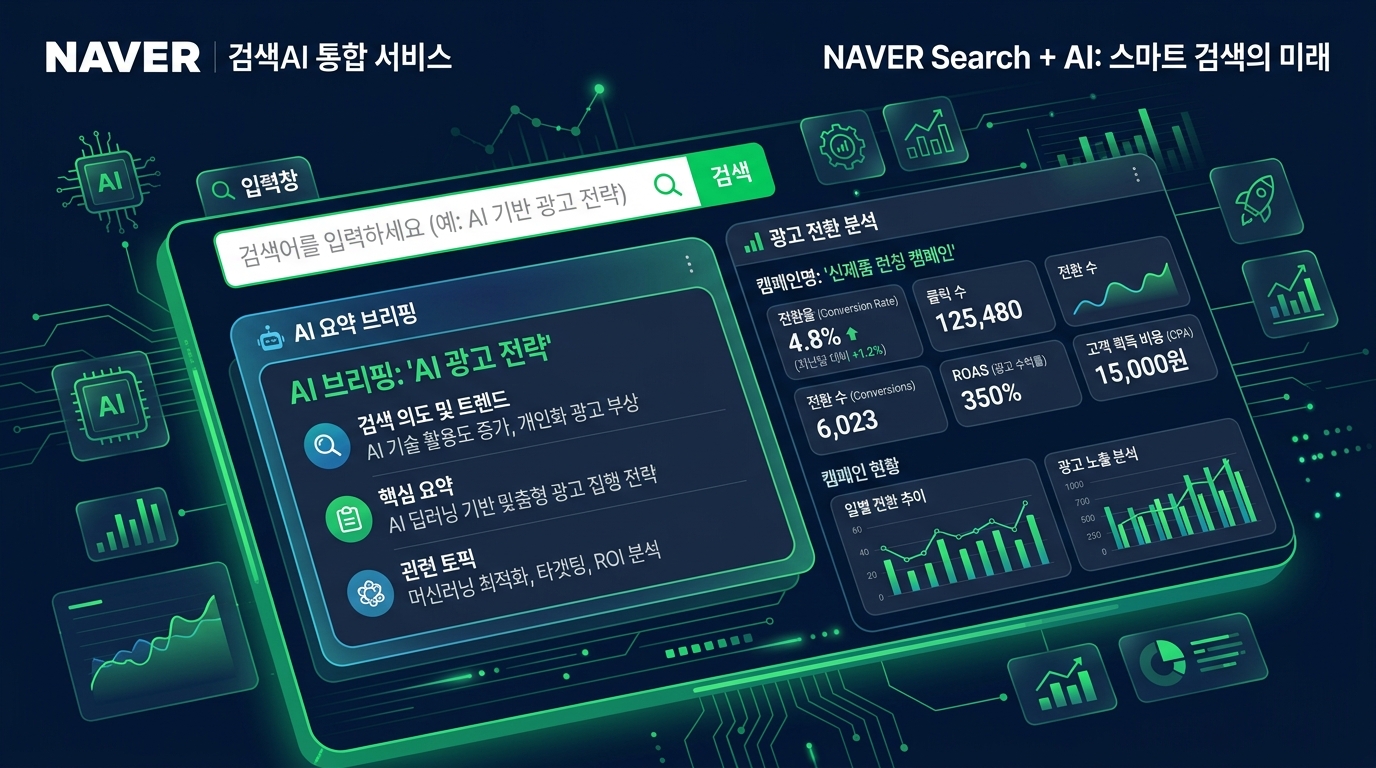
Moving beyond conventional, list-style search results, NAVER introduced ads integrated with conversational context and search intent. This approach demonstrated a 30% increase in click-through rate (CTR) and more than triple the purchase conversion rate compared to existing search ads.
With Q2 2026 consolidated revenue reaching 3.3888 trillion KRW, AI-driven contributions surpassed 60% of total platform advertising sales, emerging as the primary pillar for a second-half earnings rebound.
As the USD/KRW exchange rate fluctuates around 1,347.50 KRW and the KOSPI index closed at 6,684.37, market attention is focusing on whether the monetization of mega-cap platforms can serve as an alternative to diversify index liquidity flows.
Current Situation Overview
Amid sustained competitive pressure from global big tech firms in the domestic search landscape, NAVER has reclaimed momentum and defended its market share by reorganizing its AI tabs and deploying AI Briefing.
Officially launched in late July, "AI Briefing Ads" unlocked net-new ad inventory by embedding conversational, contextual ads within informational search queries that previously had no ad placements.
NAVER's advertising revenue in Q2 2026 rose 7.5% year-on-year to 1.4472 trillion KRW, propelled by advancements in AI-based targeting.
Ad space optimization is accelerating in September, featuring the addition of native ads on the Home Feed and expanded ad inventory on the initial mobile integrated Place search screens.
As of September 14, 2026, Daily Stock's proprietary Fear & Greed Index places the KOSPI in "Fear" (28.2) and the NASDAQ in "Fear" (33.3).
Having shifted down from "Neutral" (49.8) a week ago, this risk-off environment tests whether investor capital, previously concentrated in large-cap export stocks, will rotate toward mega-cap platforms with proven earnings resilience.
Financial Analysis
In 2025, NAVER generated annual revenue of 12.0350 trillion KRW and operating profit of 2.2081 trillion KRW, becoming the first South Korean internet company to cross the 12 trillion KRW annual revenue milestone.
In Q2 2026, the company posted record quarterly revenue of 3.3888 trillion KRW. However, operating profit edged down 0.2% year-on-year to 520.3 billion KRW due to upfront AI infrastructure investments and GPU capacity expansion costs.
| Business Division / Key Metric | Full-Year 2025 Performance | Q2 2026 Performance | Notes & Key Highlights |
|---|---|---|---|
| **Consolidated Total Revenue** | 12.0350T KRW | 3.3888T KRW | Up 16.2% YoY |
| **Consolidated Operating Profit** | 2.2081T KRW | 520.3B KRW | Reflects AI infrastructure investment (-0.2% YoY) |
| **Advertising (incl. Search Platform)** | 4.1689T KRW (Full Year) | 1.4472T KRW | AI contribution surpasses 60% of ad revenue |
| **Financial Platform** | 1.6907T KRW (Full Year) | 470.7B KRW | Quarterly transaction volume of 25.2T KRW (+21.0% YoY) |
| **Global C2C & Others** | 3.6884T KRW (Commerce basis) | 1.0159T KRW (Global ventures) | C2C surged 74.9% driven by Wallapop and Poshmark |
On the operational cost side, infrastructure depreciation from the Sejong Data Center (GAK Sejong) and AI model operational expenses have exerted pressure.
Nonetheless, restructured commerce commission fees, the successful establishment of paid "N-Delivery," and solid GMV growth in the C2C segment are buffering against typical seasonal slowdowns in the Search Platform.
[Image: /stdaily/uploads/202609/gen_6aa79ba28f9161.32015310.png]
Valuation
As of September 14, 2026, intraday trading prices are unverified (based on the latest confirmed data), yet NAVER's recent share price trades near the lower band of its historical 12-month forward price-to-earnings (P/E) multiple.
This stands in contrast to global big tech peers like Alphabet (Google) and Meta, which command multiples in the mid-to-high 20s backed by recoveries in AI search and digital advertising.
Within KOSPI 200 large-caps, NAVER has experienced relative valuation neglect, sidelined by market rallies driven by semiconductor and defense export heavyweights.
However, steady double-digit return on equity (ROE) and the ongoing execution of its 3-year (2025–2027) free cash flow (FCF)-linked shareholder return program provide strong downside support.
Market analysts suggest that if AI Briefing ads gain widespread traction across broad informational queries in the second half, the platform could eliminate its valuation discount and trigger a P/E multiple rerating.
Expert and Institutional Analysis
Securities analysts view the launch of NAVER's AI Briefing not merely as a search UI refresh, but as a critical inflection point generating net-new ad inventory.
They emphasize that NAVER has brought non-monetized keywords into its advertising fold without cannibalizing existing search ad revenue.
Major domestic institutional analysts anticipate that foreign passive inflows will return once the USD/KRW exchange rate stabilizes around 1,347.50 KRW in a large-cap-oriented KOSPI market.
Should export peaking concerns emerge across semiconductors and automotive sectors, room exists for a capital rotation into domestic-demand mega-cap platforms known for defensive earnings traits.
However, because visible revenue recognition from B2B AI solutions and international initiatives—such as the Saudi digital twin project—is scheduled for the first half of next year, near-term momentum remains concentrated on second-half advertising performance.
Risk Factors
The most significant risk involves macroeconomic softening, which could dampen private consumption and prompt domestic advertisers to slash marketing budgets.
If consumer sentiment freezes, higher CTRs in AI advertising may fail to translate into final transaction volume and revenue conversion.
In addition, elevated capital expenditures (CAPEX)—including GPU computing expenses and cloud electricity costs to sustain AI infrastructure—continue to weigh on performance.
These cost pressures may prevent near-term operating margins from breaking out of the 15–16% plateau.
Externally, potential delays in the Bank of Korea's interest rate cut trajectory alongside foreign exchange volatility could temper the pace of foreign portfolio inflows.
Investment Perspective Summary
NAVER has entered a phase of fundamental recovery centered on improved search efficiency and the operational rollout of new AI ads within its core Search Platform.
Investors must monitor whether early infrastructure investments made through the first half can materialize into concrete revenue growth and margin recovery starting in 2H.
With the Fear & Greed Index positioned in "Fear" territory (KOSPI 28.2, NASDAQ 33.3), phased dollar-cost averaging offers a more prudent approach than aggressive portfolio weighting.
An optimal strategy entails tracking the stabilization of exchange rates in the 1,340 KRW range, shifts in foreign futures positions, and continued incremental ad growth from AI Briefing in third-quarter results.
FAQ
Q1. How does AI Briefing advertising differ from existing search advertising?
While traditional search ads appear against predetermined commercial keywords, AI Briefing ads use AI to interpret the conversational context of inquiry-based and informational queries, presenting the most suitable products beneath the synthesized answer.
Q2. How much have actual advertising metrics improved with the introduction of AI?
According to NAVER, since its official rollout in July, AI Briefing ads recorded a click-through rate (CTR) and cost-per-click (CPC) more than 30% higher than conventional search ads, alongside more than three times the purchase conversion rate.
Q3. Why did Q2 2026 operating profit stagnate despite increased revenue?
Although revenue rose 16.2% year-on-year, operating profit was tempered by higher capital and operational expenditures, including GPU infrastructure additions and data center operating costs to support generative AI services.
Q4. How do macroeconomic factors like exchange rates and interest rates impact NAVER?
A rising USD/KRW exchange rate can accelerate foreign passive outflows, while persistently high interest rates squeeze marketing budgets for domestic advertisers and weigh on tech sector valuations.
Q5. What are the key catalysts determining share price direction in the second half?
Key determinants include traffic conversion rates across new Home Feed ad units expanding in September, the extent of the Search Platform's Q3 revenue recovery, and management's discipline in controlling infrastructure expenses.