Hello, as a professional writer for Daily Stock, I will provide a detailed analysis of the latest US inflation data released around midnight and the valuation defensive power of the Nasdaq market.
[Image: /stdaily/uploads/202608/gen_6a90d000eda7a7.60113287.png]
Executive Summary
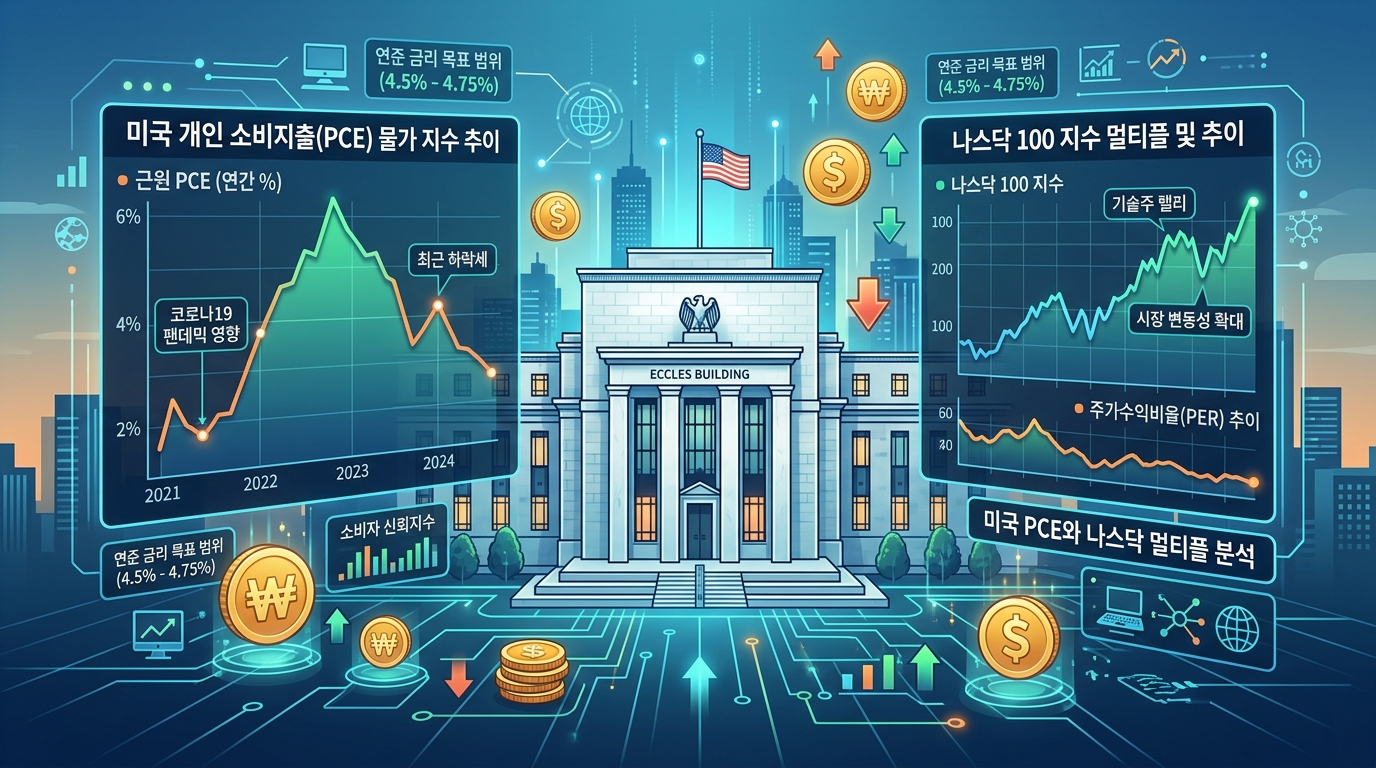
The US July Core Personal Consumption Expenditures (PCE) price index rose 3.3% year-on-year, matching market expectations and partially alleviating excessive fears over tech stock valuations.
However, the headline PCE stood at 3.7%, slightly exceeding the estimated 3.6%, highlighting the sticky and persistent nature of inflation.
As the Nasdaq 100 index's 12-month Forward P/E ratio stabilized around 21.31x, its earnings-based downside support is being tested in a prolonged high-interest-rate environment.
Market Overview
As of intraday trading today, August 28, 2026 (provisional), the KOSPI is at 6,843.47 points, and the KOSDAQ is at 834.97 points.
At the same time, the Nasdaq index is hovering at 26,541.35 points, and the USD/KRW exchange rate is trading intraday at 1,381.00 won.
According to Daily Stock's proprietary Fear & Greed Index, the KOSPI is currently in the Neutral stage (54.8), showing little change from last week's Neutral stage (52.1) but reflecting a significant recovery compared to the Extreme Fear stage (11.9) seen a month ago.
The Nasdaq Fear & Greed Index currently points to Neutral (58.2), showing a slight improvement in market sentiment compared to last week's Neutral (53.1) and last month's Fear (37.6) stages.
With the Jackson Hole Symposium (August 27-29)—a key gauge of future monetary policy—currently underway, investors are treading with extreme caution ahead of Federal Reserve Chair Kevin Warsh's remarks and the upcoming September FOMC interest rate decision.
Financial Analysis
The July PCE price index published by the US Bureau of Economic Analysis (BEA) rose 3.7% year-on-year, matching the previous month's level but exceeding the market consensus of 3.6%.
On the other hand, the Core PCE price index, which excludes volatile food and energy components, rose 3.3% year-on-year, matching expectations exactly.
Of note is the household spending structure: while nominal personal income rose 0.4% month-on-month in July, personal consumption expenditures (PCE) increased by only 0.2%, indicating that overall consumer spending momentum is slowing down.
In real terms, service consumption increased by $86.2 billion, whereas goods consumption fell by $49.9 billion, resulting in a marginal growth of just 0.01% in overall real PCE.
This structural skew, where goods spending contracts while services consumption remains robust, strongly supports service-sector inflation.
Valuation
[Image: /stdaily/uploads/202608/gen_6a90d00c0f6fa8.12362646.png]
The current trailing twelve months P/E (TTM P/E) ratio of the Nasdaq 100 index is 28.36x, resting in a stable range that is discounted by approximately 2.1% compared to its long-term average of 28.97x.
On a 12-month Forward P/E basis, it stands at 21.31x, narrowing the gap to almost parity with the S&P 500's Forward P/E of 21.2x.
| Classification | Nasdaq 100 TTM P/E | Nasdaq 100 Forward P/E | S&P 500 Forward P/E | Long-Term Average P/E (Nasdaq 100) |
|---|---|---|---|---|
| **Valuation Metric** | 28.36x | 21.31x | 21.2x | 28.97x |
These numbers indicate that the Nasdaq is not in a bubble market relying solely on multiple expansion, but is proving its valuation based on robust earnings growth led by Big Tech companies.
With the PCE inflation data not straying far from the projected path, the likelihood of a sudden collapse in valuation is limited. However, it is an environment where expecting further expansion of multiples is difficult if high real interest rates persist.
Expert & Institutional Analysis
Following the PCE release, major global investment banks (IBs) are placing greater weight on the likelihood that the Federal Reserve will freeze interest rates at the current 3.50% to 3.75% range at the upcoming FOMC meeting on September 15–16.
Bloomberg Economics evaluated that it would be difficult for the Fed to pursue early rate cuts unless retail gasoline prices fall back below the $4 per gallon level and energy uncertainties stemming from Middle East conflicts are resolved.
The Joint Economic Committee (JEC) noted that while immediate concerns of a sharp economic recession have eased due to slight increases in household income, the growth engine itself has entered a phase of gradual deceleration.
Wall Street experts expect Fed Chair Kevin Warsh to maintain a hawkish stance at this Jackson Hole Symposium, adjusting the strength of his messaging to suppress inflation expectations.
Risk Factors
The most direct risk is upward pressure on crude oil and commodity prices triggered by geopolitical instability, which could re-ignite headline inflation in autumn.
If the concentration of spending on services prolongs, it could combine with rising wages to block the downward path of services inflation, delaying the timeline for monetary easing.
Additionally, if the actual revenue performance of Big Tech companies—which have sustained Nasdaq's valuation multiples—fails to meet expectations relative to their capital expenditures (CapEx) in Artificial Intelligence (AI), the justification for current valuations could be shaken.
Investment Outlook
[Image: /stdaily/uploads/202608/gen_6a90d01697ccd9.81013929.png]
The Nasdaq market is currently demonstrating a classic "earnings-driven market," defending against multiple contraction through solid corporate earnings despite macro headwinds like high interest rates.
Even if monetary easing is delayed, a conservative approach focusing on AI hardware and core software value chains that prove bottom-line-oriented guidance remains highly valid.
Under a scenario where PCE inflation gradually stabilizes, the Nasdaq's Forward 21x support level is highly likely to serve as an excellent safety buffer for the market.
Investor Checklist Q&A
Q1. What was the immediate impact of the July PCE results on the Nasdaq market?
A1. As the Core PCE, a key inflation gauge, matched expectations (3.3%), it eased fears of rate hikes and provided psychological support for Nasdaq 100 multiples.
Q2. What caused the headline PCE to come in slightly high at 3.7%?
A2. It was largely driven by energy prices being stimulated by recent geopolitical instability, alongside consumers continuing to spend actively in the services sector.
Q3. What does it mean that the Nasdaq 100 Forward P/E is at 21.31x?
A3. It has narrowed to a level similar to the S&P 500's Forward P/E (21.2x), meaning tech stocks have stepped out of overvalued territory and are solidifying their valuations based on robust earnings projections.
Q4. What are the key variables to watch in the ongoing Jackson Hole Symposium?
A4. The key lies in how long the newly appointed Fed Chair Kevin Warsh will signal keeping rates higher for longer and how strongly he will express his commitment to controlling inflation.
Q5. What is a reasonable Nasdaq investment strategy for retail investors?
A5. Until the stability of macro indicators is fully verified, a conditional strategy is recommended—focusing on high-quality Big Tech companies with robust operating margins, particularly those with high exposure to AI infrastructure and service revenues, rather than simple index tracking.