Hello.
I am a professional writer for the Korean financial blog Daily Stock.
Executive Summary
TSMC is strengthening its leading position in the global foundry landscape by successfully entering mass production of the world's first 2-nanometer (nm) process.
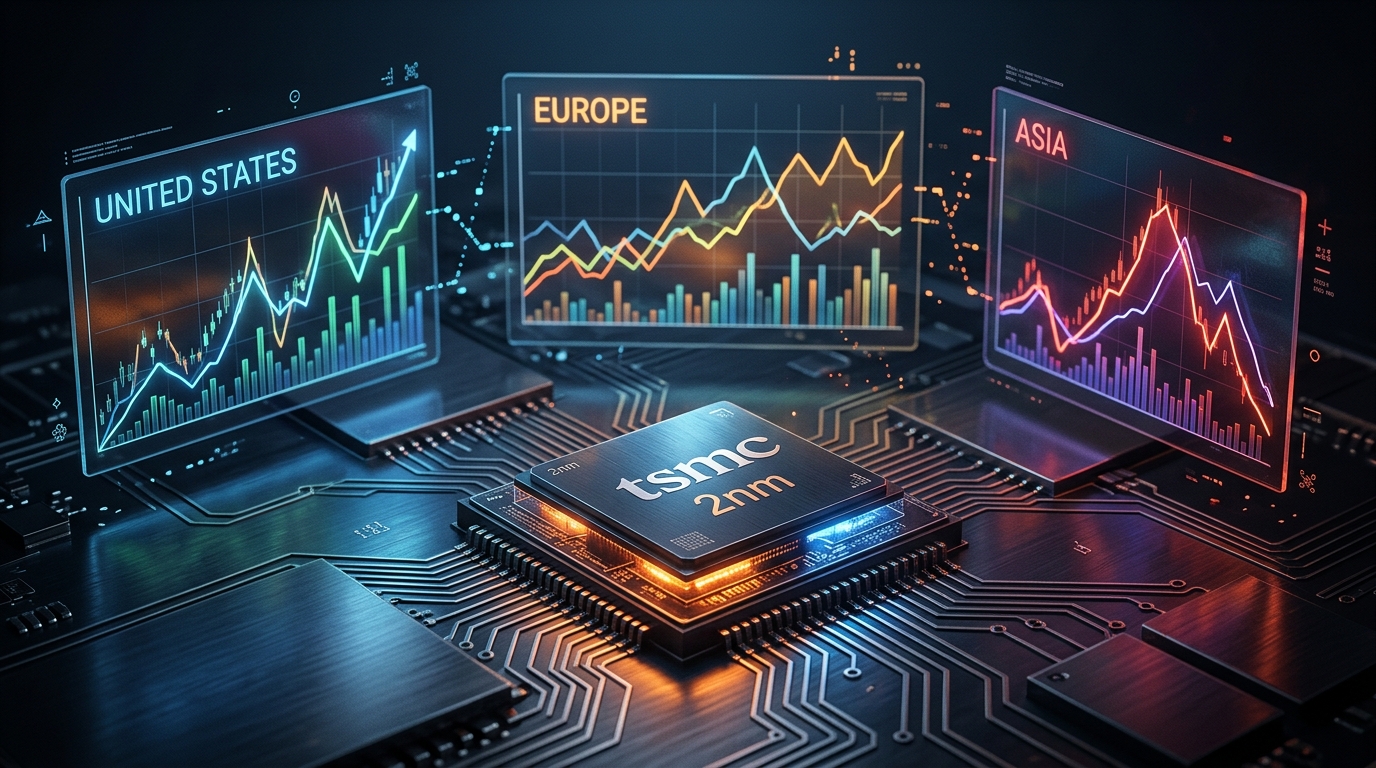
Stock markets in the three major regions—the US, Europe, and Asia—are showing clear decoupling due to differences in interest rates and economic fundamentals.
However, demand for semiconductors for high-performance artificial intelligence (AI) and next-generation agentic AI operations is increasingly concentrating on specific advanced processes.
[Image: /stdaily/uploads/202608/gen_6a8f4056897af8.46565827.png]
Current Situation Summary
TSMC has fully launched the mass production of its state-of-the-art 2nm (N2) process products, centered on Fab 20 in the Baoshan area of Hsinchu, Taiwan, and Fab 22 in Kaohsiung in southern Taiwan.
In particular, on August 25, 2026, its key customer Apple unveiled its first-ever 2nm process semiconductor, the 'M6', highlighting the visible benefits of TSMC's exclusive foundry contract.
The M6 chip boosts Large Language Model (LLM) execution speeds by up to 4.8 times compared to the previous generation, showcasing powerful on-device AI performance.
In response, Samsung Electronics is focusing on yield stabilization and price positioning for its SF2 (2nm) process, leveraging its Gate-All-Around (GAA) process know-how accumulated ahead of competitors since the 3nm process.
Meanwhile, Intel is dedicating capabilities to upgrading its 18A (1.8nm-class) process infrastructure and collaborating on the next-stage design ecosystem to join the advanced foundry race.
Financial Analysis
Driven by robust global demand for advanced semiconductors, TSMC recorded quarterly revenue of $40.2 billion in the second quarter of 2026, continuing its steep growth trajectory.
Net profit for the quarter also surged by 77.4% year-on-year, operating on an overwhelmingly high-profit structure with an operating margin of 60.3% and a gross margin of 67.7%.
To meet explosive demand for advanced processes, TSMC significantly increased its annual capital expenditure (CAPEX) range for 2026 from the initial $52 billion to $56 billion to up to $64 billion.
Furthermore, it is concentrating its financial resources on diversifying production bases, including announcing an additional $100 billion investment in its Phoenix campus in Arizona, USA.
| Foundry Segment | Key Metrics for Q2 2026 (Actual) | 2026 CAPEX Forecast | Core Technology & Mass Production Characteristics |
|---|---|---|---|
| **TSMC (N2 Process)** | Revenue approx. $40.2B / Gross Margin 67.7% | $60.0B ~ $64.0B | 1st-generation nanosheet GAA applied, target of 100k wafers/month by late 2026 |
| **Samsung Electronics (SF2 Process)** | Focusing stage on advanced foundry yield improvement | Undisclosed (GAA process optimization ongoing) | Advancing 2nd-generation GAA structure based on 3nm mass production history |
Valuation
Currently, the Price-to-Earnings (P/E) ratio of TSMC ADR (TSM) listed on the New York Stock Exchange is moving stably around 30.2x.
While this figure is slightly above its historical median, TSMC's overwhelming market share and the monopoly effect of the 2nm process are key drivers supporting its valuation premium.
In the short term, some concerns have been raised regarding global discount rate fluctuations and the discrepancy in intrinsic value based on discounted cash flow (DCF) models.
Nevertheless, its strong position as an irreplaceable core production hub for Big Tech companies acts as a powerful downside support for its stock price.
Analyst and Institutional Insights
Global investment institutions observe that TSMC's unique pricing power will be maintained as replacement demand for on-device AI devices grows.
However, the steep rise in wafer manufacturing costs for the next-generation 2nm process could emerge as a margin pressure factor for upstream fabless companies.
Accordingly, there is a possibility that major design companies like Nvidia or Qualcomm may seek Samsung Electronics' foundry as an alternative to reduce manufacturing costs, opening up 'multi-vendor' demand.
Therefore, a key point to watch is how mid-to-long-term supply chain diversification triggers unfold, even amid the short-term supply monopoly structure.
[Image: /stdaily/uploads/202608/gen_6a8f4060b1a8d4.22766889.png]
Risk Factors
The most direct risk factors are the rising acquisition costs of Extreme Ultraviolet (EUV) lithography equipment essential for ultra-fine advanced processes, and control over increasingly complex back-end packaging costs.
Additionally, tariff conflicts between the US and China, and upward pressure on the costs of auxiliary semiconductor manufacturing materials like chemical raw materials, are non-negligible variables.
In particular, the fact that the most advanced semiconductor manufacturing facilities are concentrated in mainland Taiwan remains a global geopolitical vulnerability.
Furthermore, construction delays and local recruitment difficulties arising from overseas production base expansion phases, such as the Arizona factory in the US, must be carefully monitored.
Investment Perspective Summary
As of August 27, 2026, 04:35 KST during intraday trading (tentative), the Nasdaq index stands at 26,154.42, the Kospi index is at 6,808.21, and the USD/KRW exchange rate is trading at 1,386.20 won.
In terms of global macro factors, there is a decoupling between the growth trajectory led by US tech stocks and the movements of Asian and European stock markets trying to overcome sluggish domestic indicators.
According to Daily Stock's own Fear and Greed Index, the current Kospi Fear and Greed Index points to Neutral (52), and the Nasdaq Fear and Greed Index points to Neutral (59.1).
(For reference, one week ago, Kospi was Neutral (56.6) and Nasdaq was Neutral (57.2); one month ago, Kospi was Extreme Fear (12.6) and Nasdaq was Neutral (41.3); and three months ago, they were both at Neutral levels (57.4/55.4, respectively).)
Valuations for top-tier companies in the semiconductor value chain that have secured technological dominance are increasingly likely to serve as long-term safety nets for portfolios.
However, a calm entry strategy should be considered by contrasting the cost pressures of advanced processes with the chase speed of competitors aiming to secure alternative supply chains.
Investor Checklist Q&A
Q1. When was the mass production of TSMC's 2nm (N2) process officially initiated?
TSMC achieved its scheduled development and equipment timeline, entering mass production of 2nm microprocess products through its production fabs in Taiwan at the end of the fourth quarter of 2025.
Q2. What is a recent example of a TSMC 2nm semiconductor product being applied in the market?
Apple's proprietary semiconductor 'M6' for its next-generation computer products, officially announced on August 25, 2026, is the representative first product exclusively outsourced and produced through TSMC's 2nm advanced process.
Q3. What power and performance improvements can be achieved with the 2nm process?
Compared to the existing 3nm process (N3E), processing speed increases by 10 to 15% at the same power consumption, and power consumption is significantly reduced by 25 to 30% at the same operating speed, achieving an innovation in power efficiency.
Q4. What is the niche target for Samsung Electronics' foundry in the 2nm market?
Amid TSMC's manufacturing price hikes, Samsung Electronics plans to leverage its GAA process stability—which it was the first in the world to commercialize—and price advantages to position itself as an alternative for Big Tech fabless customers facing cost limits.
Q5. What are the key financial variables of TSMC that investors should pay attention to?
As TSMC has raised its annual CAPEX guidance to up to $64 billion, investors must track the impact of short-term profit margin dilution from large-scale infrastructure spending on future earnings reports.