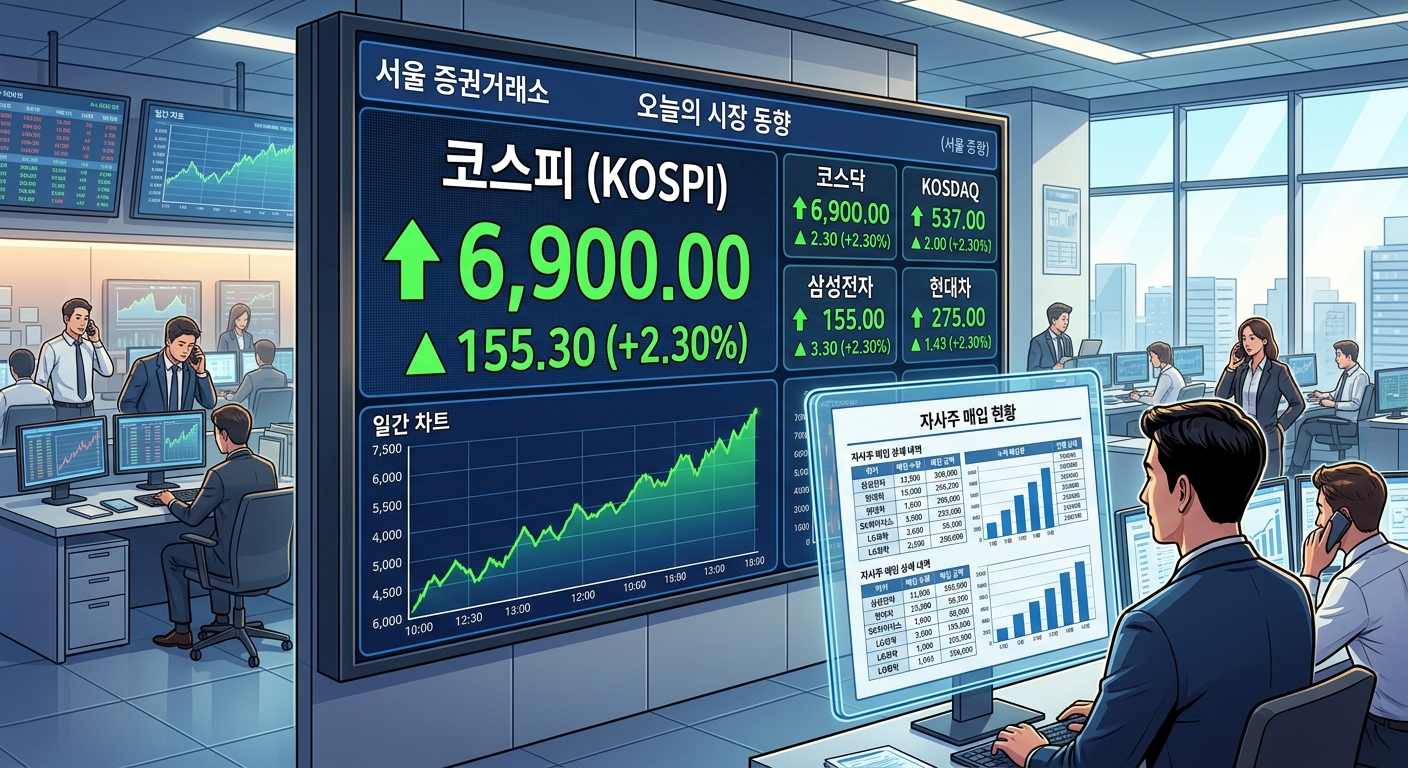
Hello. This is the KOSPI closing market analysis for August 27, 2026, brought to you by Daily Stock.
[Image: /stdaily/uploads/202608/gen_6a8fe153be6e26.97378029.png]
Key Summary
- **Nvidia Surprise and Attempt to Touch 7,000**: Driven by Nvidia's surprise earnings announcement, the KOSPI surged to 6,996.12 (+2.76%) in early trading, coming close to breaking the 7,000 level.
- **Bank of Korea's Consecutive Rate Hikes**: The Monetary Policy Board raised the base interest rate by 0.25%p from 2.75% to 3.00% per annum, raising concerns about liquidity contraction and slightly paring back early gains.
- **Other Corporate Bodies' Historic Net Purchase of Over 1.5 Trillion Won**: Funds from "other corporate bodies," presumed to be share buybacks by Samsung Electronics and SK Hynix, saw an inflow of 1.5861 trillion won, strongly supporting the index bottom.
- **Final Closing Price and Market Settlement**: Consequently, the KOSPI ended at 6,912.37, up 104.16 points (1.53%) from the previous trading day, successfully securing its footing at the 6,900 level.
Current Market Overview
On August 27, 2026, the KOSPI market recorded high volatility as global tailwinds locked horns with domestic tightening pressures.
After Nvidia in the US shook the market by posting Q2 revenue that grew 106% year-on-year, South Korea's leading semiconductor stocks, such as Samsung Electronics and SK Hynix, surged in unison.
However, the intraday gains were somewhat limited when the Monetary Policy Board decided to raise the base rate to 3.00% during the trading session, marking the second consecutive monthly hike following July.
In this mixed environment, the key entity that practically supported the market was "other corporate bodies."
On this day, other corporate bodies recorded a net purchase of 1.5861 trillion won in the main board market, overwhelming the buying force of foreign and institutional investors.
On the other hand, retail investors showed a pattern of massive profit-taking, net selling 1.9150 trillion won.
| Index & Indicator | Closing Figure (Aug 27, 2026) | Change vs. Previous Trading Day |
|---|---|---|
| **KOSPI** | 6,912.37 | +104.16p (+1.53%) |
| **KOSDAQ** | 837.65 | +10.78p (+1.30%) |
| **NASDAQ** | 26,130.20 | (Data applied based on US market standards) |
| **USD/KRW** | 1,381.60 KRW | -3.9 KRW (Based on daily announced exchange rate) |
Financial Analysis
[Image: /stdaily/uploads/202608/gen_6a8fe15eda7232.88038171.png]
This capital inflow from other corporate bodies, which has recently become the center of KOSPI supply and demand, is interpreted as a butterfly effect of large-scale treasury share buybacks by major semiconductor companies flowing into the market.
In fact, SK Hynix announced in mid-August that it would purchase 24.07 million common shares (worth approximately 40.0043 trillion won) on the open market and subsequently cancel them.
In addition, Samsung Electronics also initiated an open-market purchase of approximately 53.28 million common shares (worth approximately 15 trillion won) for the purpose of employee stock compensation, creating a powerful buying force.
The robust financial liquidity and commitment to shareholder returns shown by these large information technology (IT) players are serving as reliable shields blocking downsides whenever stock prices plunge.
With a fixed amount of around 1.5 trillion won on daily average being injected solely into the buybacks of these two companies, they managed to support stock prices even under circumstances where KOSPI trading volume was contracted compared to the annual average.
Particularly in the case of share buybacks, unlike the speculative transactions of foreign or institutional investors, there is a strong long-term purpose of cancellation or long-term holding.
As a result, it is currently exerting a financial effect of indirectly enhancing stock value by reducing the actual circulating supply in the market.
Valuation
Currently, the Price-to-Earnings Ratio (PER) of the KOSPI is hovering around 18.43 times.
While valuation burdens have increased compared to the past, the Bank of Korea's substantial adjustment of this year's real GDP growth rate outlook from 2.6% to 3.3% supports this level.
This indicates that the actual earning power of corporations and the underlying economic fundamentals are significantly improving.
Let's take a look at our proprietary Fear & Greed Index.
The KOSPI Fear & Greed Index currently stands at "Neutral (55.6)", compared to Neutral (56.6) a week ago, Extreme Fear (12.6) a month ago, and Neutral (57.4) three months ago.
The NASDAQ Fear & Greed Index also stands at "Neutral (54.9)" today, compared to Neutral (53.1) a week ago, Fear (37.6) a month ago, and Neutral (59.1) three months ago.
Only a month ago, the market faced panic selling under an "Extreme Fear" phase of 12.6, but it has recovered to neutral levels, buoyed by semiconductor share buybacks and confirmation of continued global AI infrastructure investment.
However, the current index continues its "Neutral" phase, displaying a wait-and-see attitude ahead of further rises amidst the tightening environment.
Expert & Institutional Analysis
Securities market experts are focusing on whether sector rotation will spread to other industries while semiconductor buybacks via other corporate bodies stabilize the market bottom.
Daishin Securities' Research Center analyzed, "Nvidia's solid AI guidance has restored investment sentiment across semiconductor equipment/materials and IT hardware as a whole."
It added, "However, as the Bank of Korea raised the base rate to 3.00% for two consecutive months, adding weight to tightening policies, the explosive further surge of the market could be limited to some extent."
A researcher from Miraeasset Securities also noted, "With the buyback supply of large value stocks acting as a powerful umbrella, it is positive to see sector rotation spreading warmth to oversold stocks relative to their growth potential, such as power equipment and secondary batteries."
Experts generally identify the timing of retail investors' re-entry after completing short-term profit-taking, and whether the USD/KRW exchange rate stabilizes downward, as the next driving forces.
Risk Factors
The primary source of instability is the increase in interest expenses for households and corporations following the Bank of Korea's rate hikes carried out for two consecutive months (reaching 3.00% per annum).
Although the central bank wielded the tightening sword to prevent consumer prices from exceeding the 2.8% target and to curb housing market overheating, concerns exist that this could slow down the long-term recovery speed of domestic demand.
Secondly, there is the ongoing tendency of retail investors to engage in massive profit-taking.
With retail investors dumping over 1.9 trillion won in a single day, the buying flow is exhibiting a rapid rotation rather than settling in one place for the long term.
Lastly, there are global macroeconomic variables and the sustainability of Nvidia's dominance.
Given the nature of the KOSPI market where valuation multiples have expanded significantly compared to the past, if there are any signs of a slowdown in US Big Tech capital expenditures (CAPEX), foreign selling pressure could flood back in.
Summary of Investment Perspective
Currently, the KOSPI has an unprecedentedly powerful ally in the form of record-high share buybacks (supply from other corporate bodies).
Even in a phase where the cold wind of the BOK's rate hikes and the warm wind of US Nvidia clashed, the index proved its stamina by defending the 6,900 level.
For investors considering entry, rather than chasing after short-term surges, an approach centered on large-cap value stocks with verified earnings improvements or value-up stocks with high shareholder return rates might be effective.
At the same time, it would be wise to constantly check the continuous changes in the macro interest rate environment and map out installment buying scenarios.
Investor Checkpoint Q&A
[Image: /stdaily/uploads/202608/gen_6a8fe16aa98ae9.24650651.png]
Q1. Who are the actual entities behind the '1.5 trillion won buying by other corporate bodies' that boosted the KOSPI today?
A1. It is understood that the vast majority consisted of large-scale treasury share acquisitions by mega semiconductor firms Samsung Electronics and SK Hynix. When companies directly buy back their own shares on the open market, they are recorded as "other corporate bodies" in the supply-demand classification.
Q2. How long will the ongoing share buybacks of the two companies continue?
A2. According to disclosures, SK Hynix's share acquisition worth about 40 trillion won is scheduled from August 20 to November 19, and Samsung Electronics' buyback program worth about 15 trillion won is planned from August 24 to November 21.
Q3. Is the Bank of Korea's consecutive rate hike a negative factor for the KOSPI?
A3. Rate hikes shrink liquidity, which can serve as a psychological barrier limiting the upside of the index in the short term. However, some view that there is no need to have excessive fear relative to the underlying economic health, given that the BOK raised its growth outlook to 3.3%, showing confidence in fundamentals.
Q4. What butterfly effect did Nvidia's earnings have on the Korean stock market?
A4. As Nvidia achieved a historic earning surprise, including a 106% increase in revenue, it restored trust in Samsung Electronics and SK Hynix, the core of the AI semiconductor supply chain, contributing greatly to the recovery of investment sentiment.
Q5. What major indicators should investors pay attention to going forward?
A5. One should closely monitor whether the exchange rate stabilizes around the 1,380 won level, and whether the actual buying agents smoothly transition to foreign and institutional investors after the consecutive share buyback schedules conclude in November.