Hello, this is Daily Stock, your source for in-depth analysis of macroeconomic trends and core indicators in the asset markets.
[Image: /stdaily/uploads/202608/gen_6a89f25be64a82.13092098.png]
Executive Summary
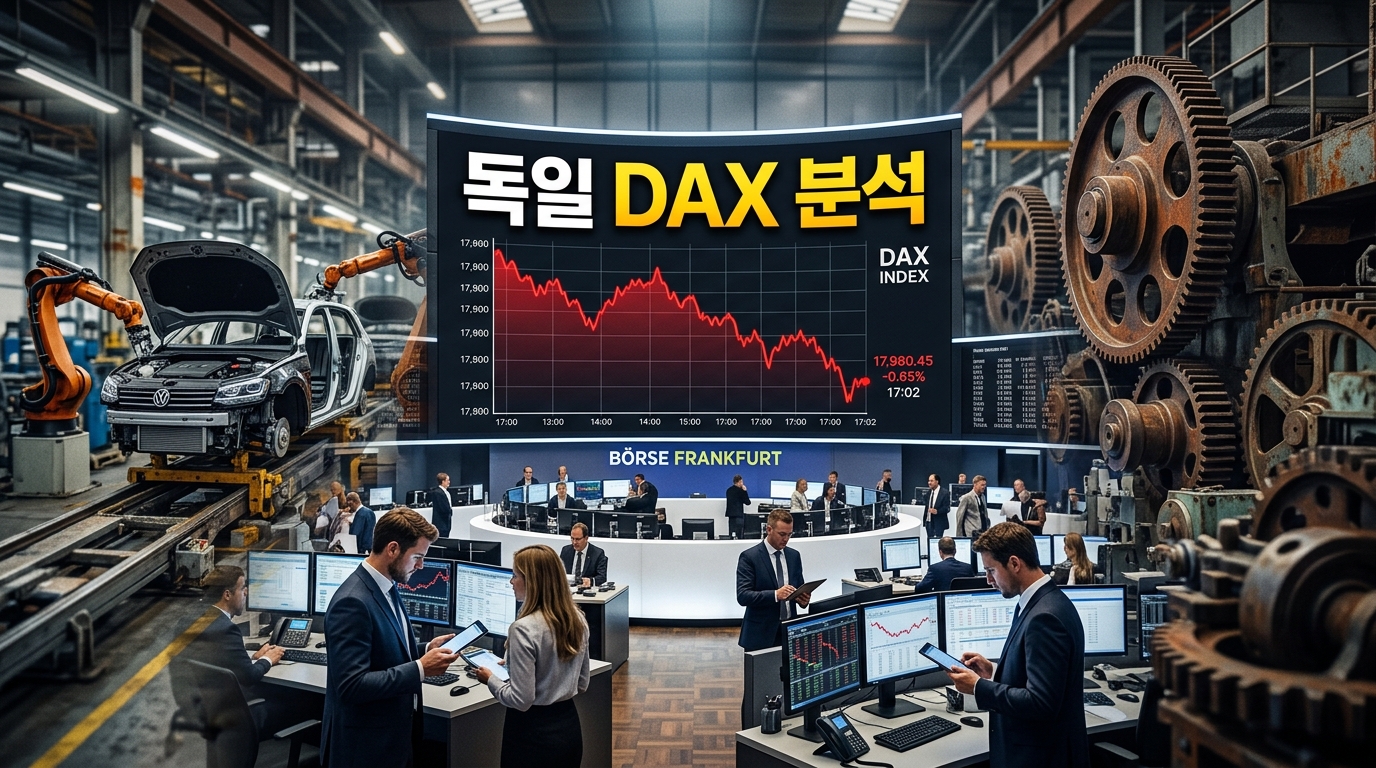
Germany's benchmark index, the DAX, closed the week at 26,136.56, down 1.15% on a weekly basis, as a fierce battle ensues over whether the 26,000 support level can hold.
Although the preliminary August German Manufacturing PMI released by S&P Global made a surprise rebound to 54.1, actual industrial production and employment indicators are showing historic declines, raising warnings of structural stagnation.
Amid the deepening three-polar decoupling among the US, Europe, and Asia, the erosion of German manufacturing's fundamental strength—driven by high energy costs and tech competition with China—is cited as a factor capping the index.
According to Daily Stock's own Fear & Greed Index, both the KOSPI (currently neutral at 55.4) and the Nasdaq (currently neutral at 55.2) remain in neutral territory, reflecting a cautious wait-and-see stance spreading across global stock markets.
Market Overview
Although the German DAX 40 index ended its last trading session up 0.59% at 26,136.56, it underwent a weekly correction, slipping approximately 1.15% from its previous peak (around the 26,573 level).
This adjustment was triggered by weak real economic indicators combined with a temporary shift in European market appeal as global investment capital gravitated toward the relatively stronger US market.
| Key Economic Indicators (As of 2026) | Value / Forecast | MoM / YoY Change | Remarks |
|---|---|---|---|
| **June Industrial Production (MoM)** | 92.00 (Index) | +0.2% | Slight rebound, but recovery remains stagnant |
| **June Industrial Production (YoY)** | - | -0.1% | Continued negative growth (working-day adjusted) |
| **August Prelim. Manufacturing PMI** | 54.1 | 7th consecutive month of expansion | Highest level since May 2022 |
| **H1 Automotive Sector Employment** | 691,500 | -5.8% (YoY) | Lowest level since 2005 |
| **2026 Annual GDP Growth Forecast** | 0.5% ~ 0.6% | - | Downgraded by EC & Bundesbank |
In fact, Germany's industrial production for June grew by only 0.2% month-on-month, missing market expectations.
This sluggish industrial performance stands in sharp contrast to the positive surprise in the August manufacturing PMI (54.1), making it difficult to guarantee a full-fledged manufacturing turnaround.
Financial Analysis
Detailed data from the German Federal Statistical Office (Destatis) reveals severe financial pressures, with the long-term slump in key industries such as automotive and metal processing translating into job cuts.
At the end of the first half of this year, employment in the automotive industry stood at 691,500, down 5.8% year-on-year, sinking to its lowest level in 20 years.
[Image: /stdaily/uploads/202608/gen_6a89f266ae1947.47580190.png]
The primary cause is elevated energy costs that have persisted since the halt of cheap Russian natural gas imports, which has squeezed manufacturing margins.
With employment forced downward across core manufacturing sectors including chemicals (-3.6%), basic metals (-3.7%), and electrical equipment (-3.4%), companies' capacity for future investment is also likely to shrink.
Valuation
Behind the threat to the DAX staying above the 26,000 level lies a macroeconomic shift: the German 10-year government bond (Bund) yield has surged to a 15-year high.
As the prolonged high-interest-rate environment increases the cost of debt financing for corporations, valuation re-rating for high-quality DAX-listed companies is being constrained.
Furthermore, compared to the tech-driven liquidity expansion in the US (Nasdaq at 26,180.46) and the volatility in Asian markets (KOSPI at 6,912.95, KOSDAQ at 801.94), the valuation appeal of Euro-denominated assets is perceived as relatively low.
Investors are favoring the US market—where shareholder returns and growth momentum are more robust—over the German stock market, which has a high concentration of traditional manufacturing, accelerating the rotation of capital.
Expert & Institutional Analysis
S&P Global Market Intelligence pointed out, "The recent trend in German manufacturing is not a simple entry into a cyclical downturn, but rather a structural decline stemming from supply chain realignments and energy transition bottlenecks."
Supporting this view, the Deutsche Bundesbank and the European Commission lowered their 2026 annual growth forecasts for Germany to 0.5% and 0.6%, respectively.
[Image: /stdaily/uploads/202608/gen_6a89f27112c467.93249903.png]
Technical analysts believe that if the DAX fails to sustain a short-term rebound and breaks below the 25,900 level, downward pressure will intensify.
Under this scenario, the analysis suggesting that the index could slide toward the previous high of 25,438 reached in May is gaining traction, prompting caution.
Risk Factors
The most direct external risk is the spike in oil prices caused by geopolitical instability in the Middle East and import price inflation due to bottlenecks in the Strait of Hormuz.
Imported inflationary pressures could restrict the European Central Bank's (ECB) rate-cutting path, keeping the financial cost burden high for German businesses.
Domestically, the combination of mass layoffs and recession raises the threat of an "L-shaped long-term stagnation" scenario where private consumer sentiment freezes further.
Additionally, if German auto brands lose global market share faster than expected, the risk of eroding the value of index components cannot be ruled out.
Investment Outlook
The surprise increase in the August flash Manufacturing PMI (54.1) is expected to provide temporary upward momentum and help support the floor for the DAX.
However, the underlying fundamentals—sluggish real industrial output and a freeze in employment—remain a heavy drag on long-term upward trajectory.
Given the global three-polar decoupling, a conservative approach to portfolio allocations in European assets appears sensible.
Strategically, rather than predicting a recovery to the index's previous highs, a cautious approach that first confirms strong support near the 25,900 level is advised.
Investor Checklist Q&A
Q1. Why is the DAX moving sideways despite the August German manufacturing PMI jumping to 54.1?
A1. The PMI is a survey-based sentiment indicator that rose on the back of inventory restocking demand, whereas actual industrial production—the physical output—only grew by 0.2%, creating a divergence.
Q2. Why is declining employment in the German automotive industry negative for the broader stock market?
A2. The drop in auto sector employment to levels last seen in 2005 points to weaker household consumption due to job losses and a reduction in long-term growth potential, which dampens the DAX's fundamental momentum.
Q3. What is the impact of rising German government bond yields on corporate valuations?
A3. With the 10-year Bund yield hovering at 15-year highs, borrowing costs for companies have surged, which reduces the relative expected return attractiveness of investing in equities.
Q4. Is the decoupling between the US market (Nasdaq) and the German market (DAX) likely to persist?
A4. Yes. Unlike US tech stocks (Nasdaq 26,180.46) which benefit from strong liquidity and shareholder returns, Germany faces high energy costs and restructuring pressures in traditional manufacturing, making a period of relative underperformance highly probable.
Q5. If the downward correction deepens, what are the key technical support levels to watch?
A5. The psychological barrier at 26,000 and the volume profile support at 25,900 are the key levels. If these break, investors must prepare for a potential slide toward the May high of 25,438.