Hello, this is Daily Stock, delivering the vivid pulse of the capital markets.
Executive Summary
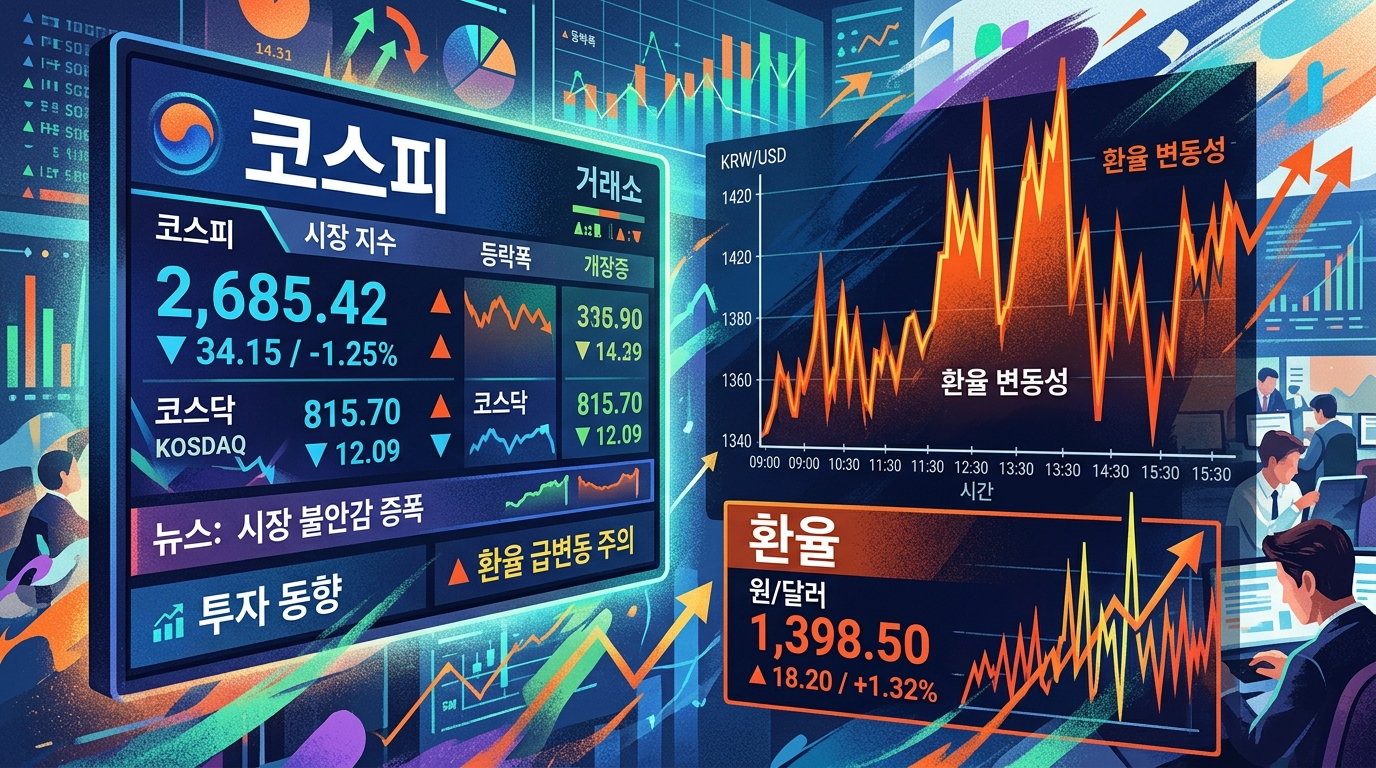
The average monthly volatility of the KRW/USD exchange rate has reached 47.0 won this year, marking the highest level since the 2009 global financial crisis, which was a period of global financial turmoil.
The exchange rate, which soared to as high as 1,555.8 won early last month, has sharply declined to 1,412.00 won, driven by coordinated market interventions by U.S. and Japanese authorities and improvements in foreign capital inflows.
While this shift toward a stronger Korean won helps stabilize import prices domestically, it acts as a factor lowering the third-quarter earnings expectations for large KOSPI exporters that had anticipated a prolonged high exchange rate environment.
In particular, there is a need for a close review of currency hedging boomerang risks, such as potential losses on derivative products for some exporters where hedging contract triggers were activated during previous high-exchange-rate periods.
[Image: /stdaily/uploads/202608/gen_6a782618a020d3.64269083.png]
Current Situation Summary
As of the close on August 9, 2026, the KRW/USD exchange rate stood at 1,412.00 won, calming its recent short-term plunge and entering a breathing spell.
The KOSPI index closed at 6,258.77 points, held back by high volatility in the foreign exchange market.
According to Daily Stock's proprietary Fear & Greed Index, the KOSPI is currently hovering at 17.1, remaining in the "Extreme Fear" territory.
This indicates that a strong wait-and-see attitude remains prevalent across the domestic capital market, compared to 17.8 a week ago and 13.1 a month ago.
In contrast, the Nasdaq Fear & Greed Index stands at 63.7, pointing to "Greed," highlighting a clear decoupling from the domestic stock market.
Expectations for a Federal Reserve rate cut following weak U.S. employment data and remarks on KRW volatility by U.S. Treasury Secretary Scott Bessent are providing some support for the downward pressure on the exchange rate in the short term.
Financial Analysis
The steep fluctuations of the KRW/USD exchange rate are delivering mixed financial impacts to large exporters and raw material importers.
Large information technology (IT) and automotive stocks, which had expected to benefit from the ultra-high exchange rate in the 1,550 won range until last month, now find themselves in a position where they must conservatively adjust their second-half KRW-denominated revenue estimates.
In particular, while the chemical and machinery sectors, which had been burdened by raw material procurement costs, have found some breathing room due to stabilizing import prices, short-term foreign exchange losses resulting from the rapid decline in the exchange rate could pressure operating margins.
Furthermore, concerns over valuation losses on derivatives are rising as so-called "hedging triggers" have been activated in currency option products set up by some competitive mid-sized exporting enterprises to prepare for high exchange rates.
Conversely, industries with relatively high USD-denominated debt, such as airlines, utilities, and financial holding companies, are seeing a rapid easing of foreign translation losses, improving their financial soundness metrics.
These contrasting margin trends across sectors are highly likely to manifest clearly during the upcoming third-quarter corporate earnings season.
| Sector Classification | Financial Impact in Ultra-High FX Phase (1,550 Won Range) | Financial Impact in Downward Stabilization Phase (1,412 Won Range) | Future Outlook Scenario |
|---|---|---|---|
| **IT & Automotive** | Temporary surge in operating profit by maximizing FX benefits | Decrease in KRW-denominated profit and lowered earnings expectations | Potential conservative adjustment of short-term earnings guidance |
| **Aviation & Raw Material Imports** | Increase in foreign translation losses and worsening cost burdens | Easing of foreign debt burdens and lower import costs | Financial soundness recovery in the second half due to cost reductions |
| **Mid-Sized Export Manufacturers** | Increase in financial costs due to high exchange rate hedging options | Worsening cash flows due to short-term foreign exchange losses | Continued concern over FX management costs due to heightened volatility |
Valuation
As the KRW/USD exchange rate slid down to the 1,410 won range, the undervalued attractiveness of the domestic stock market is once again becoming a topic of discussion.
Despite the government's corporate Value-Up Program and ongoing expectations for commercial law amendments, the index remaining at 6,258.77 reflects severely depressed investor sentiment.
Large KOSPI exporting enterprises saw their return on equity (ROE) improve on paper due to the high exchange rate, pushing their price-to-book ratios (PBR) down to historical lows.
Although exchange rate stability relieves foreign investors' anxiety over currency losses, there are concerns that a rapid strengthening of the won could limit multiple expansion if it dampens earnings momentum.
Securities analysts believe that if the KRW/USD exchange rate finds support near the annual average of 1,420 won, the book value of large exporters will find support at a PBR of around 0.85 times.
A scenario where a real valuation re-rating of the KOSPI takes place remains valid when the Fed accelerates its rate cuts and ends quantitative tightening.
Expert & Institutional Analysis
According to the latest outlook by the Overseas Economic Research Institute of the Export-Import Bank of Korea, the 1,400 won range is analyzed to become a "New Normal" in the foreign exchange market for the second half of 2026.
This is because, even if the U.S. monetary policy pivot proceeds, America-first tariff risks and demand for overseas investment will likely suppress further appreciation of the Korean won.
Major global investment banks (IBs) also project that it will not be easy for the exchange rate to stabilize below the mid-1,300 won range, and that strong downside rigidity will be maintained.
Market experts lean toward the possibility of the exchange rate attempting a technical rebound once the temporary supply of USD driven by SK Hynix flows settles down.
However, they evaluate that the possibility of a catastrophic currency crisis like in the past is extremely slim, given that external soundness indicators such as the national CDS premium and net creditor status remain stable.
Risk Factors
The most threatening element is that the monthly average volatility is nearing 47.0 won—a level comparable to the financial crisis—surpassing the limit of currency risk control for large exporting enterprises.
When short-term volatility becomes excessively large, exchange rates become unpredictable, acting as an obstacle to price negotiations with overseas buyers or the signing of long-term contracts.
In particular, mid-sized exporting companies that lack the capacity to defend against rapid drops in the exchange rate are carrying the risk of seeing previously purchased derivative hedging products trigger and turn into losses.
On top of this, the risk of a relative weakening of the price competitiveness of Korean export products cannot be ignored if the JPY/USD exchange rate turns weak again.
[Image: /stdaily/uploads/202608/gen_6a78262605e6a1.88295063.png]
Investment Perspective Summary
With the exchange rate rapidly reverting from 1,550 won to the 1,412.00 won range, it is time to adjust expectations for export-themed stocks that have grown their top line relying on a weak won.
Rather than merely relying on exchange rate benefits, portfolios should be concentrated on large-cap stocks that possess unrivaled market share and pricing power to break through high FX volatility.
For sectors that have already secured long-term order backlogs, such as shipbuilding or machinery equipment, the impact of short-term margin contraction due to a stronger won may be marginal, making a mid-to-long-term split-purchase approach a viable alternative.
As long as the overall market fear index remains trapped in the extreme fear territory of 17.1, patience is required to confirm a downward stabilization in FX market volatility.
Investor Checkpoint Q&A
Q1. What is the main reason the exchange rate dropped from the 1,550 won range last month to 1,412.00 won?
A1. It was driven by a combination of growing expectations for Fed rate cuts due to cooling U.S. employment, joint market interventions by U.S. and Japanese authorities, and a temporary inflow of dollars from ADR issuances by large semiconductor firms.
Q2. What are the practical negative side effects of financial-crisis-level exchange rate volatility on large exporters?
A2. An exchange rate fluctuating by dozens of won every month makes it nearly impossible to execute currency hedging strategies, raising uncertainty when converting export receipts into won and acting as a direct risk that disrupts margin projections.
Q3. Is a continuing decline in the exchange rate positive for overall KOSPI valuation?
A3. In the short term, it can eat into exporter earnings, but in the long term, it has positive aspects by inducing capital inflows through the stabilization of KRW asset values and easing foreign investors' fears of currency losses.
Q4. Why exactly do currency hedging trigger contracts become a problem?
A4. This is because financial option products purchased to defend against a falling exchange rate on export receipts can act as a boomerang and turn into financial losses when the exchange rate experiences unexpected surges or sudden plunges.
Q5. What indicators should retail investors watch in the current "Extreme Fear" market environment?
A5. Priority should be given to monitoring news on new U.S. tariff policies that stimulate exchange rate downside rigidity, the continuity of U.S.-Japan foreign exchange interventions, and rate of changes in 3Q corporate earnings estimates at home and abroad.