Hello, this is Daily Stock.
Summary
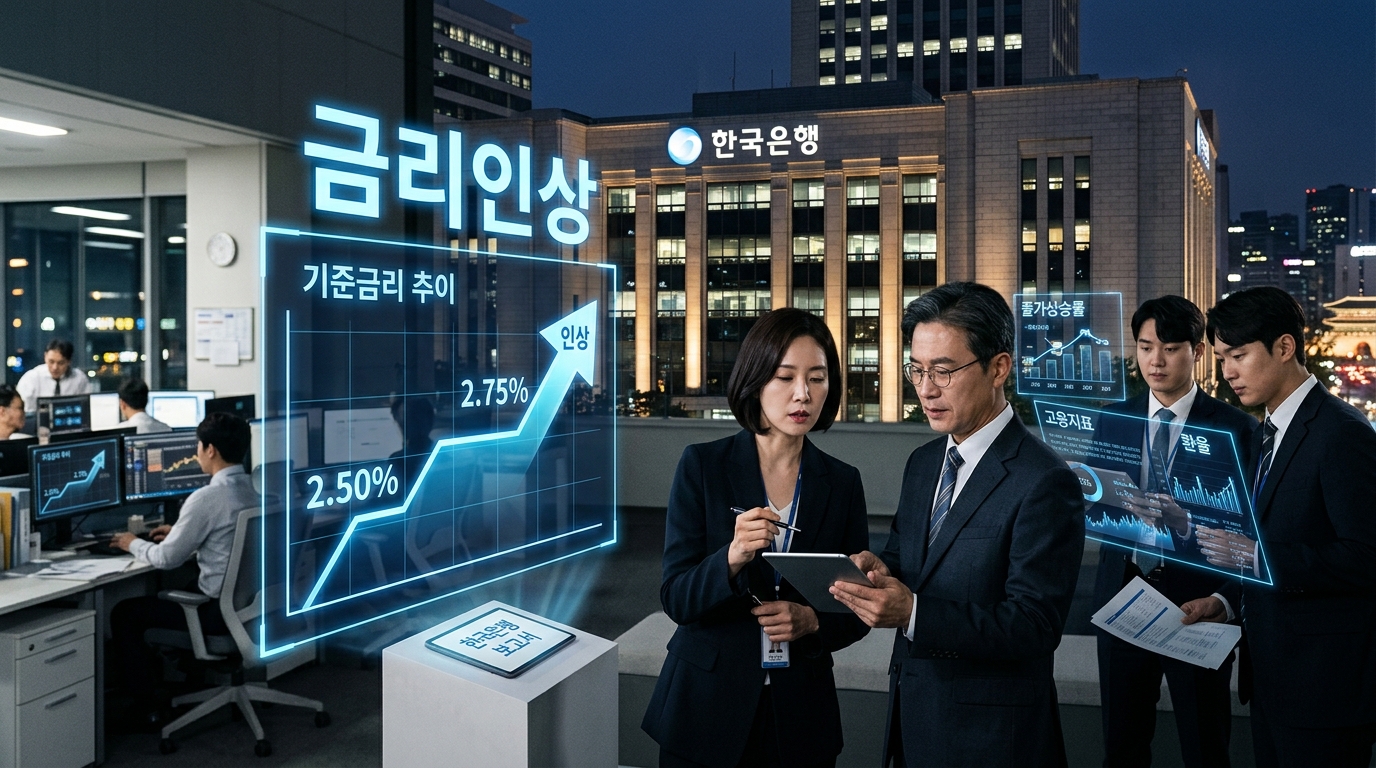
On July 16, 2026, the Monetary Policy Committee (MPC) of the Bank of Korea (BOK) unexpectedly raised the base interest rate by 0.25%p from 2.50% to 2.75% per annum, ending the monetary easing trend of the past three years and six months and shifting back toward a tightening stance.
This decision is interpreted as a preemptive measure to curb surging consumer prices, real estate overheating in the Seoul metropolitan area, and a rapid spike in household debt.
The MPC strongly hinted at the possibility of further rate hikes by inserting the hawkish phrase, "there is a need to maintain the rate hike stance" regarding its future monetary policy direction.
As a result, the KOSPI market is experiencing a sharp decline as it faces the burden of a sudden increase in discount rates alongside profit-taking pressure in the semiconductor sector.
[Image: /stdaily/uploads/202607/gen_6a5dc7e3857824.55140854.png]
Current Market Summary
As of the close on July 20, 2026, the KOSPI index closed at 6,516.27, and the KOSDAQ index finished at 749.64.
The USD/KRW exchange rate remains high at 1,479.70 KRW, elevating tension across financial markets.
According to the Daily Stock Fear & Greed Index, KOSPI has entered the "Extreme Fear" territory, scoring 11.6.
This is down from last week's Extreme Fear level of 13.1, demonstrating that investor sentiment has frozen due to the combination of the BOK's interest rate hike and downward pressure on tech stocks originating from the US.
Meanwhile, the Nasdaq Fear & Greed Index currently stands in "Fear" at 37.1.
Amid the global tech stock correction, the Korean stock market is experiencing a relatively deeper correction as it faces domestic monetary tightening alongside global macro headwinds.
Financial Analysis
The BOK's rate hike will trigger an immediate rise in market interest rates (Treasuries and corporate bonds), increasing interest expense burdens on corporations.
However, the financial sector—particularly major commercial banks—is poised to benefit directly from net interest margin (NIM) improvements driven by widening loan-deposit spreads.
According to the financial investment industry, the combined Q2 net profit of nine major domestic financial holding companies and banks is estimated to rise 5.7% quarter-on-quarter to approximately 7.1858 trillion KRW.
Among them, KB Financial Group is expected to record the highest net profit of 1.8728 trillion KRW, followed by Shinhan Financial Group and Hana Financial Group, proving the direct benefits of high-for-longer interest rates.
| Classification | Q2 2026 (Estimate / Status) | Impact of Monetary Tightening & Outlook |
|---|---|---|
| **Base Interest Rate** | 2.75% per annum (Raised on July 16) | Additional rate hike scenario activated (Terminal rate projected at 3.50%) |
| **USD/KRW Exchange Rate** | 1,479.70 KRW (As of July 20 close) | Potential downward pressure on the exchange rate as the US-Korea rate differential narrows |
| **Banking Sector NIM** | Sustained improvement (Widening loan-deposit spreads) | Increased defensiveness of banking stocks; Q2 net profit of 9 financial holdings projected at ~7.18T KRW |
| **Household Debt Balance** | Approx. 1,866 trillion KRW (End of Q1) | Delinquency rates require monitoring as lending rates rise (mortgage rates nearing 8%) |
| **KOSPI Fear & Greed Index** | Extreme Fear (11.6 as of July 20) | Weakened sentiment due to short-term rate shocks and simultaneous profit-taking in semiconductors |
Valuation
As the base rate rises to 2.75%, the Cost of Equity (discount rate) applied to large-cap KOSPI stocks is climbing across the board.
Generally, during rate hike cycles, the valuation multiples of high-growth tech stocks are downwardly adjusted because their future cash flows are discounted at a higher rate.
With KOSPI dropping to the 6,516.27 level, the index's Price-to-Book Ratio (PBR) has hit historical lows.
While the earnings fundamentals of the semiconductor industry remain solid, the overall valuation discount is worsening due to rising discount rates and foreign capital outflows.
On the other hand, financial holding companies, insurance companies, and holding firms that have committed to boosting shareholder returns (low-PBR stocks) show downside rigidity thanks to their earnings defensiveness in a high-rate environment.
This is a critical juncture for investors to seriously consider diversifying their portfolios into high-yielding stocks that stand to benefit from the government's Corporate Value-up Program.
Expert and Institutional Analysis
Bond and macroeconomic experts are paying close attention to the phrase "maintain the rate hike stance" included in the July MPC statement.
Rather than the moderate phrase "gradually adjusting the degree of easing" used at the start of the 2021 hike cycle, explicitly stating "rate hike" from the beginning suggests that the current 2.75% is entering the neutral rate range.
BOK Governor Rhee Chang-yong mentioned during the press conference that "every upcoming MPC meeting should be regarded as a 'Live Meeting,'" leaving open the possibility of consecutive (back-to-back) interest rate hikes based on incoming data.
Global investment banks (IBs) such as Citi expect the BOK to implement additional rate hikes in August or October to cool down household debt and the real estate rally in Seoul.
Some domestic research institutes have presented a baseline scenario where the terminal interest rate could reach up to 3.50% per annum, predicting that high volatility will persist in both bond and stock markets for the time being.
[Image: /stdaily/uploads/202607/gen_6a5dc7d87ceca0.86227467.png]
Risk Factors
The most concerning domestic risks are the record-high 1,866 trillion KRW in household debt and the increasing interest burden on marginal companies.
As mortgage interest rates approach the 8% range, there is a strong possibility that domestic consumption will contract further, and upward pressure on loan delinquency rates for self-employed individuals and small businesses is rising.
Externally, there are concerns that prolonged high oil prices from Middle East tensions and a high exchange rate near 1,470 KRW will fuel import prices and entrench inflation.
Although exports are strong, particularly in AI-related semiconductors, there is concern that if the polarization between exports and weak domestic demand worsens, the BOK's tightening measures could severely impact the real economy.
Investment Outlook Summary
The Bank of Korea's first hawkish pivot in three and a half years is placing significant short-term pressure on liquidity in the KOSPI market, triggering a drop below the 6,500 level.
At this juncture, a conservative approach—monitoring the stabilization of market interest rates and additional tightening signals from the BOK—seems more appropriate than aggressive dip-buying or leveraged investing.
By sector, it is worth considering a defensive portfolio strategy, scaling back exposure to high-valuation tech stocks like semiconductors, and focusing on large banking and insurance stocks that benefit from rising rates and have strong dividend payouts.
In the long run, higher interest rates could help stabilize the Korean Won, potentially paving the way for foreign capital inflows. Therefore, keeping a close eye on exchange rate trends remains essential.
Investor Checklist Q&A
Q1. What was the decisive reason behind the Bank of Korea's rate hike after three years and six months?
A1. The primary drivers for the tightening pivot include unstable June consumer prices (3.2%) driven by rising petroleum and agricultural products, record-high household debt, and a sharp increase in housing prices in Seoul and the metropolitan area.
Q2. Is the probability of additional interest rate hikes highly likely following this move?
A2. Yes. The MPC officially noted in its monetary policy direction statement that it would "continue its rate-hiking stance," and Governor Rhee left the door open for consecutive hikes, stating that all future meetings will be "live meetings."
Q3. How does a base rate hike negatively affect large-cap tech stocks on KOSPI?
A3. When interest rates rise, the discount rate used to calculate the present value of future cash flows increases. This lowers valuation multiples and increases borrowing costs, temporarily reducing the attractiveness of tech and growth stocks.
Q4. Which KOSPI sectors typically show strength in a high interest rate environment?
A4. Financial stocks, such as banks and non-life insurance companies, are representative beneficiaries. As market rates rise, loan rates tend to go up faster than deposit rates, leading to improved Net Interest Margins (NIM) and expanding capacity for dividends and shareholder returns.
Q5. What key macroeconomic indicators should investors watch closely going forward?
A5. Investors should monitor monthly USD/KRW exchange rate trends, the Consumer Price Index (CPI), and the growth rate of household debt. If these indicators do not stabilize, the BOK may pull forward the timing of its next rate hike.