Hello, this is Daily Stock, delivering in-depth analysis of key market context and corporate fundamentals.
[이미지: /stdaily/uploads/202609/gen_6aa2559e19c4c4.97869484.png]
Key Summary
On September 10, 2026, the domestic stock market concluded regular trading with the KOSPI index at 7,033.92 and the KOSDAQ index at 836.92.
The KRW/USD exchange rate closed at 1,341.30 KRW, remaining at a pivotal junction that influences the direction of foreign investor capital flows.
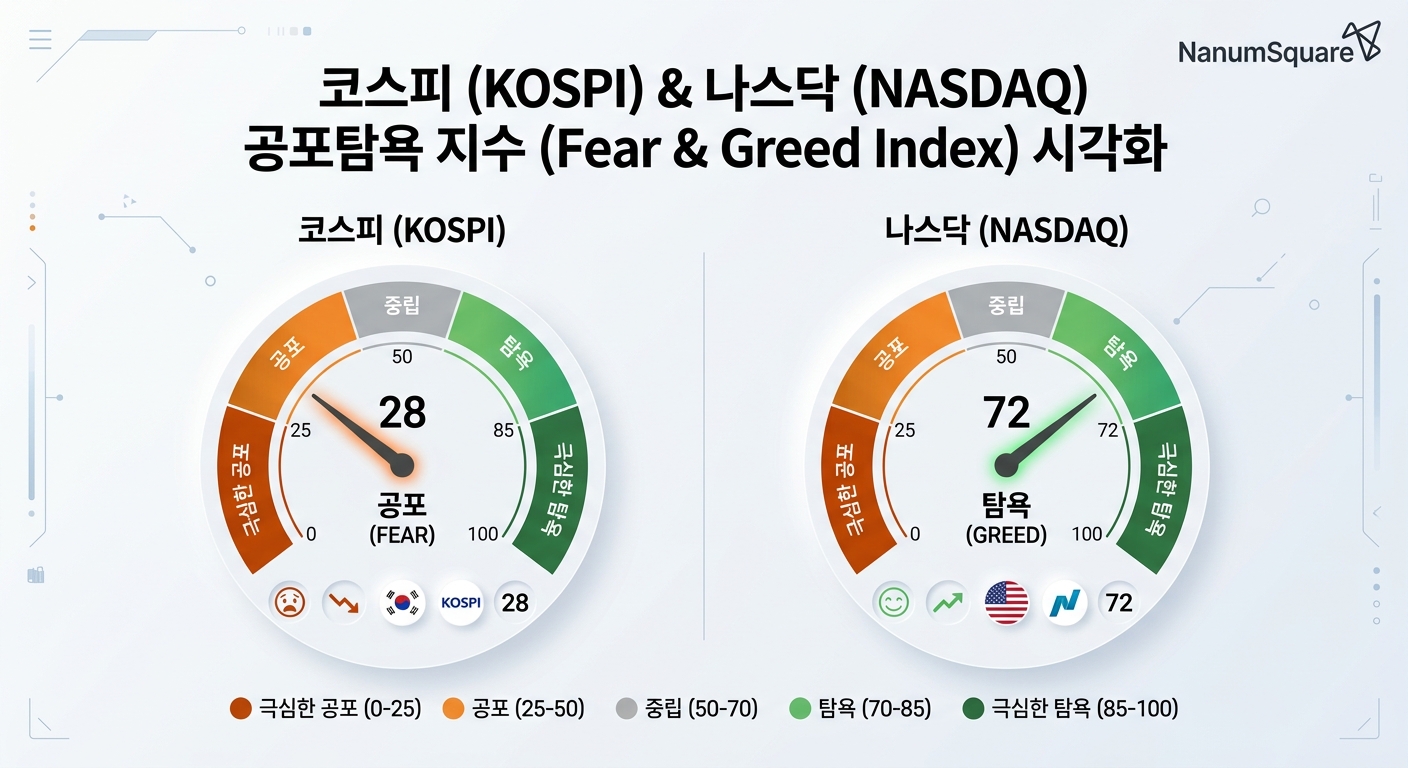
According to Daily Stock's proprietary Fear & Greed Index, the KOSPI currently sits at Neutral (47), showing a gradual stabilization of sentiment compared to Fear (28.7) last week and Fear (34.8) a month ago.
Conversely, the US NASDAQ index stands at 26,253.34, with its Fear & Greed Index in Fear (38.9), falling from Neutral (43.9) last week and Greed (64.7) a month ago, reflecting continued caution across global risk assets.
LG Energy Solution's (373220) share price for the session was marked as "current market price unconfirmed (based on latest verified value)," while market attention remains keenly focused on whether its next-generation form factor, the 46-series (46mm-diameter cylindrical battery), will smoothly settle into mass production.
Following preliminary output at the Ochang plant, its standalone 36GWh annual capacity facility in Arizona, USA, is gearing up for operation, putting to the test a strategic pivot to diversify its client roster beyond reliance on a single EV manufacturer to Mercedes-Benz, Rivian, and BMW.
Current Status Overview
As the global EV market undergoes structural reshaping amid a transitory chasm (demand deceleration) and policy shifts, the next battlefield for the battery industry is moving toward the 46-series.
LG Energy Solution has swiftly built a 46-series portfolio that can boost energy capacity by roughly five times and power output by six times compared to conventional 2170 cells.
Following the smooth commencement of mass production of varied specifications at its Ochang Energy Plant in North Chungcheong Province, South Korea, precision equipment tuning is also underway at its North American bridgehead, the Arizona plant, targeting test runs in Q4 and commercial operations by year-end.
Recently, initial shipments of NCM cathode materials were dispatched from domestic production bases to the Arizona entity, representing tangible progress in line verification.
While battery insourcing and order volatility from a leading global EV manufacturer were previously cited as overhangs, LG Energy Solution has broken through by securing successive large-scale contracts with premium global automotive brands.
With massive supply agreements for Mercedes-Benz, 4695 cell orders for the Rivian R2, and entry into the supply chain for BMW's "Neue Klasse," its 46-series order backlog stands at over 440GWh.
[이미지: /stdaily/uploads/202609/gen_6aa255a98180e9.50701329.png]
Financial Analysis
LG Energy Solution's provisional Q2 2026 consolidated financial results recorded revenue of 7.5602 trillion KRW and an operating profit of 113.3 billion KRW, swinging to profitability from the prior quarter's deficit of -207.8 billion KRW.
The recovery of quarterly revenue above the 7 trillion KRW threshold was jointly driven by the expansion of local Energy Storage System (ESS) projects in North America and a rebound in shipments to Europe.
However, a closer look reveals that Advanced Manufacturing Production Credit (AMPC) benefits under the US Inflation Reduction Act (IRA) amounted to approximately 241.0 billion KRW; excluding this subsidy, the underlying operational balance remained in the red at -127.7 billion KRW.
This reflects persistent conservative inventory strategies among EV customers alongside initial fixed-cost burdens from ramping up new North American production assets.
| Category | Q1 2026 | Q2 2026 (Prelim.) | Change (QoQ) | Key Notes |
|---|---|---|---|---|
| **Revenue** | 6.5550 trillion KRW | 7.5602 trillion KRW | +15.3% | Recovery in ESS and cylindrical cell shipments |
| **Operating Profit/Loss** | -207.8 billion KRW | +113.3 billion KRW | Turned to black | Achieved return to quarterly operating profit |
| **AMPC Tax Credit** | 189.8 billion KRW | 241.0 billion KRW | +26.9% | Impact of expanded North American footprint |
| **Profit/Loss excl. AMPC** | -397.6 billion KRW | -127.7 billion KRW | Reduced deficit | Ongoing structural improvement in core margins |
| **46-Series Order Backlog** | Over 440GWh | Maintained >440GWh | Resilient level | Diversified: Mercedes-Benz, Rivian, BMW, etc. |
With ongoing capacity expansions across North America maintaining elevated quarterly capital expenditures (CapEx), managing leverage ratios and financing costs stemming from borrowings remains a crucial medium-term health check.
Whether the Arizona plant can successfully achieve commercial ramp-up in the second half to lower unit fixed costs and further enlarge AMPC recognition will be the primary benchmark for achieving organic operational profitability.
Valuation
As a foundational bellwether representing the secondary battery sector within the KOSPI 200, LG Energy Solution serves alongside semiconductors (Samsung Electronics, SK hynix) and automotive leaders (Hyundai Motor) as a central pillar guiding the broader index trajectory.
While the overall KOSPI trades around neutral historical 12-month forward P/E levels, the battery sector has historically commanded a relatively rich valuation premium.
While global peer CATL trades at lower multiples backed by domestic Chinese market dominance and cost efficiencies, LG Energy Solution has justified its valuation premium via US market entry barriers and non-China supply chain positioning.
However, amid slowing EV growth rates and policy uncertainties surrounding AMPC provisions, its EV/EBITDA multiples have gradually normalized from historical peaks.
Prevailing share price levels partially price in the assumption that 46-series cylindrical cells and utility-scale ESS will generate robust mass-production margins going forward.
Consequently, further multiple expansion will demand quantitative proof of a fundamental turnaround in standalone manufacturing margins excluding tax subsidies, rather than top-line expansion alone.
Expert and Institutional Analysis
Domestic securities research houses highlight "46-series customer diversification" and "North American ESS localization" as key inflection points for LG Energy Solution in the second half of the year.
Moving past past reliance on a single major client in cylindrical batteries to onboard European and North American OEMs is viewed as a vital buffer against earnings volatility.
Reports from key institutions including IBK Securities positively note that long-term supply contracts with Mercedes-Benz and the Rivian deal have effectively pre-booked the Arizona facility's 36GWh capacity.
Furthermore, penetrating the supply chain for BMW's next-generation "Neue Klasse" platform has reinforced global market confidence in the firm's technological execution.
From a macroeconomic perspective, a KRW/USD exchange rate sustaining around 1,341.30 KRW acts favorably for the KRW-denominated revenues of a cell manufacturer with heavy overseas sales exposure.
Nonetheless, with Bank of Korea policy rate trajectories and broader concerns over a global economic slowdown continuing to dampen consumer sentiment, foreign institutional flows have reflected a data-dependent stance keyed to quarterly corporate reports rather than unilateral net buying.
[이미지: /stdaily/uploads/202609/gen_6aa255b38574c2.32253772.png]
Risk Factors
The most direct risk is a prolonged slowdown in EV adoption across developed markets and potential delays in automakers' electrification roadmaps.
Should rollout timelines or vehicle sales from core partners such as Rivian or Mercedes-Benz underperform projections, utilization rates across Arizona and Ochang could stall.
A second consideration involves US political and trade policy volatility.
Because AMPC tax credits currently represent an integral portion of operating income, any regulatory dilution or tightened qualification criteria emerging from shifts in US legislative or policy environments could immediately depress profitability.
A third hurdle lies in operational yields and advanced production process maturation, such as dry electrode technology.
Given that 4680 configurations carry heightened technical hurdles in tabless welding and thermal dissipation architecture, stabilization expenses during early high-volume runs may run higher than anticipated before reaching steady-state yields.
Investment Perspective Summary
At this juncture, assessing LG Energy Solution calls for looking beyond short-term quarterly variance toward the "46-series ramp-up cycle" bridging late 2026 into 2027.
Whether operational learnings gathered at the Ochang plant translate smoothly to the standalone Arizona hub to establish swift yield stability will decide the stock's valuation rerating.
Concurrently, the extent to which the North American ESS division can cushion the automotive EV chasm and bolster quarterly top-line expansion will anchor downside price support.
While heightened demand for grid infrastructure driven by US AI data center expansion is a clear positive, a sustainable upward re-rating will require margin recovery in its core automotive battery division.
With the KOSPI Fear & Greed Index lingering at Neutral (47) in a period of consolidation, maintaining an analytical rhythm—validating quarterly utilization trends and verifying actual commercial shipments from Arizona rather than aggressively chasing intraday momentum—remains the prudent approach.
Frequently Asked Questions
Q1. When will mass production of LG Energy Solution's 46-series batteries begin in earnest?
The domestic Ochang Energy Plant is already operating an advanced mass-production line, while its core North American hub, the 36GWh Arizona facility, is targeting initial trial operations in Q4 2026 and full commercial output by year-end.
Q2. Which major clients besides Tesla are sourcing 46-series batteries?
Multiple global automakers have been secured as official clients, including Mercedes-Benz (for US and European models), Rivian (R2 platform), BMW (Neue Klasse platform), and subsidiaries of Chery Automobile.
Q3. What is the current size of the 46-series cylindrical battery order backlog?
As of Q1 2026, LG Energy Solution disclosed a 46-series order backlog exceeding 440GWh, an amount sufficient to absorb planned capacity at its Arizona site and associated facilities.
Q4. How much did subsidies (AMPC) contribute to the recent return to quarterly operating profit?
Out of the preliminary Q2 2026 operating profit of 113.3 billion KRW, US IRA tax credits (AMPC) accounted for roughly 241.0 billion KRW; excluding this subsidy, underlying operating results registered a loss of 127.7 billion KRW.
Q5. What alternative growth engine is the company leveraging amid the EV demand chasm?
To address surging power requirements from AI data centers and renewable integration, the company is rapidly expanding its production weighting toward Energy Storage System (ESS) batteries, particularly across North American hubs, filling the volume void left by the EV slowdown.