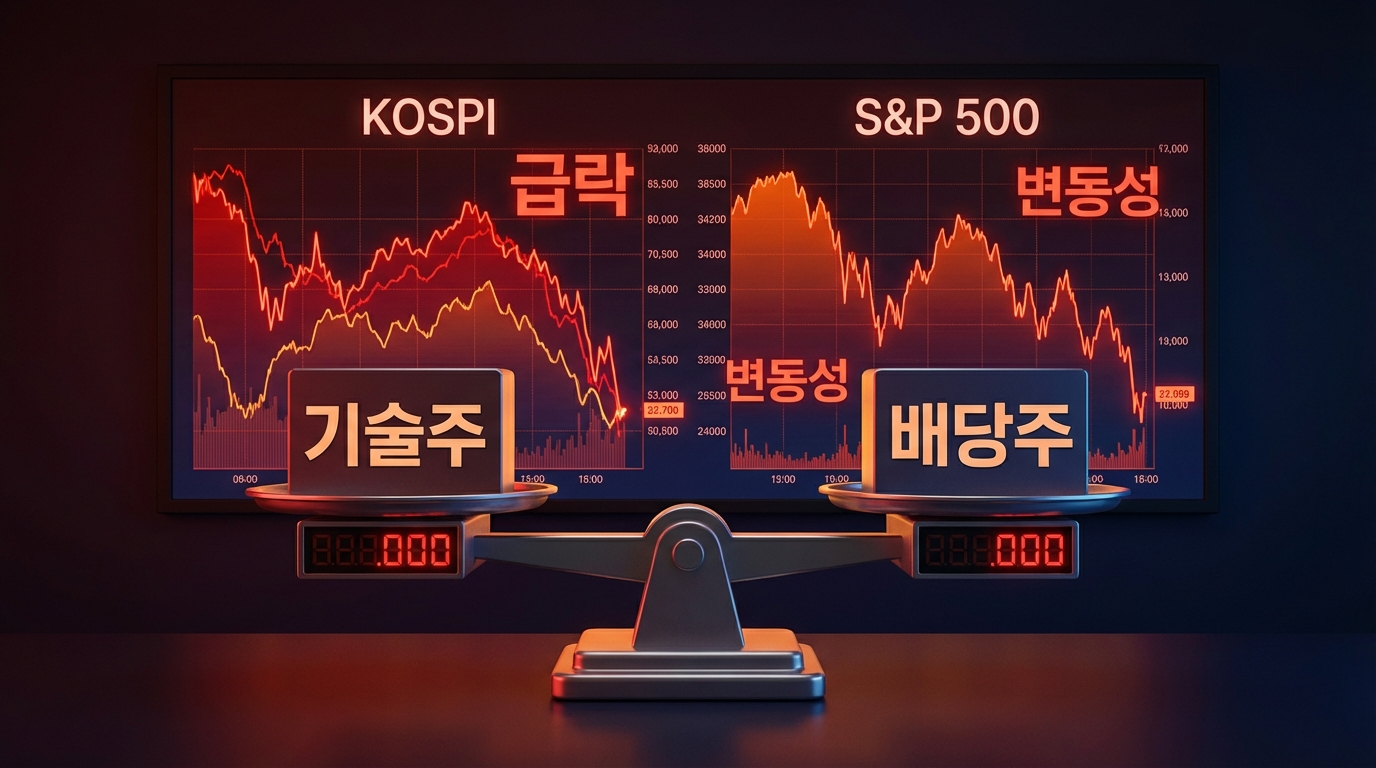
Hello, I am a professional writer for Daily Stock, analyzing the KOSPI supply and demand trends and the global macro environment during trading hours on March 23, 2026.
Core Summary
[Image: /stdaily/uploads/202603/gen_69c09123f1d4b5.41113749.png]
As of today's intraday trading (provisional), the KOSPI recorded 5424.95 and the KOSDAQ 1105.22, showing high volatility.
The US NASDAQ index is at 21647.61, and the KRW/USD exchange rate has soared to 1510.50, reflecting the tension in the macroeconomic environment.
According to Daily Stock's proprietary Fear & Greed Index, KOSPI's sentiment is currently in Extreme Fear (18.2), indicating a significant contraction in investor sentiment compared to Fear (28.2) a week ago, Neutral (57.3) a month ago, and Neutral (46.1) three months ago.
The NASDAQ's Fear & Greed Index is also currently recording Extreme Fear (14.6), continuing the trend from Fear (22.6) a week ago, Neutral (44.4) a month ago, and Fear (21.7) three months ago.
Foreigners and institutions are showing an overall selling trend in the KOSPI market, but a differentiated market is being captured where funds are shifting mainly toward specific value and defensive stocks.
Coupled with the 11-sector rotation phenomenon in the S&P 500 market, this suggests that the search for identical supply and demand safe havens is underway in the domestic stock market.
Current Situation Summary
Currently, the global stock market is facing a new turning point due to entrenched inflationary pressure and geopolitical tensions.
As the recently released US CPI (Consumer Price Index) and PCE (Personal Consumption Expenditures) indicators exceeded market expectations, expectations for a rate cut by the Federal Reserve (Fed) are receding.
This hawkish stance by the Fed is based on the fact that US employment indicators remain at a tight level.
As a result, profit-taking centered on tech stocks is occurring in the US stock market, which is directly leading to a simultaneous selling trend by foreigners in KOSPI large-cap tech stocks.
On the other hand, the top net buying stocks by institutions and foreigners in today's KOSPI market (today's quotes unconfirmed, based on the latest confirmed values) are trending toward a reorganization centered on high-dividend and defensive stocks.
As the exchange rate reaches an unusual high of 1510.50 KRW, investors' movements to hedge against exchange losses and secure definitive dividend yields have become apparent.
Financial Analysis
[Image: /stdaily/uploads/202603/gen_69c09141b1b306.14309763.png]
Looking at the recent changes in the EPS (Earnings Per Share) estimates of S&P 500 companies, performance polarization due to the macroeconomic environment is intensifying.
While EPS forecasts for defensive sectors capable of passing raw material price hikes onto selling prices are maintained or upgraded, expectations for the performance of some tech stocks are trending downward.
The domestic stock market is also moving in strong correlation with this trend of performance revaluation among global companies.
Most of the companies currently listed as top foreigner supply/demand stocks on the KOSPI are financially blue-chip companies with abundant Free Cash Flow (FCF) and cost control capabilities.
In preparation for the possibility of prolonged high interest rates and high exchange rates, investors are focusing on the financial statements of companies that have proven their current profit-generating stamina rather than their future growth potential.
Value stocks with low debt ratios and excellent cash generation capabilities are acting as safety valves for portfolios amidst market uncertainty.
Valuation
Currently, the forward PER (Price-to-Earnings Ratio) of the S&P 500 is undergoing a gradual adjustment, reflecting the market's extreme fear sentiment.
Accordingly, the valuation gap between the growth stocks that led the market and the alienated value stocks is rapidly narrowing, marking a phase where sector readjustment occurs.
In particular, the Russell 2000 index, centered on interest rate-sensitive small and mid-cap stocks, is unable to escape relative weakness compared to large-cap stocks due to the burden of interest expenses.
In the domestic stock market as well, a supply and demand imbalance is occurring where funds are shifting away from the valuation burden of the KOSDAQ (1105.22) into large-cap value stocks on the KOSPI (5424.95).
| Valuation Indicator | S&P 500 Market Trend | KOSPI Supply/Demand Correlation Analysis |
|---|---|---|
| **Forward PER** | Reduction of overvalued growth stock premium | Influx of foreigner buying centered on low-PER value stocks |
| **Dividend Yield** | Downward pressure on dividend attractiveness due to rising government bond yields | Fund concentration into high-dividend holding companies with excellent cash flow |
| **Value vs. Growth** | Relative strength advantage of defensive and value stocks | Selling KOSPI large-cap tech stocks, rotation focused on defensive stocks |
This valuation re-evaluation process is highly likely to signify fundamental capital movement driven by changes in the macroeconomic environment, rather than just a simple short-term theme.
In a situation where the stock market's expected return must compete with high risk-free interest rates, practical dividend yields and valuation attractiveness become key yardsticks.
Expert and Institutional Analysis
[Image: /stdaily/uploads/202603/gen_69c09154e71fd5.50259740.png]
Major Wall Street institutions are paying close attention to the fact that the Atlanta Fed's GDPNow Q1 growth rate estimate is recently being revised downward.
Analyses continue to emerge that concerns over typical stagflation—where prices rise while the economy's fundamental stamina slows down—are rearing their heads.
Fed officials also acknowledge that the pace of inflation slowdown is slower than initially expected, repeatedly emphasizing prudence in monetary policy.
Such macroeconomic uncertainty causes global hot money to flee from emerging market risk assets into dollar cash or defensive stocks.
Experts diagnose that the current foreigner net buying trend in the KOSPI market (today's quotes unconfirmed, based on the latest confirmed values) is thoroughly subordinated to the macro-linked market conditions of the S&P 500.
For the time being, the direction of supply and demand is expected to stay within restricted value stock sectors that can minimize interest rate sensitivity and withstand macroeconomic shocks.
Risk Factors
The risk factor to be most wary of is the possibility that the 'Soft Landing' scenario, which the stock market has firmly believed in, may be compromised.
If the accumulated high interest rate environment begins to pressure the real economy in earnest and worsens the unemployment rate indicators, this could act as a strong signal for economic recession.
Additionally, if the KRW/USD exchange rate maintains its high level of 1510.50 KRW, there is a high risk that the margins of domestic companies with a high proportion of imported raw materials will be structurally compromised.
It should also be noted that since concerns about exchange losses grow for foreign investors as well, the speed of fund outflows across the broader KOSPI market could accelerate.
The fact that both the KOSPI and NASDAQ Fear & Greed Indices have currently entered the 'Extreme Fear' zone is a result of pre-reflecting such potential Tail Risk.
In a state where investor sentiment has become extremely fragile, the entire market can react oversensitively to even a minor piece of bad news, potentially triggering rapid dump-selling.
Investment Perspective Summary
The concentration phenomenon of KOSPI supply and demand identified during today's intraday trading (provisional) directly reflects the defensive rotation of the global macro environment.
Until the uncertainty of the Fed's future interest rate path and high exchange rate pressures are resolved, it may be advantageous to maintain a proportion of assets with relatively excellent defensive power among the 11 sectors.
However, the fact that the market's Fear & Greed Index is located at 'Extreme Fear' implies an opportunity from a contrarian perspective to accumulate companies with solid fundamentals at cheap prices.
Therefore, rather than unreasonable directional betting, strategic patience seems necessary to increase portfolio defensiveness centered on financial blue chips that see a continuous influx of supply and demand from institutions and foreigners.
Investor Checkpoint Q&A
Q1. What are the characteristics of foreigner supply and demand in the KOSPI market today?
A1. Even amidst an overall selling advantage, selective net buying (today's quotes unconfirmed, based on the latest confirmed values) is concentrating on high-dividend value stocks and defensive stocks in response to changes in the global macro environment.
Q2. How does the impact of the S&P 500's sector rotation manifest in the domestic stock market?
A2. The trend of reducing tech stock exposure in the US stock market and shifting into defensive sectors like consumer staples and financials is identically manifesting as a change in the top supply/demand stocks in the KOSPI.
Q3. What is the relationship between the current KRW/USD exchange rate in the 1510s and the KOSPI stock market?
A3. A high exchange rate raises concerns about exchange losses for foreigners, fueling the selling of large-cap stocks overall, but conversely, it bears a two-sided nature by granting an exchange rate effect premium to defensive stocks with high export proportions.
Q4. What does the sluggishness of the US Russell 2000 index imply for domestic investors?
A4. Since the interest expense risk of small and mid-cap stocks is highlighted by concerns of prolonged high interest rates, it implies that confirming financial health, such as debt ratios, is essential when investing in KOSDAQ and KOSPI small and mid-cap stocks.
Q5. How should one respond when both the NASDAQ and KOSPI Fear & Greed Indices are in 'Extreme Fear'?
A5. Since it is a period of maximized volatility, aggressive chase buying should be avoided, but it can be used as a contrarian opportunity to select blue-chip stocks that are excessively undervalued relative to fundamentals due to the market's excessive concerns.