Welcome to Daily Stock, where we pinpoint key market trends using objective data in a changing macroeconomic environment.
Key Summary
[Image: /stdaily/uploads/202603/gen_69bcf17d725fb2.77538473.png]
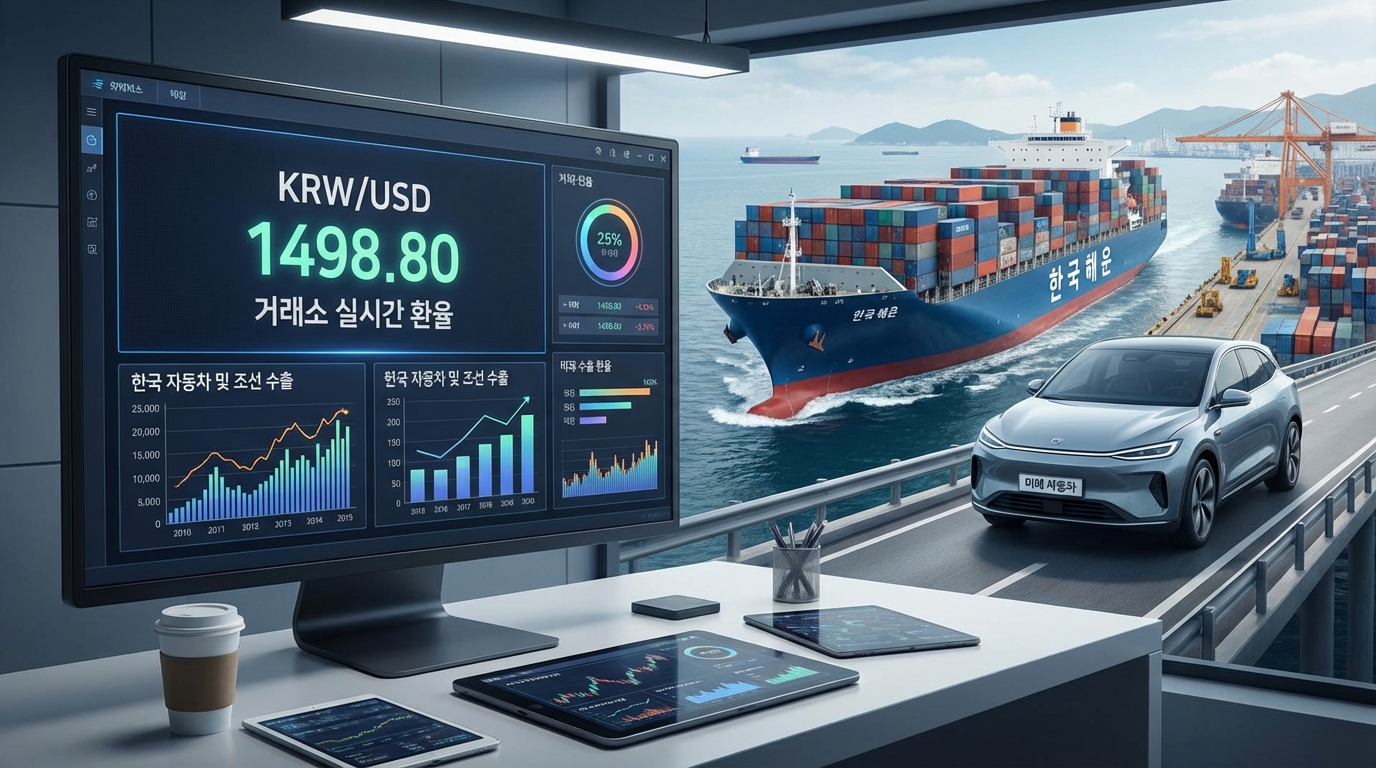
As the KRW/USD exchange rate reached 1,498.80 won on March 20, 2026, market attention is focusing on the first-quarter earnings defense of KOSPI's large-cap export stocks.
While the tech-heavy market shakes due to concerns about a global economic slowdown, expectations of foreign exchange gains enjoyed by Korea's traditional equipment industries, such as autos and shipbuilding, have emerged as a key variable supporting the index's bottom.
However, this ultra-high exchange rate phenomenon does not unconditionally lead to stock price increases.
A conditional market is unfolding, requiring simultaneous observation of strict sector differentiation based on earnings sensitivity and the volatility of foreign supply and demand wary of foreign exchange losses.
Current Situation Summary
On the day, the KOSPI index closed at 5,781.20 and the KOSDAQ index at 1,161.52, showing a fierce supply and demand battle between large-cap export stocks and small- to mid-cap domestic stocks.
The U.S. NASDAQ index recorded 22,090.69, reflecting deep vigilance against macroeconomic downside risks.
The KRW/USD exchange rate fluctuated throughout the session before forming a closing price at a record level of 1,498.80 won, proving the strong upward pressure of the dollar.
This divergence in macroeconomic indicators is directly reflected in the investment sentiment of both countries' stock markets.
According to Daily Stock's own Fear & Greed Index, KOSPI's sentiment is currently in a state of Fear (37.1), slightly recovered from Fear (23.7) a week ago, but still contracted compared to Neutral (57.1) a month ago and Neutral (50.2) three months ago.
On the other hand, the NASDAQ Fear & Greed Index currently indicates Extreme Fear (17.3), showing an intensifying downward pressure after moving through Fear (22.6) a week ago, Neutral (44.4) a month ago, and Fear (21.7) three months ago.
Financial Analysis
[Image: /stdaily/uploads/202603/gen_69bcf196651672.85811749.png]
The current environment, where the exchange rate threatens the 1,500 won mark, heralds significant changes in the first-quarter financial statements of the automobile and shipbuilding sectors within the KOSPI 200, where the export share is absolute.
Typically, major domestic automakers have a high earnings sensitivity, where their quarterly operating profit structurally increases significantly for every 10 won increase in the KRW/USD exchange rate.
The shipbuilding industry is also highly likely to see the high exchange rate trend directly contribute to improved operating profit margins during the process of receiving dollar payments for building previously ordered ships.
Conversely, the aviation and food and beverage sectors, which have a high proportion of domestic demand or massive foreign currency debt, must preemptively prepare for a Q1 earnings shock due to surging cost burdens.
| Sector | Estimated Earnings Sensitivity (Operating Profit Direction) | Major Causes and Financial Characteristics |
|---|---|---|
| Automobiles (Finished Cars) | Positive (Upward) | Expansion of North American export share, increased KRW translation profit of dollar revenue |
| Shipbuilding | Positive (Upward) | Dollar settlement upon ship delivery, additional FX gains generated beyond hedged volumes |
| Semiconductors | Limited Positive | Based on dollar settlements, but partially offset by increased raw material import costs |
| Aviation/Transportation | Negative (Downward) | Massive FX debt valuation losses, surging burden of dollar payments for aviation fuel |
Valuation
Despite their record-breaking profit generation capabilities, large-cap KOSPI export stocks are currently subject to a relatively low price-to-earnings ratio (PER) compared to global competitors or overseas indices.
This is because the market's conservative view dominates, seeing the high exchange rate as merely a one-off earnings boosting effect.
Compared to the KOSDAQ, a benchmark for small and mid-cap stocks, the relative valuation of KOSPI 200 large-caps maintains a premium thanks to dividend appeal and short-term earnings stability.
However, market participants will continue to try to verify the "actual stamina" of their core businesses with the exchange rate effect removed.
Investors are showing moves to explore value investment opportunities based on the price-to-book ratio (PBR) of auto and shipbuilding stocks, which are below historical averages.
Simultaneously, a global demand contraction scenario where export volume (Q) itself could decrease must be reflected in the valuation models.
Expert & Institutional Analysis
Major institutional investors analyze that the KRW/USD exchange rate of 1,498.80 won is acting as a double-edged sword for foreign spot and futures supply and demand.
While there remains the possibility of a mechanical exit of passive funds wary of FX losses, selective bottom-fishing volume is also flowing in as the price attractiveness of large-cap KOSPI stocks in dollar-translated terms increases.
From a macroeconomic perspective, the dominant assessment is that the Bank of Korea has fallen into a dilemma, unable to easily decide on the direction of the base interest rate between defending the exchange rate and sluggish domestic demand.
This is because raising rates recklessly carries high concerns about household debt and economic slowdown, while maintaining a freeze could encourage an exodus of foreign capital.
Experts forecast that Korea's upcoming import and export trend data will be the key indicator determining short-term market direction.
The process of confirming how much the exchange rate increase (P) has offset the decrease in export volume (Q) caused by the global consumption slump will be the true inflection point for foreign supply and demand.
Risk Factors
[Image: /stdaily/uploads/202603/gen_69bcf1ac4e1cb6.08456963.png]
The macroeconomic risk to be most wary of is the fear of a global economic slowdown, which could completely overwhelm the short-term exchange rate effect.
As glimpsed in the NASDAQ index's state of Extreme Fear, if the U.S. consumption slump materializes, there is a risk that the absolute demand base for importing Korean cars and ships will collapse entirely.
Also, the ultra-strong dollar phenomenon approaching 1,500 won could return as a boomerang, restimulating domestic inflation by drastically raising the import prices of essential raw materials.
This could cause a chain reaction of increased borrowing costs for companies, triggering long-term damage to operating profit margins.
A volatile market where the KRW/USD exchange rate drops sharply due to verbal intervention by major countries or expectations of a shift in monetary policy cannot be ruled out either.
In this case, large-cap export stocks that had preemptively priced in the benefits of a high exchange rate could face a short-term valuation shock, so caution is needed.
Investment Perspective Summary
In an extreme exchange rate environment of 1,498.80 won, a defensive approach that meticulously examines the sustainability of profits is required rather than blindly following traditional export stocks.
Rather than relying on the optical illusion of operating profits increasing simply due to foreign exchange gains, investors should select structurally growing companies that defend their global market share with overwhelming product competitiveness.
In the short term, ahead of the Q1 earnings announcement season, large-cap auto and shipbuilding stocks within the KOSPI 200, where the exchange rate effect will be fully reflected, can be noted from a trading perspective.
However, when constructing a mid-to-long-term portfolio, thorough risk management must be accompanied.
Daily cross-verification of whether foreigners switch to net buying of KOSPI 200 futures and whether the KRW/USD exchange rate breaks through the upper resistance line is essential.
A conditional strategy that prepares for various macroeconomic scenarios without blindly trusting the uptrend would be the most rational way to survive in the current market.
Investor Checkpoint Q&A
- **Q: Is an exchange rate approaching 1,500 won per dollar unconditionally bad news for the entire KOSPI?**
A: On the supply and demand side, the overall downward pressure on the index may increase due to concerns about foreign capital flight. However, KOSPI 200 large-cap export stocks such as autos and shipbuilding show a distinct sector-by-sector divergence, as their KRW-translated earnings from dollar revenues increase significantly.
- **Q: Why is the earnings sensitivity of the auto and shipbuilding industries particularly high?**
A: Both sectors have an overwhelmingly high export share and mainly receive payments in dollars. Therefore, they have a structural characteristic where the KRW-based operating profit increases significantly for the same amount of dollars earned as the value of the won falls (exchange rate rises).
- **Q: What is the biggest risk to watch out for when investing in high exchange rate beneficiaries?**
A: If the drop in actual sales volume (Q decrease) due to the global economic slowdown is greater than the increase in profit due to the exchange rate (P increase), the final earnings could actually worsen. Therefore, the order backlog and market share defense capabilities of the company must be verified.
- **Q: What is the background behind the difference in the Fear & Greed Index between KOSPI and NASDAQ currently?**
A: The NASDAQ is experiencing Extreme Fear (17.3) due to macroeconomic slowdowns and tech stock peak controversies, but the KOSPI is showing downward support at a relatively moderate Fear (37.1) level, partially driven by expectations of Q1 earnings defense by large-cap export stocks.
- **Q: How is the Bank of Korea's base interest rate direction affecting the current market?**
A: To defend the high exchange rate, a rate hike is necessary, but the BOK is facing a dilemma where it cannot easily raise rates due to concerns about a domestic consumption slump. These policy constraints stimulate foreign investors' fears of FX losses, becoming a factor that increases the volatility of the domestic stock market.