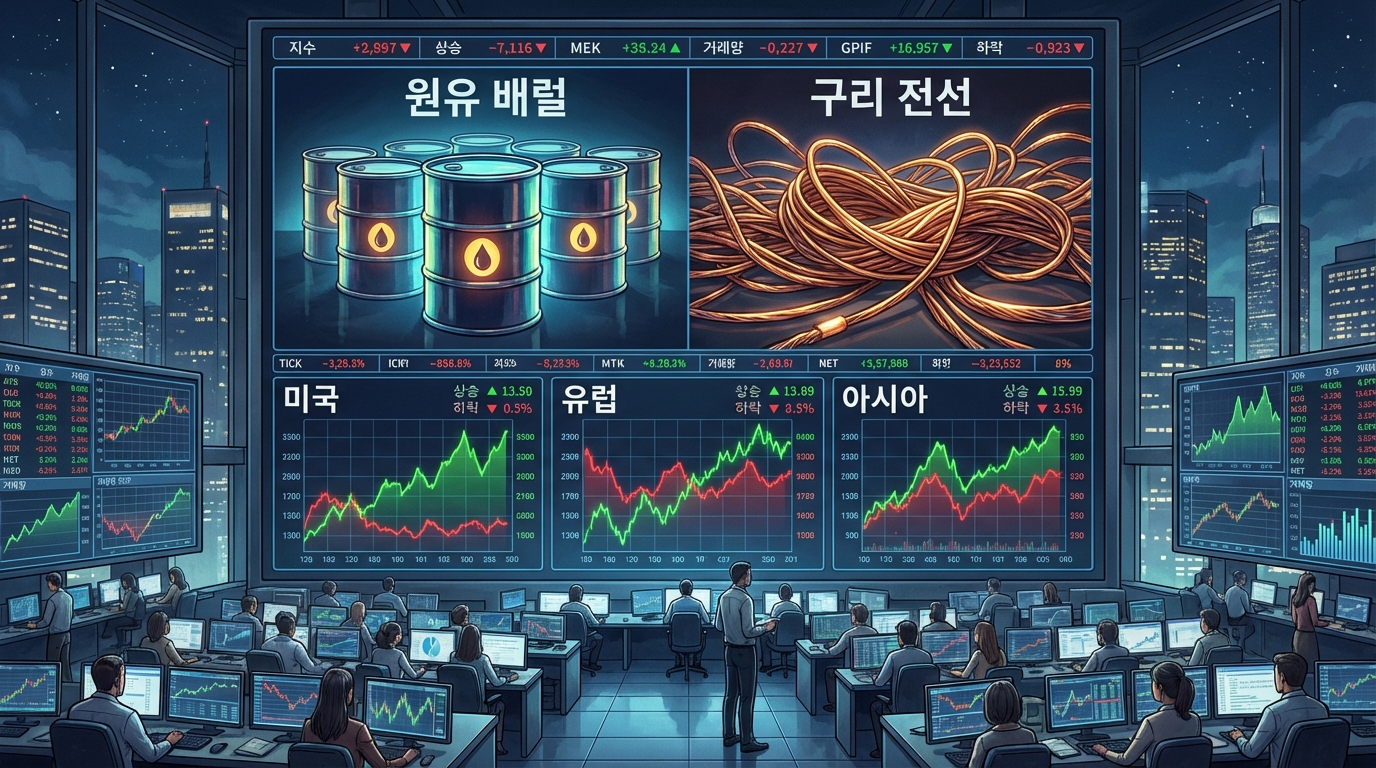
Hello, I am a professional writer for Daily Stock. Today, we will deeply analyze the contrasting ripple effects of soaring commodity prices on the top three global stock markets and the fundamental decoupling phenomenon.
[Image: /stdaily/uploads/202603/gen_69bb49b0338c54.16075386.png]
Key Summary
As Brent crude oil surpasses $100 per barrel and copper, known as 'Doctor Copper,' hits an all-time high, a massive wave originating from commodities is sweeping over the global financial market.
Even amidst such inflationary pressure, a stark decoupling is observed: the US stock market defends against the shock with the strong momentum of AI infrastructure investments, while Asian stock markets see their fundamentals damaged by surging exchange rates and capital outflows.
Current Situation Summary
As of intraday on March 19, 2026 (provisional), major global stock markets are showing a distinct difference in temperature.
The US NASDAQ index is recording 22,152.42, while South Korea's KOSPI and KOSDAQ are experiencing extreme volatility at 5,756.69 and 1,143.93, respectively.
In particular, the KRW/USD exchange rate has soared to 1,501.30 won, exerting strong downward pressure on the overall Asian asset market.
According to Daily Stock's proprietary Fear & Greed Index, the KOSPI is currently in the Fear (35.1) stage, with sentiment slightly worsening compared to Fear (30.9) a week ago. The NASDAQ is currently recording Extreme Fear (18.2), indicating a sharp cooling of investor sentiment compared to Neutral (41.9) a month ago.
Financial Analysis
The renewal of all-time highs in copper prices is interpreted not merely as a supply-demand imbalance, but as the result of worldwide AI data center expansion and power infrastructure investments.
Big tech companies in the US are enduring the rise in raw material costs based on their strong cash-generating abilities, but manufacturing-centric Asian companies have fallen into a structural dilemma where operating margins are severely damaged by surging import prices.
Looking at the recently released global PMI indices, the US and Europe are maintaining an expansion phase above the baseline (50), driven mainly by the service sector.
On the other hand, in the Asian region highly dependent on Middle Eastern oil-producing countries, the spike in oil prices is threatening the financial health of marginal companies and causing a bottleneck in global liquidity.
[Image: /stdaily/uploads/202603/gen_69bb49ca365f54.13751969.png]
Valuation
Currently, the index relative strength and valuations of the three regions are moving completely separately depending on the central banks' policy paths and commodity sensitivity.
The US is justifying its premium by proving an overwhelming Return on Equity (ROE) even in a high-interest-rate environment, while Europe is defending its valuation appeal centered on traditional cyclicals and value stocks.
In contrast, Asian emerging markets have entered a phase where valuation metrics such as the Price-to-Earnings Ratio (PER) hover around historical averages or are discounted, compounded by the strong dollar phenomenon and the exodus of foreign capital.
The following is a comparison table of fundamentals and policies by major region.
| Region | Core Fundamental Drivers | Valuation Characteristics | Central Bank Policy Direction (March 2026) |
|---|---|---|---|
| **US** | AI Theme and Tech Stock Earnings | Sustained High Premium | Fed: Cautious on Rate Cuts (Dot Plot Changes) |
| **Europe** | Strong Services PMI | Defensiveness Centered on Value Stocks | ECB: Expectations of Further Easing upon Inflation Slowdown |
| **Asia (Japan/Korea, etc.)** | Import Price Burden and Weak Currency | Deepening Structural Discount | BOJ: Maintaining 0.75% / PBOC: Struggling with Economic Stimulus |
Expert and Institutional Analysis
Global investment banks unanimously agree that the direction of energy prices in the short term is the key variable that will determine the fate of the stock markets.
Citigroup forecasted that Brent crude prices could rise to $110-$120 per barrel in the future, citing production cuts at Middle Eastern refineries and risks in the Strait of Hormuz.
On the monetary policy front as well, experts point out the differentiated stances where the European Central Bank (ECB) supplies liquidity through preemptive interest rate cuts, while the Bank of Japan (BOJ) maintains its rate at the 0.75% level, weighing the timing for further hikes.
These uncoordinated moves by central banks of various countries are analyzed as the main reason causing global capital to tilt towards relatively safe US assets with high expected returns.
[Image: /stdaily/uploads/202603/gen_69bb49e078a196.31755591.png]
Risk Factors
By far the most fatal detonator is the disruption of the global supply chain due to the escalation of geopolitical risks.
If instability in the Strait of Hormuz prolongs, it could lead to rising freight rates and logistics paralysis beyond a simple increase in energy costs.
Also, if expectations for interest rate cuts in the US recede and treasury yields spike again, the risk of a sharp contraction in the valuations of growth stocks scattered across global markets remains ever-present.
The continuous high-flying of the KRW/USD exchange rate is also cited as a macroeconomic headwind that can accelerate the exodus of foreign capital.
Investment Perspective Summary
In the current market conditions, it is necessary to acknowledge the fundamental decoupling by region and employ a flexible scenario-based asset allocation strategy.
One might consider including a portion of energy and copper-related sectors in the portfolio for hedging purposes, which can directly defend against the benefits of the commodity rally.
While approaching the weight of Asian stock markets exposed to exchange rate risks conservatively, it seems effective to diversify focus towards US big tech or European cyclical blue-chip stocks that demonstrate relative defensive power.
However, as it is a period of maximized market volatility, risk management through staggered buying should be prioritized over prematurely predicting the bottom.
Core Keywords at a Glance
- **Brent Crude Surpassing $100**: Concerns over reigniting global inflation are spreading as international oil prices surge due to Middle Eastern geopolitical risks and supply chain anxieties.
- **Doctor Copper (Copper) All-Time High**: With explosive demand for AI data centers and power infrastructure, copper is rapidly emerging as a 'strategic asset' beyond a simple industrial material.
- **Tri-Polar Stock Market Decoupling**: A stark divergence in stock price trends has occurred among the US withstanding the oil shock, Europe centered on value stocks, and Asia shaken by soaring exchange rates.
- **KRW/USD Surpassing 1,500 Won**: Structural discount pressures on the Asian asset market are intensifying due to the gap in growth attractiveness with the US and the outflow of foreign capital.
- **Central Bank Misalignment (ECB vs BOJ)**: While the ECB shows a monetary easing stance to defend the economy, the BOJ maintains a policy wait-and-see attitude after interest rate normalization, inducing differentiation in global liquidity flows.