This is Daily Stock, closely analyzing the trends of key large-cap stocks in the domestic market and the next turning point of the secondary battery industry.
[Image: /stdaily/uploads/202610/gen_6abf56a2cd4ee4.15071671.png]
Key Summary
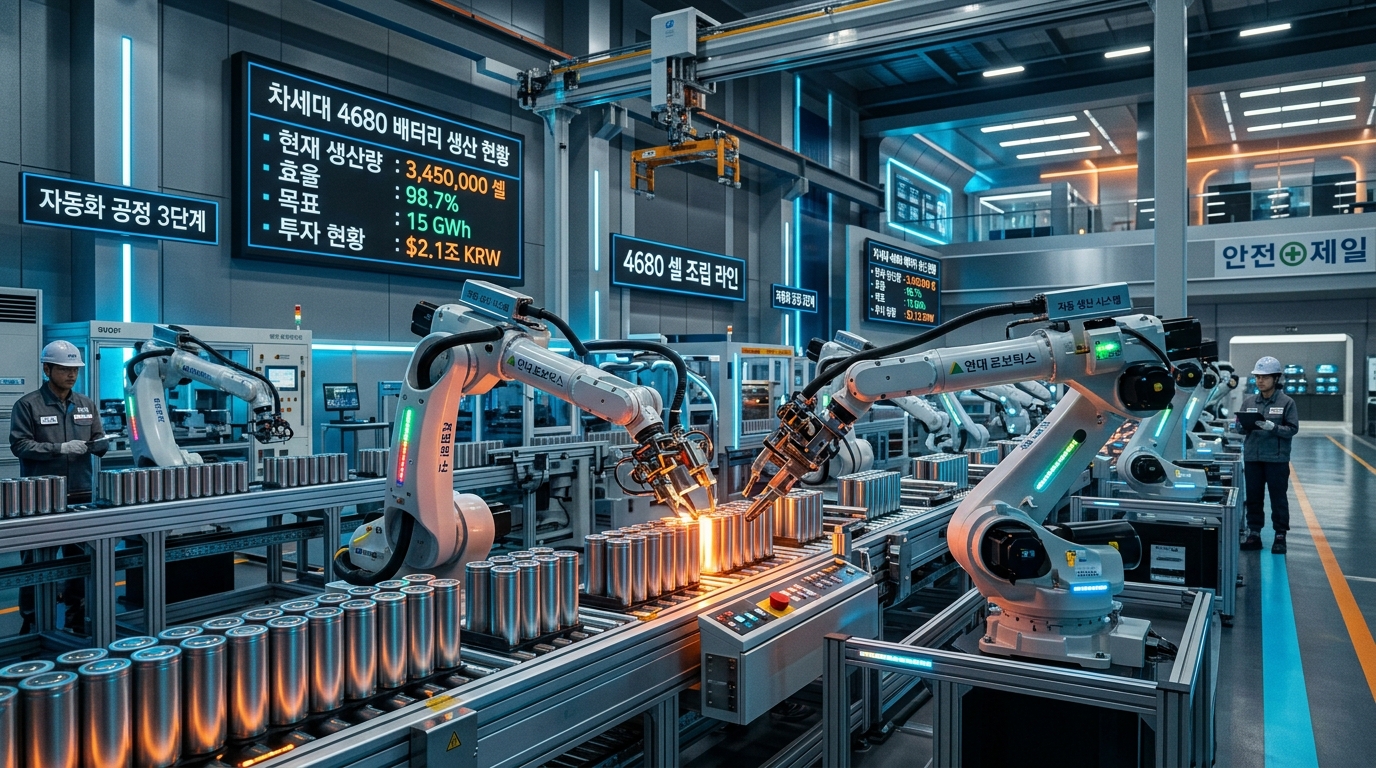
LG Energy Solution has begun solidifying its dominance in the North American market by rapidly expanding its portfolio from its existing pouch-centric setup to next-generation cylindrical 46-series cells (4680, 4695, and 46100).
Building on pre-mass production experience at its Ochang plant, commercial operation of its standalone facility in Arizona, U.S., has entered visible range, with the global order backlog for the 46-series alone exceeding 440GWh.
Amid a USD/KRW exchange rate of 1,351.50 won and a neutral KOSPI Fear & Greed Index reading (40.9), foreign investor flows are simultaneously weighing concerns over a prolonged EV chasm (temporary demand stagnation) against expectations for early market capture in ESS (Energy Storage Systems) and next-generation cylindrical cells.
Despite short-term capacity utilization volatility, large-scale, long-term contracts signed with global automakers such as Mercedes-Benz and Rivian are highly likely to serve as key pillars supporting mid- to long-term earnings downside.
Current Market Situation
The domestic stock market closed with the KOSPI at 7,003.74 and the KOSDAQ at 893.29, continuing a consolidation phase centered on large caps.
While the U.S. Nasdaq composite recorded 26,871.60 and the Nasdaq Fear & Greed Index remained in the "Fear" zone (28, compared to 36.9 a week prior), the domestic KOSPI Fear & Greed Index held at a "Neutral" level (40.9, compared to 55.3 a week prior, 30.5 a month prior, and 19.8 three months prior).
While LG Energy Solution's share price for the day remains unconfirmed (based on the latest confirmed data), the broader large-cap secondary battery sector is absorbing volatility amid sector rotation between semiconductors and financials.
In particular, the Bank of Korea's base rate trajectory and the direction of subsidy policies (such as the IRA and AMPC) surrounding the U.S. presidential election serve as major macroeconomic variables linked to foreign net buying and selling across spot and futures markets.
The battery industry's attention is focused on stabilizing the 46-series at the Ochang Energy Plant in North Chungcheong Province and on the standalone cylindrical battery facility currently being built in Arizona with an annual capacity of 36GWh.
Moving away from heavy reliance on a single customer like Tesla, the supply base is diversifying to include Mercedes-Benz (contracts totaling around 107GWh) and Rivian (67GWh), clarifying the company's strategy to pre-secure capacity utilization at its North American plants.
| Category | Key Details & Execution Timeline | Notes |
|---|---|---|
| **Market Macro** | KOSPI 7,003.74 / USD/KRW 1,351.50 | KOSPI Fear & Greed 40.9 (Neutral) |
| **Ochang Energy Plant** | Pre-mass production of 4680 & 4695; Mother Factory online | Completed validation of next-gen cylindrical processes |
| **Arizona Standalone Plant** | Building 36GWh cylindrical lines (out of 53GWh total) | Driving ramp-up of the North American hub |
| **46-Series Order Backlog** | Cumulative backlog exceeding 440GWh secured | Customer diversification (Benz, Rivian, Ford, etc.) |
| **ESS Business Transition** | Expanding North American grid-scale LFP lines; supporting utilization | Addressing power demand from AI data centers |
Financial Analysis
Although LG Energy Solution experienced quarterly fluctuations in utilization rates and profitability due to the global EV demand slowdown, it has built an earnings defense through North American AMPC (Advanced Manufacturing Production Credit) incentives and growing ESS revenue.
As of Q1 of this year, local manufacturing policy benefits formed an important axis of cash flow, with 189.8 billion won in North American production subsidies recognized in earnings.
[Image: /stdaily/uploads/202610/gen_6abf56aee43ad8.12981568.png]
The company is enhancing capital efficiency by pacing its capital expenditures (CAPEX) alongside repurposing idle pouch lines for ESS applications.
In particular, once full-scale mass production of the 46-series gets underway, the number of manufacturing steps required per unit of energy decreases compared to traditional 2170 batteries, creating expectations for structural financial improvements via meaningful reductions in fixed costs and manufacturing unit costs.
However, rising depreciation expenses from early operations at new facilities and the cost burdens associated with yield stabilization remain constraints on short-term operating margins.
Looking ahead to the second half and beyond, the pace of reaching quarterly break-even will hinge on the expansion of initial shipments from Ochang and the operational progress rate of the Arizona lines.
Valuation
Currently, valuations of large-cap secondary battery stocks within the KOSPI 200 reside near the lower end of their historical bands, having significantly relieved earlier valuation pressures.
However, compared to other major manufacturing groups with clearer earnings visibility—such as semiconductors (Samsung Electronics, SK Hynix) or automotive (Hyundai Motor, Kia)—a future growth premium remains priced into the stock.
Compared to global competitors like CATL, LG Energy Solution's local manufacturing infrastructure in North America and non-China supply chain advantages are viewed as clear premium drivers.
The market is paying close attention to whether the EV/EBITDA multiple will normalize once the 440GWh 46-series order backlog begins translating into recognized revenue.
If the USD/KRW exchange rate maintains stability above the 1,350 won level, it could yield favorable foreign-currency translation gains for overseas revenue.
Conversely, if global automakers delay EV rollouts, pressure for multiple de-rating could resurface, calling for a conservative approach to valuation.
Expert & Institutional Analysis
Research analysts at major domestic and international brokerages look favorably on LG Energy Solution's early positioning in next-generation form factors and its ESS portfolio diversification.
According to institutional analyses, including Mirae Asset Securities, mid- to long-term earnings power is projected to recover gradually as North American ESS bottlenecks ease, European delivery volumes resume, and early shipments of the 46-series begin.
[Image: /stdaily/uploads/202610/gen_6abf56bc5fb7e7.74598067.png]
IBK Securities analyzed that the Arizona facility's 36GWh cylindrical production capacity is already largely covered by orders, citing large-scale cylindrical contracts with Mercedes-Benz.
Their perspective suggests that while overseas competitors like Panasonic struggle to secure mass-production yields, LG Energy Solution could seize market leadership using tabless manufacturing processes and high-nickel NCMA technology.
On the other hand, foreign investors maintain a cautious trading posture, heavily weighing the possibility that major North American automakers could revise their electrification roadmaps.
Against a backdrop of a 1,351.50 won exchange rate, foreign institutional liquidity across large-cap Korean stocks remains sensitive to index futures rollover trends and quarterly earnings reports.
Risk Factors
The primary factor requiring caution is delivery schedule delays by automotive clients caused by the deepening EV chasm across core North American and European markets.
As seen previously during contract negotiations with Tesla, automaker efforts toward in-house battery production or delayed vehicle rollouts can directly lead to declining manufacturing capacity utilization.
Furthermore, debates over reducing or repealing Inflation Reduction Act (IRA) tax credit benefits amid shifts in the U.S. political landscape add uncertainty to North American profitability assumptions.
Under circumstances of substantial ongoing CAPEX, a sustained strong dollar and elevated borrowing costs increase financial expenses, which could weigh on net income.
Finally, the global market penetration of Chinese LFP batteries and intensified technical standard competition among other form factors (prismatic, cylindrical) represent medium- to long-term risks to market share.
Investment Perspective
Even amid the secondary battery industry downcycle, LG Energy Solution is carving out clear growth paths through 46-series cylindrical cells—led by the 4680—and grid-scale ESS.
If the Ochang plant's mother-factory role and the Arizona plant's ramp-up settle according to plan, the company is poised to establish a firm leadership position in the North American cylindrical battery market from 2026 onward.
From an investor's perspective, tracking the conversion timing of customer diversification into actual shipments and factory yield curves is more essential than reacting to short-term quarterly earnings fluctuations.
In the current environment where the KOSPI Fear & Greed Index stands at 40.9 (Neutral), managing macroeconomic currency volatility and adopting a staged, pacing approach rather than aggressive position building represents a prudent strategy.
Investor Checkpoint Q&A
Q1. What is the current production footprint and schedule for LG Energy Solution's 4680 battery?
The company has completed pilot production and validation of the next-generation 46-series at its Ochang Energy Plant and is preparing for phased ramp-ups following equipment installation at its primary North American base in Arizona.
Q2. What is the scale of the 46-series order backlog, and who are the key clients?
As of 2026, the cumulative 46-series order backlog is estimated at over 440GWh, with key customer accounts secured, including Mercedes-Benz, Rivian, and Ford.
Q3. What alternative growth drivers is the company deploying to counter the EV demand slowdown (chasm)?
The company is sharply increasing local North American production of LFP-based ESS to meet demand from AI data center expansions and renewable grids, while defending overall utilization by converting legacy EV pouch lines to ESS production.
Q4. How is the macro environment (FX rates and institutional flows) impacting the share price?
While a USD/KRW exchange rate around 1,351.50 won supports overseas export pricing conversions, foreign investor flows remain selective amid global economic cooling concerns and neutral sentiment toward the KOSPI.
Q5. What are the key catalysts to monitor for a future share price rebound?
Key milestones include the commencement of commercial shipments from the Arizona facility, the integration schedule of 46-series cells into flagship vehicles like the Rivian R2, and the continuity of U.S. manufacturing credit (AMPC) policy support.