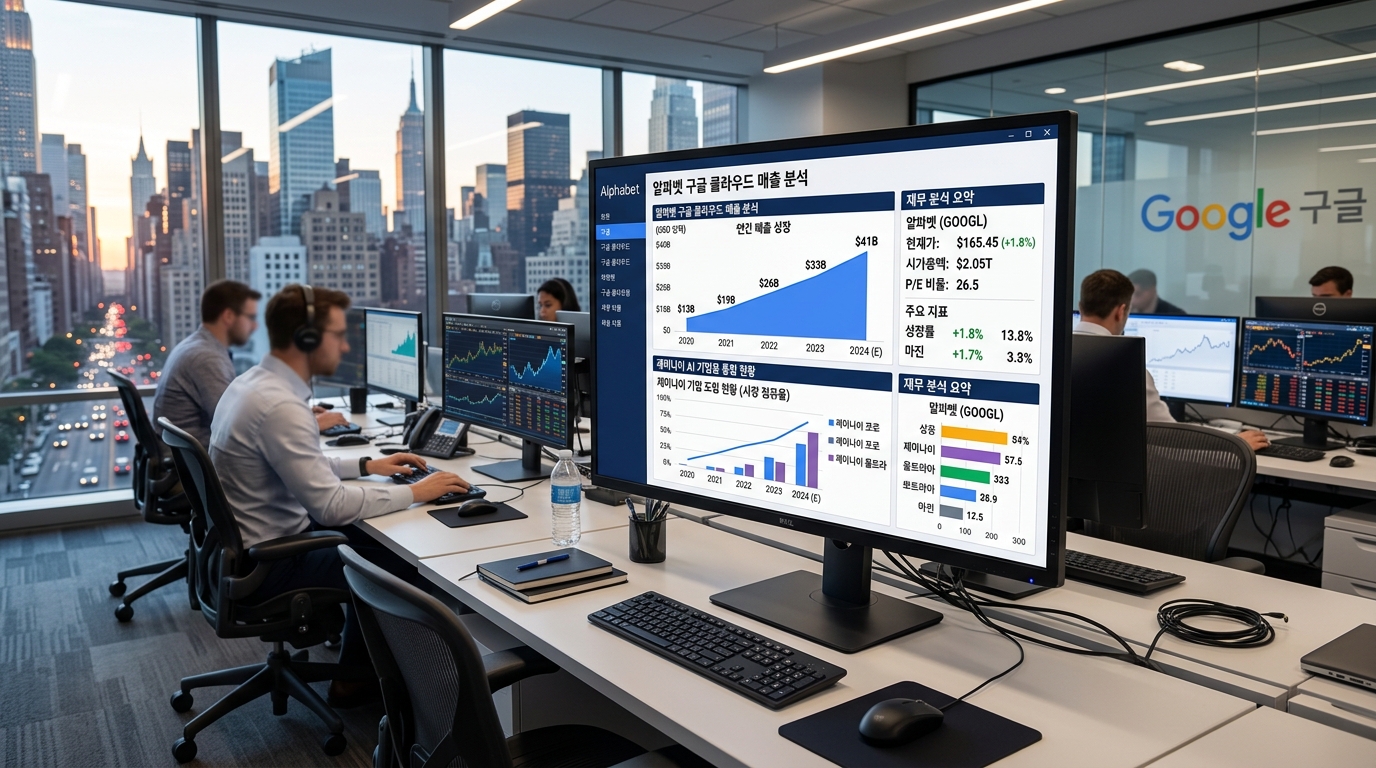
This is Daily Stock, delivering an in-depth analysis of AI monetization pathways and structural margin shifts among global tech leaders.
Key Takeaways
Alphabet (GOOGL) is proving robust margin leverage in enterprise B2B artificial intelligence (AI) solutions by combining Google Workspace and Google Cloud Platform (GCP), moving beyond a single revenue structure centered on search advertising.
The successful integration of Gemini Enterprise capabilities is driving expansion in average revenue per user (ARPU), establishing itself as the core engine cementing double-digit operating margins for the Cloud segment.
[이미지: /stdaily/uploads/202609/gen_6ab1c53edeeee3.17347308.png]
Current Market Overview
As of 9:00 AM KST on September 22, 2026 (preliminary), global equity markets remain in a phase of closely scrutinizing the gap between mega-cap tech capital expenditure (CAPEX) pace and actual cash flow generation capability.
In the domestic Korean market, the KOSPI stands at 7,165.92, the KOSDAQ is at 847.14, and the USD/KRW exchange rate continues trading at 1,373.50 KRW.
The Nasdaq Composite is fluctuating around the 27,122.09 level, while Alphabet (GOOGL) shares are digesting revisions to earnings guidance, with the intraday quote unconfirmed (based on the latest verified data).
According to the Daily Stock Fear & Greed Index, the Nasdaq Fear & Greed Index sits at 33.7, indicating a state of 'Fear.'
While this is a slight rebound from 'Fear' (31.0) one week ago, it reflects a significant contraction compared to 'Neutral' (54.7) one month ago and 'Greed' (66.2) three months ago, illustrating heightened investor sensitivity toward valuation burdens.
In contrast, the KOSPI Fear & Greed Index currently stands at Neutral (51.6), showing a recovery from Fear (25.0) a week ago.
Amid localized tensions across the US Dollar Index (DXY) and the Volatility Index (VIX), the market is closely watching Cloud operating margin as a tangible gauge of AI monetization.
Financial Analysis
Google Cloud (including GCP and Google Workspace) has completely moved past its historical loss-making phase driven by massive infrastructure depreciation, transforming into a primary pillar boosting Alphabet's overall operating income.
The Gemini Enterprise tier, bundled as an add-on subscription to enterprise Workspace, has effectively raised per-seat pricing and rapidly accelerated fixed-cost coverage.
| Segment & Metric | Performance & Metric Trend | Key Drivers & Analysis |
|---|---|---|
| Google Cloud Quarterly Revenue | Sustained steep double-digit growth | Expanding enterprise deal wins and massive AI workload demand |
| Cloud Segment Operating Margin | Settling in double digits with expanding leverage | Workspace high-margin subscription gains and proprietary TPU cost efficiencies |
| Gemini Enterprise Adoption | Adopted by numerous Fortune 100 enterprises | Increased unit pricing via integrating generative AI directly into productivity suites |
| Alphabet Annual CAPEX Trend | Expanding AI server and data center footprint | Upfront infrastructure investments deployed to meet surging inference demand |
The establishment of an in-house TPU (Tensor Processing Unit) accelerator ecosystem is lowering reliance on costly Nvidia GPUs while optimizing unit acquisition costs for external cloud clients, significantly aiding margin expansion.
However, persistently expanding quarterly capital expenditures (CAPEX) could accumulate depreciation burdens, making sustained expansion in revenue per user critical.
[이미지: /stdaily/uploads/202609/gen_6ab1c5492158d9.06843493.png]
Valuation
Valuations across S&P 500 growth equities relative to the Nasdaq 100 currently exhibit extreme sensitivity to shifts in the interest rate environment.
The trajectory of the US 10-Year Treasury Yield (US10Y) remains the central variable determining the discount rate applied to long-duration cash flows of mega-cap tech firms like Alphabet.
Alphabet is driving a multiple re-rating for its cloud division backed by strong operating cash flows from its legacy search engine.
While the Philadelphia Semiconductor Index (SOX) is largely dictated by supply chain capex cycles, Alphabet's valuation benefits from relative downside resilience anchored in B2B software subscription conversion rates and infrastructure efficiency.
Expert & Institutional Perspectives
Major Wall Street investment banks assess that Gemini's penetration across Google Workspace has formed a legitimate market share contest with Microsoft's M365 Copilot.
Numerous institutions emphasize that enterprise customer retention will be determined not simply by raw model parameter scale, but by enterprise-grade data security, API call costs, and depth of workflow integration.
Morgan Stanley and Goldman Sachs, in particular, project that Cloud segment margin leverage will be the primary alpha driver pushing Alphabet's consolidated EPS consensus higher.
Conversely, certain tech research firms caution that the conversion pace from enterprise AI pilot programs to full-scale, company-wide paid subscriptions may fall short of elevated market expectations.
Risk Factors
The most fundamental operational risk is that infrastructure running costs (inference costs) associated with generative AI deployment could erode incremental subscription revenues.
Additionally, antitrust actions led by the US Department of Justice (DOJ) and global regulators targeting ad tech and ecosystem unbundling present structural uncertainties for the core search cash cow.
From a macroeconomic perspective, any shifts in Federal Reserve monetary policy or sudden spikes in the US 10-Year Treasury yield (US10Y) could trigger broad valuation de-rating across high-multiple growth equities.
Investment Perspective
Alphabet is one of the few mega-cap technology firms that have established a fully vertically integrated AI stack (TPUs - Models - SaaS - Cloud).
Expanding Gemini adoption across enterprise Workspace improves the quality of recurring revenue (ARR) rather than providing one-off windfalls, reinforcing Cloud margin stability.
Investors should look past short-term price volatility and focus on whether Cloud operating margins continue their structural expansion alongside the pacing of the infrastructure investment payback cycle.
Frequently Asked Questions
Q1. How is Gemini Enterprise billed within Google Workspace?
It is billed as a per-user monthly add-on license on top of existing Workspace Business or Enterprise plans, driving near-term ARPU expansion.
Q2. Why is Google Cloud's operating margin improvement crucial for Alphabet's stock price?
With search advertising growth entering a mature phase, Cloud must demonstrate its viability as a double-digit operating margin growth engine to sustain Alphabet's valuation premium.
Q3. What differentiates Google from competitors like Microsoft Azure and M365 Copilot?
Its cost efficiency driven by proprietary TPU infrastructure, combined with a deeply integrated web-native collaboration environment across Google Docs and Drive, serves as key competitive advantages.
Q4. What is the specific impact of US 10-Year Treasury yield fluctuations on Alphabet?
Rising yields increase the discount rate applied to mega-cap tech firms' long-term projected cash flows, exerting downward pressure on price-to-earnings (P/E) multiples.
Q5. Does Alphabet's aggressive AI CAPEX pose a threat to cash flows?
Robust free cash flow generated quarterly by the core search business provides a strong buffer; however, if cloud revenue growth fails to outpace rising depreciation expenses, it could emerge as a source of margin compression.