Hello, this is Daily Stock, delivering in-depth analysis of key global macroeconomic trends and industrial landscapes.
[이미지: /stdaily/uploads/202609/gen_6aa6f2d2816db3.32278062.png]
Key Summary
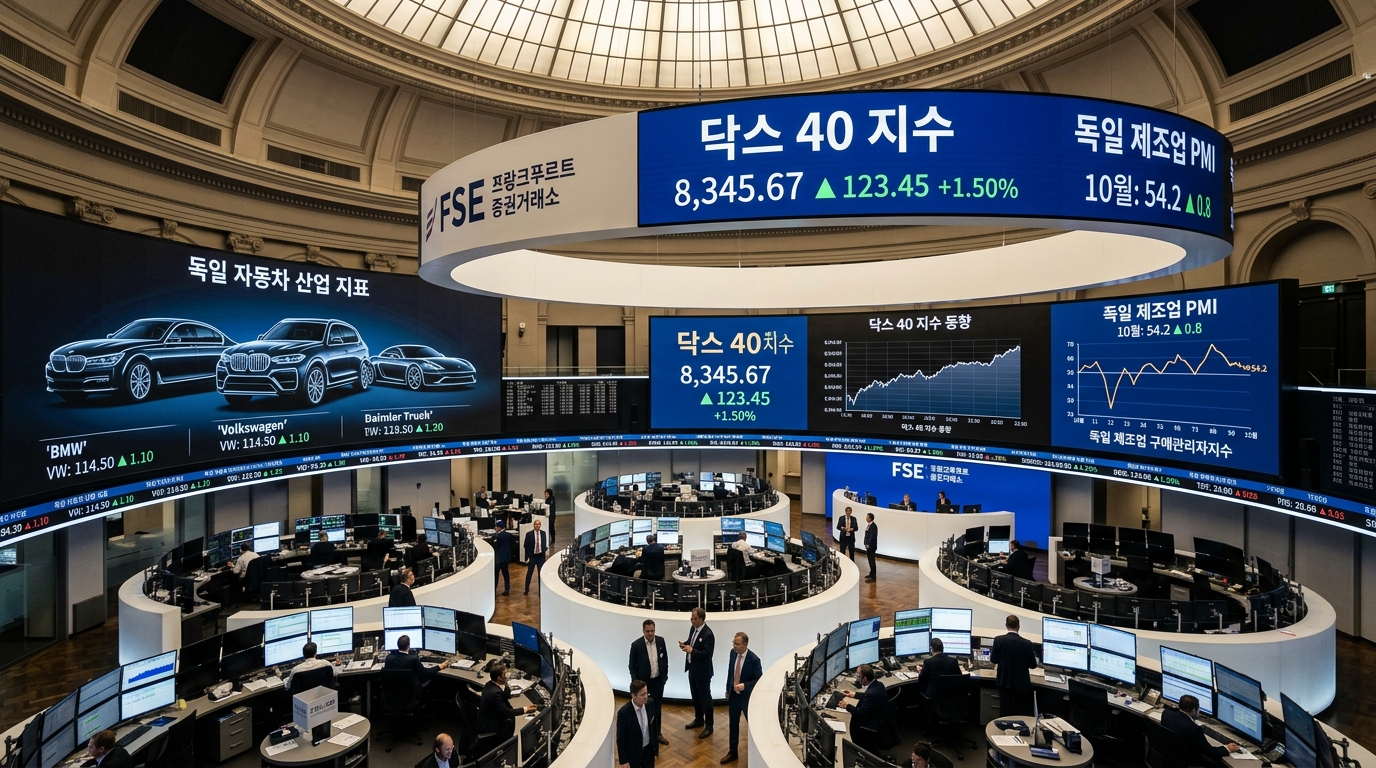
Germany's manufacturing Purchasing Managers' Index (PMI), the heart of the European economy, recorded a finalized 54.2 in August, entering its most distinct expansion phase since 2022.
Despite the index rebound, key German finished-vehicle manufacturers such as Volkswagen, Mercedes-Benz, and BMW are concurrently executing intensive restructuring efforts amidst electric vehicle (EV) transition costs and global supply chain competition.
Amid US Big Tech-led growth alongside Asia's aggressive EV price cuts and policy stimulus, European equity markets are showing differentiated trends depending on whether traditional manufacturing can successfully overhaul its fundamentals.
The domestic Korean market shows neutral sentiment, with the KOSPI at 6,909.91 and KOSDAQ at 820.64 intraday (provisional); however, an examination of export value chains is warranted given global macro decoupling.
Current Market Status
The German DAX40 index has recently fluctuated around the 25,300–26,000 range, digesting energy price volatility and monetary policy uncertainties.
(As of September 14, 2026, the German index intraday quote was pre-market, reflecting the latest verified levels rather than finalized daily figures.)
Germany's August Composite PMI was revised upward to 51.8, and more specifically, the Manufacturing PMI rose to 54.2, signaling an exit from a prolonged manufacturing slump.
In contrast, the DAXsector Automobile index, which experienced a drop of over 20% year-to-date, has recently attempted a rebound driven by bargain buying and structural improvement plans, including headcount reductions.
According to Daily Stock's proprietary Fear & Greed Index, the Nasdaq is currently in the "Fear" zone (33.3), reflecting a clear rise in risk aversion compared to "Neutral" (45.2) a week ago, "Greed" (60.1) a month ago, and "Greed" (60.3) three months ago.
The KOSPI Fear & Greed Index currently stands at "Neutral" (42.1), representing a modest wait-and-see sentiment compared to last week (49.8), last month (50.9), and three months ago (54.5), while the KRW/USD exchange rate shows limited movement around 1,343.80 KRW.
[이미지: /stdaily/uploads/202609/gen_6aa6f2ddeec7b6.86988464.png]
Financial Analysis
Combined 1H 2026 earnings for the three major European automakers showed notable deceleration in operating profit margins (OP Margin), despite defending top-line revenue.
Volkswagen approved a large-scale future plan that includes cutting up to 50,000 additional jobs by 2030 and trimming its vehicle lineup to curb fixed costs.
Mercedes-Benz and BMW defended margins near the double-digit mark through premium internal combustion engine (ICE) and plug-in hybrid electric vehicle (PHEV) sales; however, sluggish demand in the Chinese market and persistent R&D spending burdens remain.
The European auto parts supply network is also seeing pressure on free cash flow (FCF) due to rising Software-Defined Vehicle (SDV) transition costs, even as raw material prices such as copper and aluminum stabilize.
| Key Metric / Region | German DAX40 Auto Sector | US S&P 500 Auto/Tech | Asia (KR/CN/JP) Auto |
|---|---|---|---|
| **Manufacturing PMI Trend** | Aug 54.2 (Recovery to expansion) | Fluctuation around the 50 level | Mixed around 49–51 by country |
| **Sector 12M Fwd P/E** | Approx. 5.5x – 6.5x | Approx. 18x – 25x (incl. Tesla, etc.) | Approx. 6.0x – 8.0x |
| **Dividend Yield (Average)** | Approx. 6.5% – 8.0% (High dividend) | Approx. 1.5% – 2.5% | Approx. 3.5% – 5.0% |
| **Key Monetary Policy Stance** | ECB: Prudent stance amid inflation & oil alerts | Fed: Defending slowdown & tuning cut timing | PBOC easing vs. BOJ gradual normalization |
Valuation
Currently, the 12-month forward price-to-earnings (Forward P/E) ratios of major German finished-vehicle manufacturers sit around 5–6x, with price-to-book (P/B) ratios hovering between 0.4–0.6x.
This represents a discount of more than 70% compared to tech-based mobility companies in the US S&P 500, positioning them near the lower band of historical ranges.
The DAXsector Automobile's annual dividend yield of around 7% serves as a primary factor providing downside support.
However, market participants are weighing cash flow preservation—underpinned by the potential easing of emissions regulations and deferred phaseouts of internal combustion engines—as a critical benchmark rather than relying solely on low P/B appeal.
[이미지: /stdaily/uploads/202609/gen_6aa6f2e912e726.08904603.png]
Expert & Institutional Analysis
Global investment banks are presenting split views on the European auto sector: some assess that excessive pessimism has already been priced in, while others warn of structural market share losses.
Bank of America (BofA) analyzed that European automakers will prove resilient in earnings defense, aided by easing carbon emission mandates and the reassessment of ICE phase-out timetables.
Conversely, Deutsche Bank and Goldman Sachs point out that cost pressures could intensify once again if global liquidity contraction and crude supply instability from the Middle East persist.
S&P Global highlighted that German manufacturing new orders and export orders marked their sharpest increase in four years, suggesting that a 2H improvement in facility utilization rates could serve as a solid pillar for European equity markets.
Risk Factors
The most significant external risk is geopolitical friction surrounding the Strait of Hormuz and the accompanying potential spike in global crude oil prices.
If global oil prices exceed $100 per barrel, tightening pressures on the European Central Bank (ECB) could mount, worsening the auto financing environment, which is highly sensitive to interest rates.
Additionally, should bottlenecks re-emerge in global procurement of semiconductors and key electronic components, plant operating rate recoveries could face disruption.
The aggressive low-price offensive and market share encroachment by local domestic brands in China remain a structural hurdle continuously threatening European automakers' profitability in Asia.
Investment Perspective
Amid fundamental decoupling across the US, Europe, and Asia, the German DAX40 auto sector stands at a crossroads between "undervalued value plays" and a "structural transition phase."
While the manufacturing PMI settling above the 54 mark offers a positive signal of physical production recovery, it will be difficult to trigger valuation re-rating without aggressive cost structure overhaul.
From the standpoint of domestic Korean investors, it is necessary to closely track order backlogs and export channel shifts among domestic secondary battery and auto parts companies directly linked to the European automaker value chain.
A staged entry leveraging high dividend yields may be valid, but volatility management tied to crude oil trends and ECB policy stances must take precedence.
Investor Checkpoint Q&A
Q1. Does the rebound in German manufacturing PMI to 54.2 signify a full recovery of the European economy?
While rising manufacturing output and export orders increase the likelihood that the cycle has bottomed out, it is premature to conclude a full economic expansion given service sector slowdowns and high energy costs.
Q2. Why are the P/E multiples for European automakers extremely low at 5–6x?
This reflects discounts associated with large CapEx burdens during the EV transition, intensifying competition in the Chinese market, and Europe's high-cost domestic production structure.
Q3. Does Volkswagen's large-scale workforce reduction plan act as a positive catalyst for its share price?
While it entails short-term expenses such as labor disputes and severance payouts, markets generally view it positively over the long run because it trims billions of euros in annual fixed costs to defend profitability.
Q4. What unique characteristics does the European stock market possess in the US-EU-Asia tri-polar decoupling environment?
While the US market is centered on AI and Big Tech growth stocks, Europe features high dividend yields and substantial weightings in traditional manufacturing, defense, and luxury goods, giving it strong value-stock characteristics and tighter linkages to commodity prices.
Q5. Why should Korean automotive and secondary battery investors monitor the DAX auto index?
Adjustments in European automakers' electrification pace and parts procurement plans directly impact the earnings guidance of Korea's major battery cell manufacturers and automotive electronics suppliers.