Hello, this is Daily Stock, tracking the intrinsic value indicated by numbers in complex capital markets.
[이미지: /stdaily/uploads/202609/gen_6a9e612de80aa1.35221536.png]
Executive Summary
- The South Korean government and Korea Electric Power Corporation (KEPCO, 015760) maintained the Q3 2026 fuel cost adjustment unit price at the current level of +5 KRW per kWh, effectively freezing electricity tariffs.
- Despite a calculated reduction factor of 3.4 KRW per kWh under the pricing formula, the decision was made to continue recovering unadjusted balances in light of an accumulated operating deficit of approximately 34 trillion KRW and total debt exceeding 206 trillion KRW.
- KEPCO recorded an all-time high operating profit of 13.5248 trillion KRW in 2025 and posted a 3.7842 trillion KRW surplus in Q1 2026; however, a daily financing interest burden of 11.4 billion to 12.0 billion KRW continues to hinder financial normalization.
- With the government allocating an unprecedented 850 billion KRW in direct fiscal support in the 2027 draft budget (500 billion KRW in equity injection and 350 billion KRW in state-funded welfare discount subsidies), a policy-driven burden-sharing phase has begun.
- The upcoming expiration of the expanded KEPCO bond issuance cap at year-end 2027 (issuance cap cliff) and transmission/distribution network expansion costs for AI and semiconductor clusters (over 10 trillion KRW annually) are emerging as critical variables for medium- to long-term cost-reflective tariff reforms.
Current Market Context
On September 7, 2026, the KOSPI closed at 6,995.39 points in the domestic equity market, testing support near the 7,000 level, while the KOSDAQ closed at 822.19 points.
The KRW/USD exchange rate closed slightly lower compared to the previous trading session at 1,341.50 KRW, indicating easing foreign exchange volatility.
According to Daily Stock's proprietary Fear & Greed Index, the KOSPI recorded a Neutral reading of 49.8 (Neutral at 48.5 one week ago; Extreme Fear at 18.4 one month ago; Fear at 32.2 three months ago).
The global Fear & Greed Index based on the Nasdaq (26,506.99) registered Neutral at 41.9 (Neutral at 52.3 one week ago; Neutral at 60 one month ago; Greed at 61.2 three months ago), indicating balanced overall market sentiment.
Against this macroeconomic backdrop, KEPCO closed at around 32,250 KRW on September 7, 2026.
KEPCO's Q3 electricity tariff decision took the form of locking the unit price while deferring reduction factors.
In the short term, downward stabilization in international thermal coal and LNG import prices yielded a 3.4 KRW per kWh reduction factor under the fuel cost formula.
However, relevant government ministries finalized maintaining the upper limit (+5 KRW) to offset past deficits incurred from supplying power below cost.
[이미지: /stdaily/uploads/202609/gen_6a9e613a187b68.75774002.png]
Financial Analysis
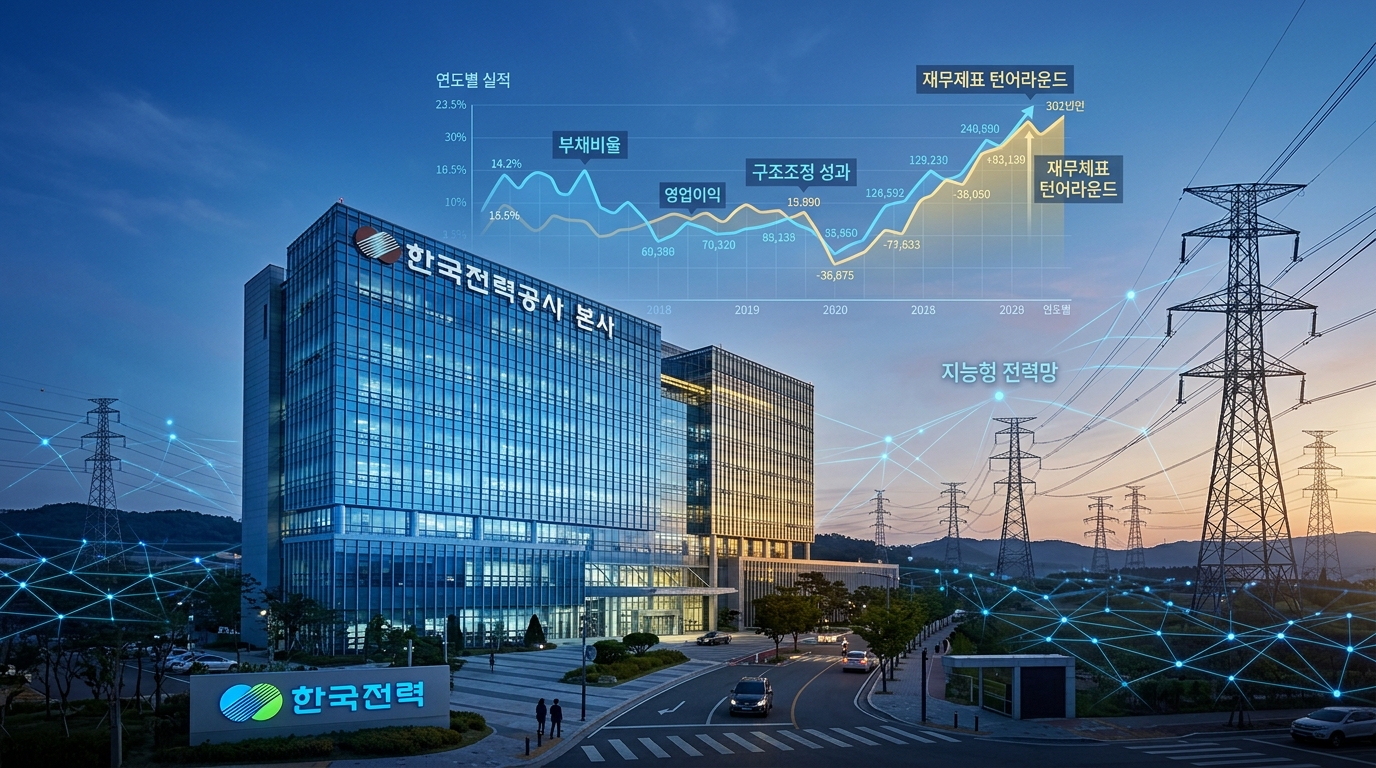
KEPCO's consolidated income statement demonstrates a pronounced top-line recovery from its turnaround in 2024 through 2025 and the first half of 2026.
However, an examination of the balance sheet reveals that clearing the accumulated deficit will require substantial time.
Full-year consolidated revenue reached 97.4345 trillion KRW and operating profit hit 13.5248 trillion KRW in 2025, setting historical record highs.
In Q1 2026, the company sustained quarterly profitability with revenue of 24.3985 trillion KRW and operating profit of 3.7842 trillion KRW.
| Key Financial Metrics (Consolidated) | FY2024 | FY2025 | Q1 2026 |
|---|---|---|---|
| Revenue | ~92.7000T KRW | 97.4345T KRW | 24.3985T KRW |
| Operating Profit | ~8.3600T KRW | 13.5248T KRW | 3.7842T KRW |
| Net Income | ~3.6000T KRW | 8.7372T KRW | ~2.1000T KRW |
| Total Debt | ~202T KRW | 205.7T KRW | 206.4T KRW |
| Total Borrowings | ~134T KRW | 129.8T KRW | 128.2T KRW |
| Standalone Accumulated Deficit | ~43T KRW | ~36.1T KRW | ~34T KRW |
| Daily Avg. Interest Expense | ~12.5B KRW | ~11.9B KRW | ~11.4B KRW |
Despite annual operating profit exceeding 10 trillion KRW, total debt remains stagnant around 206 trillion KRW due to substantial financing costs.
With annual interest expenses running at approximately 4.2 trillion to 4.4 trillion KRW on borrowings of 128 trillion KRW, a large portion of generated earnings is absorbed by financial expenses.
On a standalone basis, the accumulated operating deficit—which surged to 47.8 trillion KRW during the 2021–2023 fuel cost shock—has decreased to roughly 34 trillion KRW.
This structure requires the current surplus run-rate to continue uninterrupted for more than 3 to 4 years to fully eliminate the balance-sheet deficit.
Valuation
KEPCO's valuation metrics trade near historical trough levels.
Based on the closing price of 32,250 KRW, market capitalization is approximately 20.7 trillion KRW, with a P/B of roughly 0.43x–0.47x and a P/E of 2.4x–3.0x.
This represents an extreme discount compared to large-cap KOSPI 200 manufacturing names (semiconductors, autos, etc.), which trade at average P/B ratios of 1.0x–1.6x.
It also contrasts with global utilities such as NextEra Energy and Duke Energy in the United States, which command P/B ratios of 1.5x–2.2x and P/E multiples of 15x–18x.
Global utilities operate under mechanical fuel cost pass-through frameworks, securing stable return on equity (ROE) and dividends.
Conversely, KEPCO's role as a tool for public utility price regulation has caused structural profit volatility and high debt leverage, capping its valuation ceiling.
The key to future equity rerating depends less on the nominal size of operating profits and more on the feasibility of resuming dividend payouts and the pace of equity base expansion.
As long as accumulated deficits impair total equity, distributable profits under commercial law remain restricted; hence, the timing of capital replenishment will serve as the inflection point for P/B normalization.
Expert and Institutional Analysis
Domestic and foreign brokerages alongside policy research institutes offer favorable short-term assessments of KEPCO's earnings resilience, while flagging medium- to long-term funding structures.
The National Assembly Legislative Research Office noted in a recent report that prolonged gaps between costs and tariffs ultimately pass the burden onto future generations.
The office recommended that the government materialize specific plans for rate normalization by customer class in H2 2026 or H1 2027.
Rather than simple blanket increases, recommendations focus on sophisticated time-of-use and seasonal tariff structures alongside clear frameworks to recover grid investment capital.
Major domestic brokerage research centers project that solid operating margins will persist in H2 2026 owing to stable international fuel prices.
However, rebound risks in spot LNG prices from Middle East geopolitical tensions and lagged crude oil price reflections remain key variables to monitor.
Global investment banks (IBs) are focusing on the 850 billion KRW in direct fiscal support incorporated in the 2027 government budget.
While funding welfare discounts through the national budget rather than public corporate balance sheets is seen as institutional progress, analysts highlight that the amount covers only a portion of annual interest expenses (~4 trillion KRW).
Risk Factors
First is the sunset clause of the KEPCO Act revision scheduled for year-end 2027.
The special provision enacted after the Russia-Ukraine war—raising the corporate bond issuance cap from 2x equity plus reserves to 5x (up to 6x with ministerial approval)—is set to expire.
If the law is not extended or if major capital replenishment does not materialize, the new bond issuance ceiling could drop precipitously into the 30 trillion KRW range from 2028, creating a "bond cliff."
Given the need to issue roughly 20 trillion KRW annually in rollover bonds, this poses notable liquidity constraints.
Second is the massive transmission and distribution CAPEX required for high-tech infrastructure.
Connecting the Yongin semiconductor mega-cluster and nationwide AI data centers requires over 10 trillion KRW annually in capital expenditures, including West Coast high-voltage direct current (HVDC) lines.
Third is joint FX and crude oil volatility.
If the KRW/USD exchange rate surges from the 1,340 KRW level or if Middle East conflict escalation raises crude and LNG import costs, systemic wholesale power prices (SMP) paid to generation subsidiaries could rebound sharply.
Investment Perspective
KEPCO has moved past its severe negative-spread cycle and entered a recovery phase with sustained positive cash flow.
However, unlike typical cyclical names, policy regulations and heavy debt repayment schedules dominate its equity trajectory.
In the short term, favorable earnings momentum can continue despite the Q3 tariff freeze, supported by stable oil-LNG cost spreads.
Foreign ownership maintaining downside rigidity at around 21.0% provides additional supply-demand support.
Over the medium to long term, the genuine valuation ceiling will likely be decided by discussions on the next tariff structure starting in late 2026 and whether the National Assembly extends the KEPCO Act revision.
A phased accumulation strategy based on monitoring expanded state fiscal burden-sharing and the implementation of cost-reflective tariff mechanisms offers a prudent approach.
Investor FAQ
Q1. Why were electricity rates frozen when Q3 fuel costs declined?
Under the formula reflecting the prior three months of fuel costs, a 3.4 KRW per kWh reduction factor occurred.
However, because KEPCO's standalone accumulated deficit remains at 34 trillion KRW and unrecovered fuel adjustments remain substantial, the government elected to maintain the existing ceiling of +5 KRW per kWh.
Q2. Why are financial crisis concerns raised when annual operating profit exceeds 13 trillion KRW?
While operating profit is at record highs, consolidated total debt stands at 206 trillion KRW, requiring more than 4 trillion KRW in annual interest payments.
With daily interest expenses alone totaling 11.4 billion to 12.0 billion KRW, sustained high-margin surpluses over several years are essential before principal debt can be substantially reduced.
Q3. What is the 'KEPCO Bond Issuance Cliff' slated for year-end 2027?
Under the emergency KEPCO Act amendment passed in late 2022, the bond issuance limit was temporarily raised to 5x equity and reserves.
If this clause sunsets at the end of 2027, the limit reverts to 2x from 2028, potentially creating physical constraints in refinancing maturing corporate bonds.
Q4. What is the significance of the 850 billion KRW allocated in the government budget?
It marks the first official instance of direct state cash equity injection (500 billion KRW) and direct fiscal cost-sharing for welfare discounts (350 billion KRW).
It holds symbolic importance by transitioning public welfare burdens from the public enterprise alone to shared state fiscal responsibility.
Q5. Are AI infrastructure and semiconductor clusters an opportunity or a burden for KEPCO?
Rising demand for advanced power generation serves as a long-term tailwind for electricity sales volumes.
Conversely, preemptive investments exceeding 10 trillion KRW annually are required to build out grid transmission, which could exacerbate short-term financing strain unless coupled with appropriate capital recovery mechanisms.