Hello.
This is Daily Stock, delivering deep analysis and supply/demand flow insights into the Korean large-cap market.
Key Summary
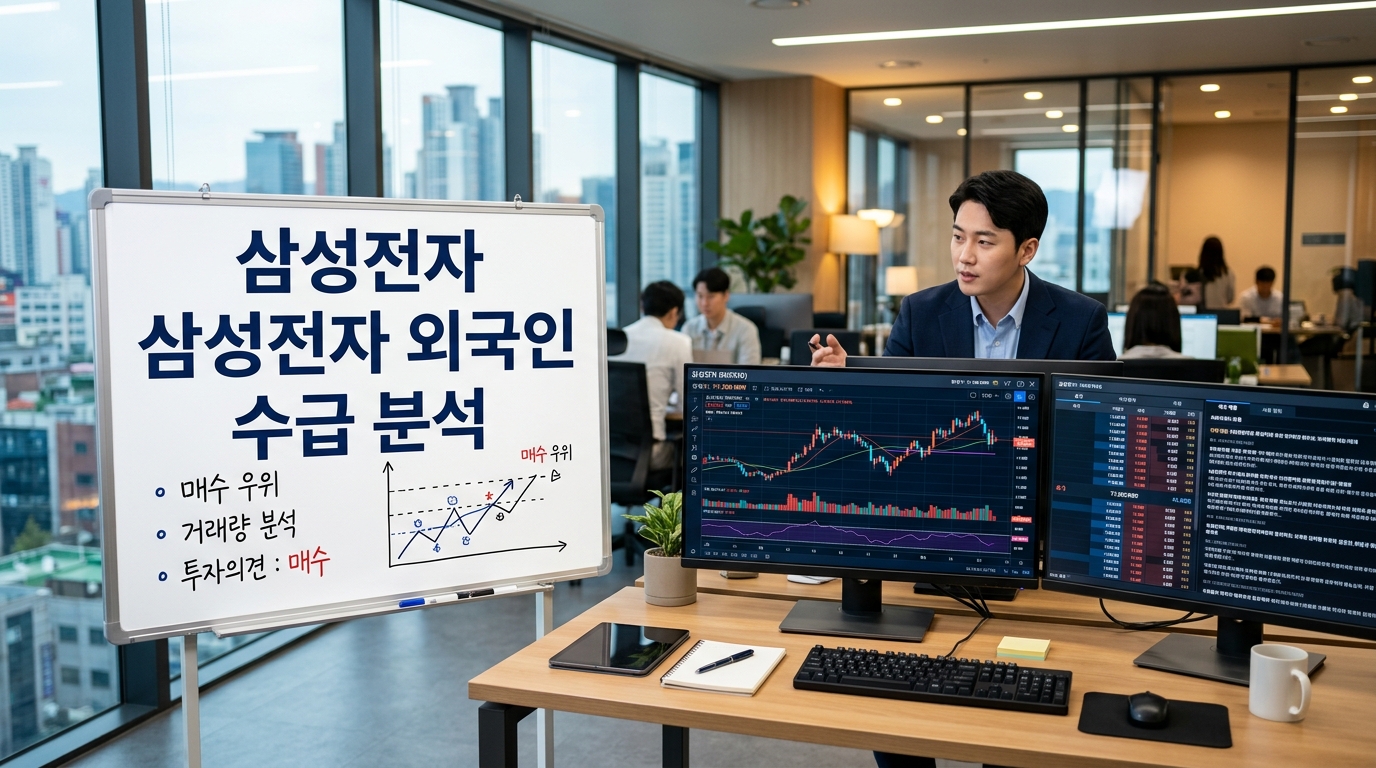
Samsung Electronics' foreign ownership rate has recently fallen to 46.69%.
This represents an extreme capital outflow, reaching its lowest level in approximately 13 years.
Currently, the only buffer defending the stock price is Samsung Electronics' share buyback program (categorized as "other corporate" buying).
However, if these share buyback funds are exhausted ahead of schedule in early October, a supply/demand vacuum could occur.
With pressure from the USD/KRW exchange rate and global macro variables, foreign risk-off sentiment persists.
Going forward, proving technical competitiveness—such as supplying HBM4 to Nvidia—will be a key condition for the return of foreign investors.
Current Status Summary
[Image: /stdaily/uploads/202609/gen_6a991b536cec70.27006306.png]
As of September 3, 2026, the KOSPI index closed at 6,579.48, up 0.26% from the previous day.
Samsung Electronics closed the day at 250,000 KRW, down 0.19% (-500 KRW) from the previous trading day.
Currently, Samsung Electronics' foreign exhaustion rate stands at 46.69%, continuing a downward trend.
This is due to global passive fund rebalancing and high-interest rate environments intensifying risk-averse sentiment among foreign investors.
Most of the volume dumped by foreign investors has been absorbed by Samsung Electronics' ongoing 15 trillion KRW share buyback program.
However, due to the rapid pace of purchases—executing at approximately 2 million shares per day—the buyback program is expected to be completed around October 8.
If the buyback is completed a month earlier than expected, there are concerns that a significant supply/demand vacuum could emerge in the market.
Ultimately, whether foreign investors return to fill this gap is expected to be the biggest turning point for Samsung Electronics' stock price in the second half of the year.
[Image: /stdaily/uploads/202609/gen_6a991b5ecbcc08.72692432.png]
Financial Analysis
Global investment bank Citi recently lowered its operating profit forecast for Samsung Electronics for Q3 2026.
Citi presented a conservative outlook by lowering its estimate by about 10% from the previous 115.5 trillion KRW to 104.1 trillion KRW.
This figure is approximately 9% lower than the market consensus of 114.4 trillion KRW.
An exchange rate burden stemming from a weak Korean Won—amounting to roughly 5 trillion KRW—and one-off expenses such as performance bonuses were cited as adjustment factors.
However, the fundamentals of the memory semiconductor business itself remain solid, supported by multi-year contracts and demand for high-value memory products.
In fact, the operating profit for the semiconductor division reached 105.1 trillion KRW, continuing to serve as a cash cow.
| Metric | Value & Indicator (As of Sep 3, 2026 Close) |
|---|---|
| **Closing Price** | 250,000 KRW |
| **Change** | -500 KRW (-0.19%) |
| **Market Cap** | Approx. 1,473.26 trillion KRW |
| **Foreign Ownership** | 46.69% |
| **P/E Ratio (PER)** | 11.26x |
| **Industry Avg PER** | 8.36x |
Valuation
Samsung Electronics is currently trading at a P/E ratio of 11.26x, representing a premium over the industry average of 8.36x.
Whether this premium over the industry average can be sustained will depend on the company's next-generation product leadership in the AI market going forward.
However, the fact that foreign ownership has shrunk to the 46% range—a 13-year low—could conversely serve as an opportunity.
Once the macroeconomic environment improves and bad news is fully priced in, there is potential for a rapid influx of foreign buying as they look to rebuild their hollowed-out positions.
Expert & Institutional Analysis
Securities market experts analyze that the high exchange rate environment, with the USD/KRW rate reaching 1,356.80 KRW, has accelerated foreign outflows.
As long as high interest rates and a strong dollar persist, there is little incentive for foreign investors to aggressively buy emerging market assets.
A researcher at Shinhan Securities pointed out that while share buybacks act as a support line for the market, they are not an upward catalyst driving the stock price.
Ultimately, resolving macroeconomic uncertainties and restoring foreign inflows are the fundamental prerequisites for an upward trend.
A researcher at Mirae Asset Securities also evaluated that risk-off sentiment has deepened ahead of major monetary policy events, such as the September US Federal Open Market Committee (FOMC) meeting.
Consequently, volatile trading is highly likely to continue until these macroeconomic events pass.
[Image: /stdaily/uploads/202609/gen_6a991b6ad6aa35.07059985.png]
Risk Factors
The first risk is the concern over a supply/demand disruption after the share buyback program ends, which is expected in early October.
If foreign investors do not shift back to net buyers by the time the buyback program concludes, the stock price could face further correction.
The second risk is the instability of the global macroeconomic environment and the prolonged high-interest-rate stance.
In particular, as US Treasury yields face upward pressure again, overall investor sentiment toward emerging market stock markets is freezing up.
Investment Perspective Summary
The current stock price correction for Samsung Electronics is driven more by temporary supply/demand dislocations than by damaged fundamentals.
Daily Stock's proprietary KOSPI Fear & Greed Index currently stands at the "Fear" (28.7) stage, down from "Neutral" (55.6) the previous week.
With the Nasdaq Fear & Greed Index also hovering in the "Fear" (33.3) stage, anxiety is widespread across global stock markets.
While keeping short-term volatility in mind, a conditional scenario of accumulating positions in installments remains valid once confirmation is received regarding the approval of HBM4 supply to Nvidia and a clearer path for US interest rate cuts.
Investor Checklist Q&A
Q1. Why has foreign ownership fallen to 46.69%?
A1. It is the combined result of mechanical selling during global asset allocation rebalancing and risk-off sentiment driven by a strong dollar.
Q2. Is the forecast that the share buyback will end early true?
A2. Because purchases are being executed at a faster-than-expected rate of approximately 2 million shares per day, it is highly likely to be completed around October 8 instead of November.
Q3. What are the specific reasons why Citi slightly lowered its target price to 430,000 KRW?
A3. Citi conservatively adjusted its Q3 earnings forecast due to an exchange rate burden of approximately 5 trillion KRW and one-off expenses such as performance bonuses.
Q4. How will Samsung Electronics' stock price be supported after the share buyback program ends?
A4. Once the buyback program ends, the return of foreign inflows becomes essential; otherwise, there will be pressure from having to rely on retail investor sentiment.
Q5. What is the key supply/demand inflection point that investors should monitor going forward?
A5. The direction of the US FOMC's interest rate decision in September and the final approval of next-generation HBM4 quality testing for Nvidia.