Hello, this is Daily Stock, providing in-depth analysis of daily market trends.
Key Summary
- **Record Earnings vs. Stock Price Divergence**: Samsung Electronics posted preliminary Q2 2026 revenue of KRW 171 trillion and operating profit of KRW 89.4 trillion, securing the world's top operating profit ahead of global Big Techs. However, the stock recently underwent a sharp correction due to peak-out concerns and supply-demand factors.
- **Foreign Ownership at a 17-Year Low**: As of mid-July, foreign ownership fell to 46.58%, its lowest level since the global financial crisis. This is analyzed as mechanical passive selling driven by market-cap weight limits within global funds.
- **Valuation at Historical Lows**: Currently, Samsung Electronics' 12-month forward PER stands at 4.42x, entering extreme undervaluation territory. On July 21, amid an intraday buy sidecar trigger, the stock staged a sharp 6.15% rebound backed by strong bargain hunting.
Current Situation Summary
Recently, the domestic stock market has experienced severe volatility amid cooling short-term overheating in the artificial intelligence (AI) semiconductor value chain and rising geopolitical tensions in the Middle East.
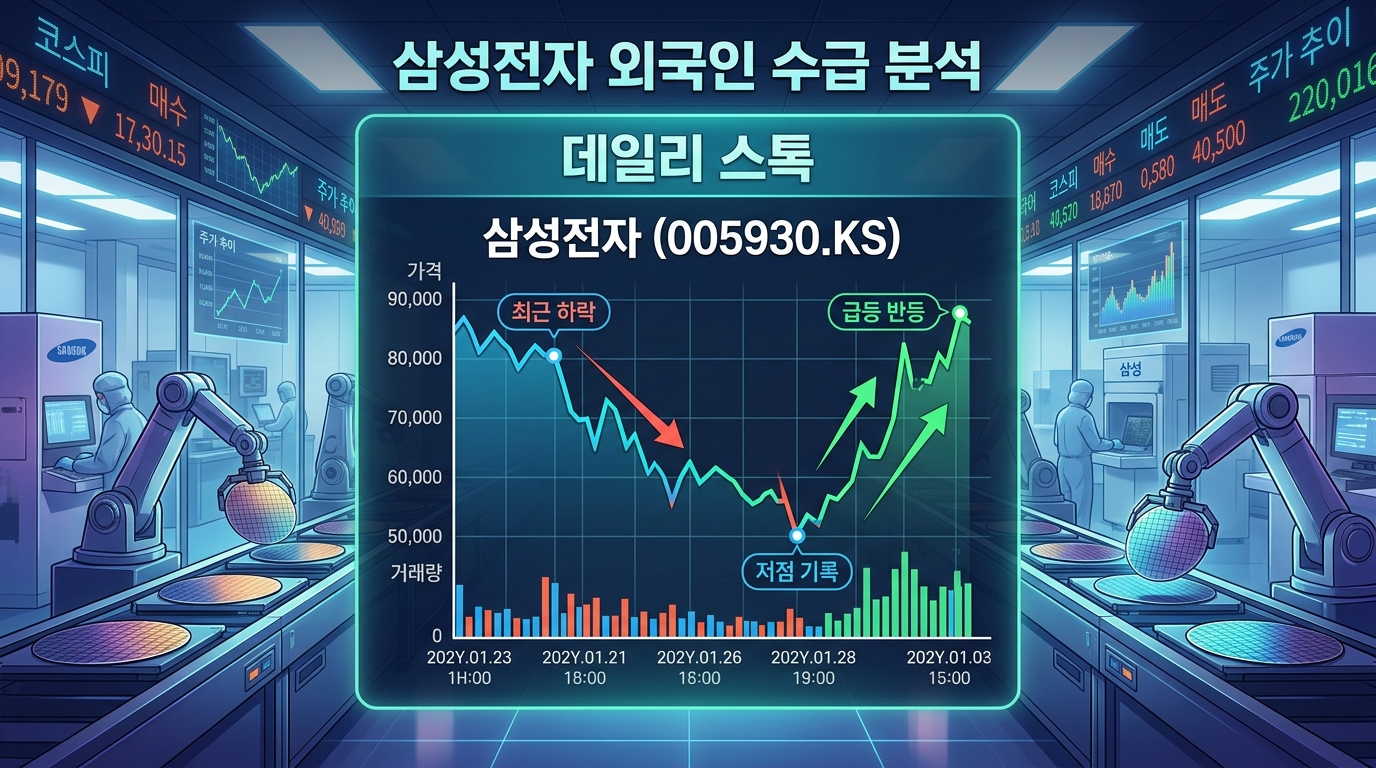
In particular, after reaching a peak of KRW 374,500 in mid-June, Samsung Electronics plunged over 30% in a month to close at KRW 244,000 on July 20.
However, today, July 21, 2026, confirmed strong semiconductor exports led to robust joint buying by foreign investors (KRW 295 billion) and institutions (KRW 1.3901 trillion). The stock surged 6.15% from the previous day to close at KRW 259,000.
During this process, rising prices in the KOSPI futures market triggered a temporary halt on program buy orders (buy sidecar), demonstrating strong downside support in the market.
[Image: /stdaily/uploads/202607/gen_6a5f197117bec6.66177209.png]
Financial Analysis
On July 7, Samsung Electronics announced preliminary consolidated Q2 2026 results with sales of KRW 171 trillion and operating profit of KRW 89.4 trillion.
This represents a massive surge of 129.31% in sales and an astronomical 1810.26% in operating profit year-on-year, marking the largest single-quarter performance in the history of South Korean listed companies.
This earnings surprise was driven by soaring memory semiconductor prices amid expanding AI investments and solid sales growth of HBM4, the world’s first mass-produced 6th-generation high-bandwidth memory.
This milestone was achieved despite reflecting approximately KRW 17 trillion in provisions for special performance bonuses following labor-management agreements. Excluding this, actual operating profit exceeded KRW 106 trillion, even surpassing the historic quarterly earnings of NVIDIA and Apple.
| Item | Q2 2026 (Preliminary) | QoQ (1Q26) | YoY (2Q25) | Remarks |
|---|---|---|---|---|
| **Revenue** | KRW 171T | +27.74% | +129.31% | Record-high single quarter |
| **Operating Profit** | KRW 89.4T | +56.21% | +1810.26% | Reflects special bonus provisions |
| **HBM4 Cumulative Sales** | Exceeded USD 1.2B | - | - | To be loaded in next-gen accelerators in 2H |
Valuation
Despite the record earnings, the steep decline in the stock price over the past month has dragged valuation attractiveness down to historic lows.
According to securities sources, Samsung Electronics' 12-month forward price-to-earnings ratio (PER) stands at 4.42x, substantially lower than the bottom of 6.27x seen during the 2008 global financial crisis.
In an extreme scenario where a future semiconductor downturn cuts profit forecasts in half, applying a long-term average PER of 10x suggests that its theoretical value is still higher than the current stock price.
In addition, stock loan balances (potential short-selling backlog) decreased by about 6.5% from KRW 23.3 trillion in early July to KRW 21.8 trillion in mid-July, alleviating a significant portion of supply-side selling pressure.
[Image: /stdaily/uploads/202607/gen_6a5f197babcc64.00219266.png]
Expert & Institutional Analysis
Market analysts interpret the recent large-scale foreign selling (approx. KRW 6.6 trillion net sold from July 1–16) not as a negative outlook on the South Korean economy or semiconductor fundamentals.
Instead, experts view it as mechanical selling triggered by asset allocation rules that prevent global passive funds from exceeding concentration limits for specific stocks within portfolios.
Last year, Samsung Electronics and SK Hynix accounted for about 30% of the KOSPI market, but that share ballooned to 60% during the first-half rally, triggering an influx of mechanical rebalancing volume.
Furthermore, some argue that foreign investors are actively diversifying their portfolios by easing concentration in large-cap memory stocks to target undervalued small-and-medium-sized players (testing, equipment, substrates) that are poised for second-half earnings growth.
Risk Factors
- **Pace Adjustments in Global AI Investment**: Capital expenditure (CAPEX) growth of major US Big Techs is expected to slow from 78.5% this year to 30.2% next year, which could serve as a trigger for profit-taking.
- **Geopolitical Risks and Oil Price Volatility**: Concerns over geopolitical conflicts between the US and Iran have reignited high inflation pressures. This pushed the KRW/USD exchange rate to the 1,475.10 level, acting as a macro variable that limits foreign capital inflow.
- **Chasing from Chinese AI Startups**: The emergence of low-cost, high-performance AI models by rising Chinese firms like Moonshot AI could intensify global competition and spark concerns over South Korean chipmakers' dominant positions.
Investment Perspective Summary
Currently, Daily Stock's KOSPI Fear & Greed Index points to Extreme Fear (12.4), showing deeply depressed market sentiment (for comparison, the Nasdaq Fear & Greed Index is at Fear [37.6]).
Historically, when fear reaches extreme levels, the valuation appeal of large-cap stocks increases, offering attractive dollar-cost averaging opportunities for medium-to-long-term investors.
The decline in foreign ownership to a 17-year low of 46.58% suggests that additional selling pressure is gradually exhausting, leaving the door open for passive capital inflows over the medium term.
In the short term, investors should monitor macro indicators such as Middle East developments and exchange rates, but a gradual approach based on historically cheap valuations appears highly valid.
FAQ
Q1. Why were Samsung Electronics' Q2 2026 earnings so strong?
A1. Expanding investments in AI infrastructure sustained supply shortages of high-bandwidth memory (HBM) and conventional DRAM, sending prices soaring. The company also recognized full-scale mass production revenue from 6th-generation HBM4.
Q2. Why did the stock price plunge recently despite record-high earnings?
A2. The drop was caused by a combination of factors: semiconductor peak-out worries, concerns over CAPEX moderation by US Big Techs, geopolitical instability in the Middle East, and mechanical portfolio rebalancing sales by international funds.
Q3. What does it mean that foreign ownership is at a 17-year low?
A3. In the past, during the 2009 global financial crisis, foreign ownership bottomed out before massive buying resumed, leading to a strong stock rebound. It can be interpreted as a positive signal that downside selling pressure has eased.
Q4. What caused the sharp stock rebound and the buy sidecar trigger today on July 21?
A4. Samsung Electronics' 12-month forward PER fell to 4.4x, highlighting extreme valuation appeal. Strong bargain hunting flowed in alongside solid July export growth data and a technical rebound in US semiconductor shares.
Q5. What variables should retail investors focus on going forward?
A5. Investors should closely monitor upcoming earnings releases and AI CAPEX guidance from major US Big Tech companies, the stabilization of the KRW/USD exchange rate, and whether the stock loan balance continues to decline.