[Image: /stdaily/uploads/202609/gen_6a97c9cb5c2370.46566363.png]
Hello, this is Daily Stock.
Key Summary
According to the August 2026 import and export trends released by the South Korean Ministry of Trade, Industry and Energy, exports surged by 68.7% year-on-year to hit $98.25 billion.
During the same period, imports grew by 22.5% to reach $63.51 billion, resulting in a solid trade surplus of $34.75 billion.
The cumulative trade surplus from January to August of this year reached $202.5 billion, successfully demonstrating the strong fundamentals of the Korean economy.
Current Situation Overview
This export performance marks the largest ever for any August and is the third-highest monthly figure on record, following June and July of this year.
Considering the number of working days, the average daily export value rose by 72.5% year-on-year to $4.47 billion, firmly maintaining the $4 billion level for four consecutive months.
In particular, the semiconductor sector broke historical records once again, driven by global Big Tech companies expanding their capital expenditures on Artificial Intelligence (AI) infrastructure.
[Image: /stdaily/uploads/202609/gen_6a97c9d73c2284.97471210.png]
Financial Analysis
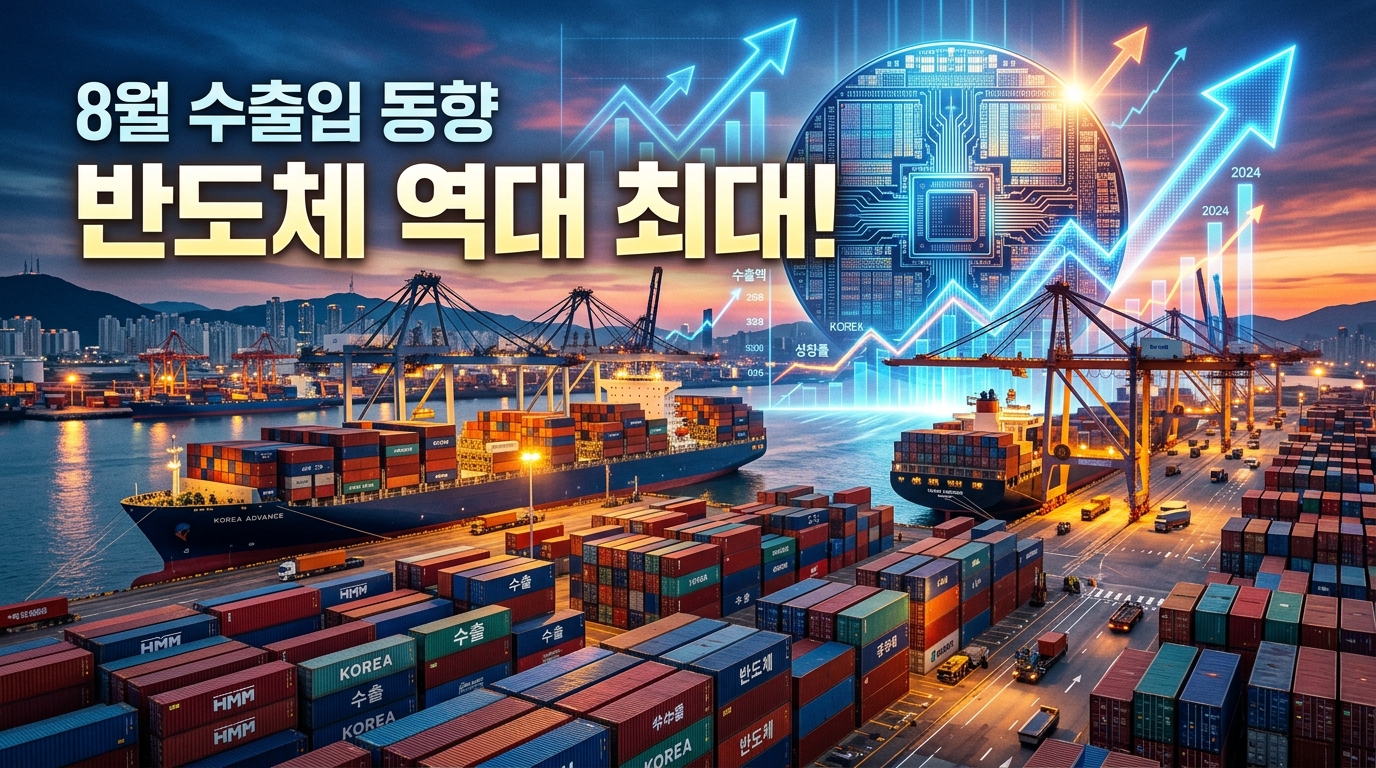
Looking at August's export performance by key categories, semiconductor exports led the overall growth, skyrocketing by 209.0% year-on-year to reach $46.65 billion.
This was driven by rising contract prices for DRAM and NAND flash memory, alongside exploding demand for High Bandwidth Memory (HBM) and high-capacity enterprise SSDs.
| Category | August 2026 Performance ($100M) | YoY Growth (%) | Note |
|---|---|---|---|
| **Total Exports** | 982.5 | +68.7% | Surpassed $90 billion for 3 consecutive months |
| **Total Imports** | 635.1 | +22.5% | Increase in semiconductor equipment and energy imports |
| **Trade Balance** | +347.5 | (Surplus expanded) | Surplus exceeding $30 billion for 3 consecutive months |
| **Semiconductor Exports** | 466.5 | +209.0% | Broke all-time monthly record |
| **Computers (SSD)** | 62.4 | +419.5% | Surge in demand for enterprise SSDs |
| **Automobile Exports** | 38.5 | -29.8% | Impact of summer vacation schedules and strikes |
| **Ship Exports** | 16.9 | -45.9% | Impact of a temporary decline in delivery volume |
In the import sector, energy imports grew by 15.3% to $12.68 billion due to rising oil prices, and semiconductor equipment imports also increased significantly.
By region, exports to China increased by 119.3% to $24.1 billion, driven by robust demand for general machinery and semiconductors, exceeding $20 billion for three consecutive months.
Exports to the United States grew by 89.3% to $16.50 billion, and exports to ASEAN countries increased by 75.4% to $19.09 billion, showing well-diversified growth.
Valuation
This unprecedented streak of trade surpluses acts as a solid floor supporting the valuation of the South Korean KOSPI market, which is highly dependent on global trade.
The KOSPI index closed at 6,562.72 points, continuing a cautious trend.
With the USD/KRW exchange rate linked at 1,368.10 won, robust export volumes and rising unit prices could further lift the earnings estimates of large-cap exporters.
However, the KOSPI Fear & Greed Index compiled by Daily Stock is currently in the "Fear" stage (30.5), showing weakened sentiment compared to the "Neutral" stage (51.4) a week ago.
This indicates that despite the record-breaking export performance, caution regarding macro uncertainties still lingers across the market.
Expert and Institutional Analysis
Financial market analysts believe that annual cumulative exports are highly likely to surpass $1 trillion for the first time in history this year.
Government officials projected that this positive trend will continue at least until the end of the year or early next year, given stable semiconductor prices and supply controls.
On the other hand, some experts advise caution regarding portfolio concentration risks, pointing out that semiconductors alone account for nearly half of total exports.
Nevertheless, the fact that non-semiconductor consumer sectors like cosmetics (+52.1%) and bio-health (+22.3%) reached record highs for any August is seen as an encouraging sign.
[Image: /stdaily/uploads/202609/gen_6a97c9e1c134a1.14182019.png]
Risk Factors
The biggest risks are the strengthening of protectionism in the US and the European Union (EU), as well as global tariff barriers.
Uncertainties in the trade environment, such as potential US tariff measures and the EU's Steel Tariff-Rate Quotas (TRQ), persist and warrant close monitoring.
Furthermore, volatility in international oil prices due to heightened geopolitical tensions in the Middle East is another potential factor that could drive up import costs.
Whether automobile exports—which fell by 29.8% due to summer vacations and temporary strikes—will recover quickly also remains a key trend to watch.
Investment Perspective Summary
August's import and export trends once again proved the solid earnings power of Korea's large-cap exporters.
However, with the Nasdaq Fear & Greed Index pointing to "Neutral" (44.2), concerns over global monetary tightening could temporarily limit a strong rebound in the KOSPI.
Therefore, a phased accumulation strategy focusing on high-performance semiconductors and core materials stocks with guaranteed earnings growth may be a safer approach.
At the same time, a portfolio strategy centered on high-quality large-cap stocks with local production bases that can bypass protectionist risks appears highly valid.
[Image: /stdaily/uploads/202609/gen_6a97c9ec04fff9.80466135.png]
Investor Checklist Q&A
Q1. What is the fundamental background behind the explosive growth of August's trade surplus?
A1. It is driven by the surging demand for High Bandwidth Memory (HBM) and enterprise high-capacity SSDs, fueled by US tech giants expanding their capital expenditures on AI data centers.
Q2. Is it really possible to achieve $1 trillion in annual exports this year?
A2. Cumulative exports from January to August have reached approximately $693.3 billion. If this trend does not reverse for the remainder of the year, surpassing $1 trillion for the first time in history is a highly plausible scenario.
Q3. Which sectors besides semiconductors are showing strong export growth?
A3. The cosmetics sector (+52.1%) is advancing due to the global preference for K-beauty, and the bio-health sector (+22.3%), bolstered by expanding biosimilar orders in Europe, also achieved its highest-ever August performance.
Q4. What caused the sluggish exports in automobiles and ships, and does it represent damaged fundamentals?
A4. The decline in automobiles was caused by shifts in summer vacation schedules and labor union strikes, while the decline in ships was a temporary drop due to delivery scheduling. It is not considered a downturn in the industries themselves.
Q5. Why does the KOSPI Fear & Greed Index remain in the 'Fear' stage (30.5) despite strong exports?
A5. External uncertainties, such as exchange rate volatility risks and concerns over strengthening tariffs in major countries depending on the outcome of the US presidential election, continue to weigh down local investor sentiment.