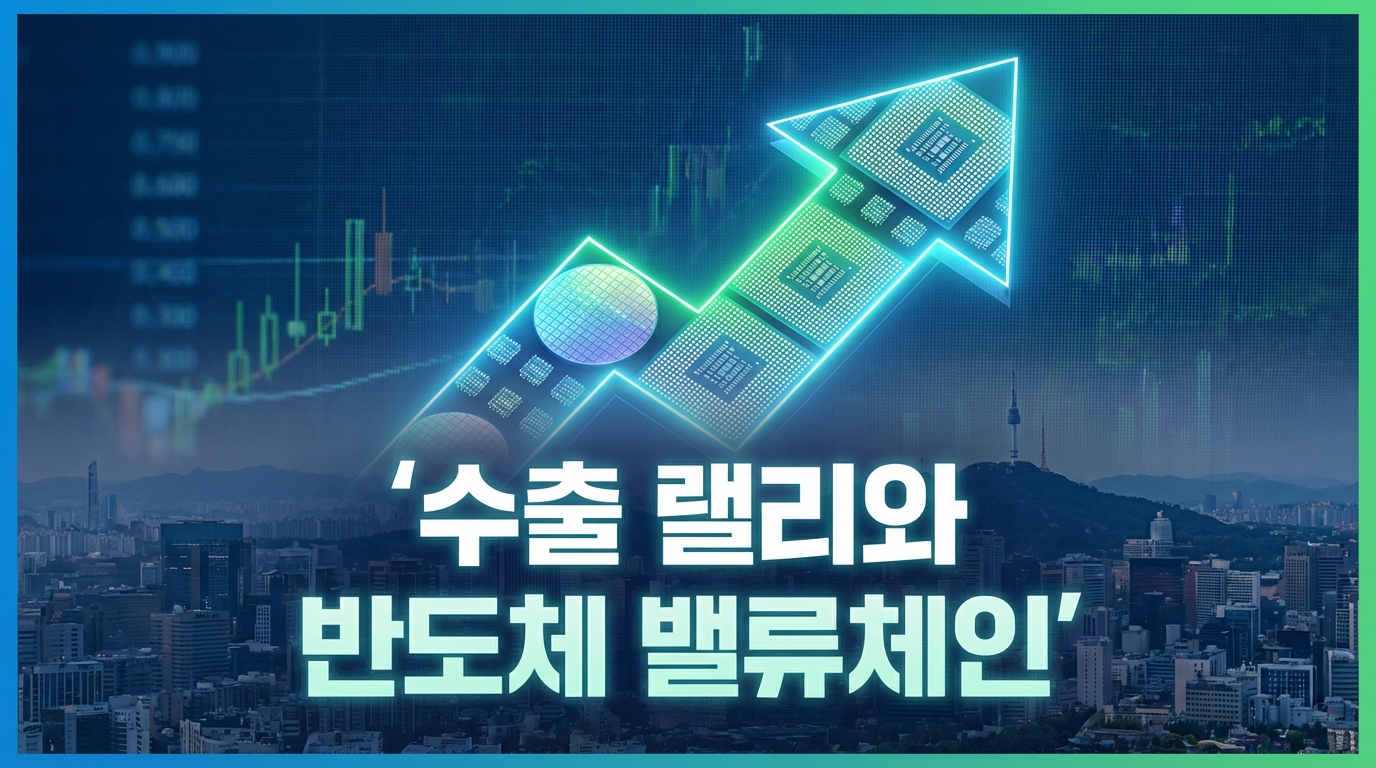
Hello, for those of you seeking successful investment insights today, we provide an in-depth analysis of the correlation between the latest South Korean export indicators and the semiconductor industry conditions.
Core Summary
[Image: /stdaily/uploads/202603/gen_69c23723bcedc4.10159577.png]
The KOSPI index closed at 5553.92 today, maintaining a high index level, but the underlying market atmosphere remains somewhat rigid.
This is because investors' anxiety persists despite the Korea Customs Service announcing that exports from March 1 to 20 increased by 50.4% year-on-year.
| Key Indicators (As of Mar 24, 2026 Closing) | Value | Note |
|---|---|---|
| **KOSPI Index** | 5553.92 | Closing figure vs. previous day |
| **KOSDAQ Index** | 1121.44 | Closing figure vs. previous day |
| **USD/KRW Exchange Rate** | 1,493.90 KRW | Approaching 1,500 KRW level |
| **Mar 1~20 Semiconductor Exports** | $18.7 Billion | YoY +163.9% |
| **KOSPI Fear & Greed Index** | 31.9 (Fear) | Down from 57.3 (Neutral) a month ago |
Current Situation Summary
[Image: /stdaily/uploads/202603/gen_69c23739a8b259.86149852.png]
According to the Korea Customs Service, semiconductor exports from March 1 to 20, 2026, recorded $18.7 billion, surging 163.9% year-on-year.
This is interpreted as the result of exploding demand for High Bandwidth Memory (HBM) and high-capacity storage devices driven by the continuous expansion of AI server investments by global Big Tech companies.
At the same time, the USD/KRW exchange rate is at 1,493.90 KRW, continuing an ultra-strong dollar phase on the verge of breaking through 1,500 KRW.
While this is a period where export-driven companies maximize their KRW-converted profits, it is a double-edged sword as concerns over foreign exchange losses may increase from the perspective of foreign supply and demand.
Financial Analysis
The domestic semiconductor value chain, led by SK Hynix, is showing a clear earnings turnaround supported by the surge in AI memory demand.
The expansion of margin spreads for DRAM and NAND flash, whose fixed transaction prices have rebounded, is expected to serve as the core driver of Q1 operating profits.
In addition, major materials, parts, and equipment companies, such as semiconductor outsourced semiconductor assembly and test (OSAT) and inspection equipment firms, are also expected to secure stable cash flows through long-term supply contracts.
Although high exchange rates raise raw material import costs, the overwhelmingly high export proportion is highly likely to have a positive impact on the ultimate financial structures of these companies.
Valuation
[Image: /stdaily/uploads/202603/gen_69c237522238c3.65408958.png]
Currently, large-cap KOSPI semiconductor stocks are not fully recognized with the Price-to-Book (P/B) ratios seen during past supercycles, despite record-breaking upward revisions in profit forecasts.
Increased volatility in global stock markets and macroeconomic uncertainties are pointed out as the main causes of this valuation discount.
On the other hand, a scenario is unfolding where certain equipment and materials companies exclusively supplying core process equipment related to HBM are being granted a premium compared to their global peers.
As the fundamental improvement of the export surge is clear, there is room for a rapid valuation rerating upon transitioning to an earnings-driven market.
Expert and Institutional Analysis
Market experts evaluate that the phenomenal semiconductor export performance in March is solidly supporting the fundamentals of KOSPI large-cap stocks.
However, the dominant analysis is that the contraction in global tech stock sentiment, with the NASDAQ's Fear & Greed Index dropping to 16.2 (Extreme Fear), is holding back the domestic market.
Institutional investors are warning that the high exchange rate in the late 1,490 KRW range could limit foreign spot buying.
In fact, the KOSPI Fear & Greed Index has fallen from a Neutral level (57.3) a month ago to the current Fear stage (31.9), showing that market participants' anxiety remains high despite the index's rise.
Risk Factors
The biggest risk is the potential macro shock and the possibility of a rapid outflow of foreign funds if the USD/KRW exchange rate breaks through 1,500 KRW.
Amid the delay in the Bank of Korea's base rate cuts, the interest rate gap between Korea and the US could act as a catalyst for exchange rate hikes.
Also, if global geopolitical tensions or the US-led tech stock correction prolongs, stock prices have room for adjustment regardless of the structural boom in the semiconductor industry.
It is important to note that the 'Extreme Fear' sentiment hidden behind the high NASDAQ index level of 21,946.76 can maximize the volatility of domestic materials, parts, and equipment stocks.
Investment Perspective Summary
Currently, the South Korean stock market is in a phase of fierce tug-of-war between record-high export performances led by semiconductors and uncertainties from the high exchange rate.
Rather than obsessing over short-term stock price fluctuations, a strategy focusing on the HBM and AI server-related value chains proven by export data may be effective.
When considering investments, one must recognize the paradoxical market situation where the KOSPI index has surpassed the 5553 mark, yet the fear index points to 31.9.
The point at which the direction of foreign supply and demand and the USD/KRW exchange rate stabilizes is highly likely to be the inflection point for overweighting high-performing semiconductor stocks.
Investor Checkpoints Q&A
Q1. Why did semiconductor exports surge by more than 160% year-on-year in March?
This is because demand for high value-added memory semiconductors has exploded as competition among global Big Tech companies to build AI data centers has intensified.
In particular, a significant rebound in the fixed transaction prices of DRAM and NAND flash served as the main cause.
Q2. The exchange rate is high at the 1,490 KRW level; is this unconditionally advantageous for semiconductor companies?
It is positive for short-term financial indicators because the export profits converted into KRW increase.
However, from the perspective of foreign investors, it can be a double-edged sword that limits stock price gains as supply and demand may become entangled due to concerns over foreign exchange losses.
Q3. The KOSPI index crossed the 5,500 mark, so why is the Fear & Greed Index in a state of 'Fear'?
The Daily Stock proprietary Fear & Greed Index of 31.9 (Fear) is a figure that reflects market volatility and momentum slowdown rather than the absolute height of the index.
It implies that investor sentiment has contracted due to global stock market instability and high exchange rate risks.
Q4. Besides large-cap semiconductor stocks, what is the outlook for materials, parts, and equipment companies?
As the trickle-down effect of exports materializes, the earnings improvement of back-end processing and inspection equipment companies is clearly visible.
Core materials, parts, and equipment companies included in the next-generation memory value chain, such as HBM, are highly likely to enjoy a structural growth premium.
Q5. What impact will the NASDAQ's 'Extreme Fear' state have on KOSPI semiconductors?
If the sentiment of the tech-heavy NASDAQ freezes, the preference for risk assets among foreign capital may generally decline.
Therefore, while preparing for short-term volatility expansion, one can also consider a scenario of using it as an opportunity to buy the dip on high-quality companies whose export performances are proven.