Welcome to Daily Stock, where we sharply analyze the latest economic trends and investment values of key domestic and global companies.
![Image: /stdaily/uploads/202608/gen_6a9283d18032f4.51695554.png]
Key Summary
* Record-Breaking US Sales: Hyundai Motor recorded its highest-ever first-half sales in the US, selling 450,568 units in H1 2026. July sales also set a record for the month at 82,480 units.
* Hybrid (HEV)-Driven Growth: Amid the EV chasm, combined hybrid sales for Hyundai and Kia in July surged 52.2% year-on-year, providing robust support for overall performance.
* Ambitions of the 2026 CEO Investor Day: At the Investor Day held on August 26, the company raised its 2030 operating margin target to over 9%, announcing plans to expand hybrid lineups and introduce EREVs (Extended-Range Electric Vehicles).
* Profitability Improvement and Localization: To overcome trade barriers in the US, Hyundai plans to increase the production capacity of its Georgia plant (HMGMA) to up to 800,000 units, expanding local production to over 80%.
Current Status Overview
Hyundai Motor is demonstrating solid fundamental strength in its main market, the US, despite macroeconomic headwinds such as slowing global demand and US tariff risks.
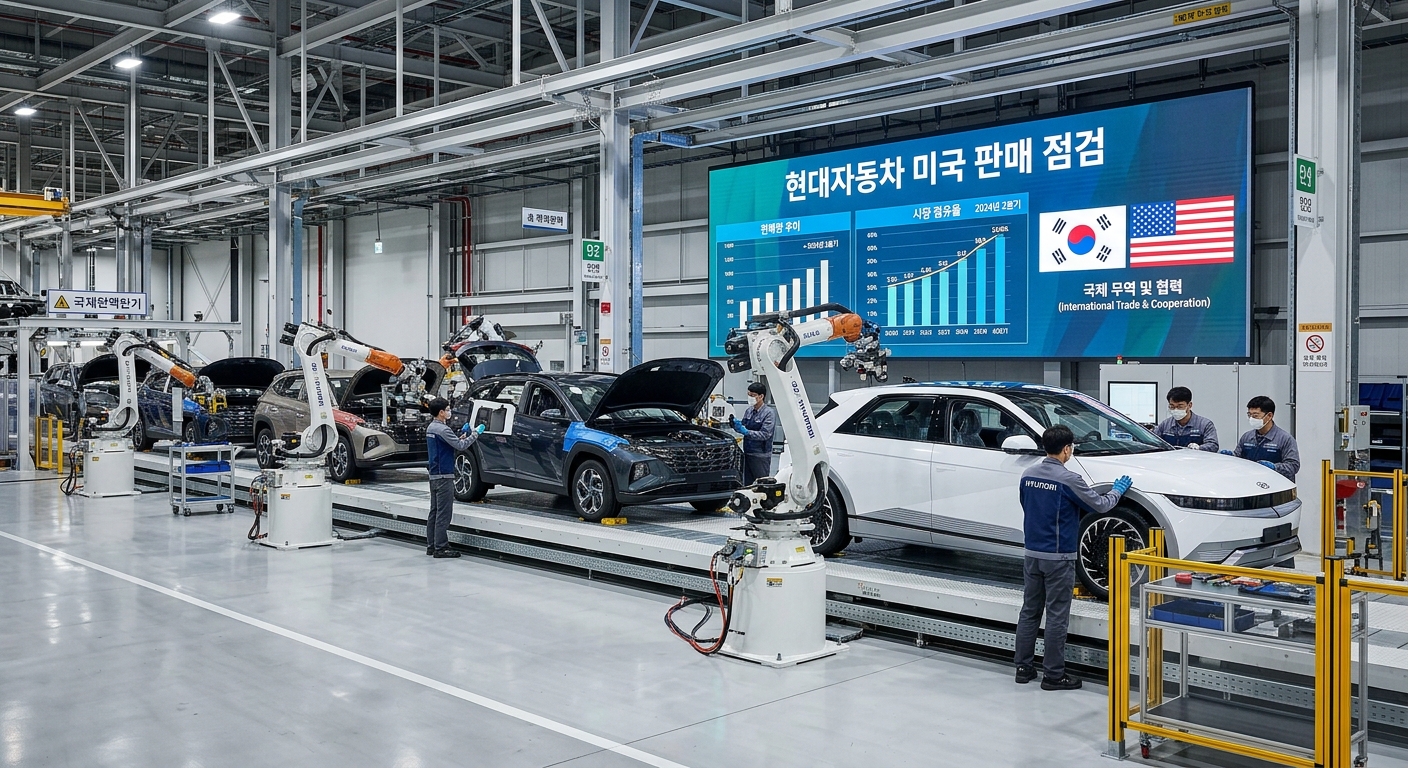
In the first half of 2026, the combined US sales of Hyundai, Kia, and Genesis reached an all-time high of 920,383 units, narrowing the gap with the third-largest player, Ford, to under 100,000 units.
In July 2026, in particular, the automaker sold 82,480 units in the US—the highest July sales since its entry into the market—marking a 3.7% year-on-year increase.
This strong performance in the US was driven by high-performance hybrid models, which stepped in as pure electric vehicle growth stalled due to reduced EV subsidies and charging infrastructure limitations.
In fact, in July, Hyundai's hybrid sales increased by 35% year-on-year, while pure EV sales fell by 46.1%, showcasing the brilliance of transitional flexibility in its product mix.
![Image: /stdaily/uploads/202608/gen_6a9283de03cd11.00689743.png]
Financial Analysis
Hyundai Motor's Q2 2026 revenue increased by 1.9% year-on-year to KRW 49.2153 trillion, marking a historic quarterly high.
However, its operating profit for the same period fell 20.8% year-on-year to KRW 2.8509 trillion, slightly missing market expectations (consensus of KRW 2.9940 trillion).
Several complex factors temporarily slowed profitability:
First, a fire at a domestic engine valve supplier caused temporary production disruptions for Genesis and key hybrid models.
Second, high tariffs in the US market (amounting to approximately KRW 900 billion per quarter) and rising costs (with the cost-of-goods-sold ratio rising to 82.2% due to strong raw material prices) eroded profits.
Third, increased dealer incentives to clear existing inventory ahead of new car launches added to expenses.
However, once parts supply fully normalizes in the second half and the new car effects of high-volume models like the Tucson and Avante kick in, a dramatic rebound in profit margins is expected.
| Classification | Q2 2026 Performance | YoY Growth Rate | Notes |
|---|---|---|---|
| **Revenue** | KRW 49.2153T | +1.9% | Record quarterly revenue |
| **Operating Profit** | KRW 2.8509T | -20.8% | Impact of parts supplier fire & tariff costs |
| **Net Profit** | KRW 2.8880T | -11.2% | Partially reflects FX effects |
| **Operating Margin** | 5.8% | -1.7%p | Recovery momentum expected in H2 |
Valuation
Currently, Hyundai Motor's 12-month forward price-to-earnings (P/E) ratio in the Korean stock market stands in the high 5x range, placing it in an absolute undervalued territory.
Its dividend yield also ranges from 4.5% to the low 6% level, providing strong downside support as a beneficiary of the government's Value-up Program.
Notably, during the '2026 CEO Investor Day' on August 26, Hyundai Motor announced plans to further strengthen its shareholder return policy.
If the US production system optimizes and the company sails smoothly toward its 2030 global sales target of 5.55 million units, the stock's P/E ratio could re-rate to up to 7x.
The success of upcoming SDV (Software Defined Vehicle)-based lineups will likely act as a key trigger to break through the valuation ceiling.
Analyst & Institutional Perspective
Securities analysts highly appreciate Hyundai's proactive investment strategy in the face of tariff uncertainties.
Hana Securities analyzed that tariff issues are already sufficiently reflected in earnings guidelines and stock prices, and that uncertainty is entering a resolution phase as tariff rates are adjusted and finalized.
Many institutions, including Kiwoom Securities, pointed out that Hyundai's "HEV flexible production strategy" is a powerful weapon that positions it alongside Toyota and Honda at the forefront of the US hybrid market.
Since Chinese automakers have little practical export benefit in the hybrid space to the US, Korean automakers are expected to maintain strong dominance in the North American HEV market.
Furthermore, its plan to invest a total of $26 billion in the new Georgia plant (HMGMA) by 2028 to raise the local production share to over 80% is considered the best strategy to bypass regulatory risks.
![Image: /stdaily/uploads/202608/gen_6a9283e9d4bd31.69212392.png]
Risk Factors
The most immediate risk is short-term margin volatility.
With the cost-of-goods-sold ratio soaring close to the mid-80% level, pressure from rising raw materials and labor costs due to global inflation continues.
In addition, shifts in regulatory intensity and sudden changes in subsidy policies following the US presidential election could act as major variables in the green car portfolio mix.
Furthermore, if prolonged high interest rates continue to dampen consumer sentiment, dealer incentive spending could rise further, adding to operating expense burdens.
Sharp fluctuations in the KRW/USD exchange rate (1380.50 KRW as of August 29, 2026) also directly impact export profitability, requiring continuous monitoring.
Investment Summary
Driven by booming hybrid vehicle sales, Hyundai Motor is one of the most flexible automakers navigating the global EV chasm.
Although it went through a correction phase due to a drop in Q2 operating profit in the short term, the strength of its fundamental recovery is expected to be high in the second half, supported by normalized production and a new model cycle.
Particularly, its commitment to shareholder returns—raising the 2030 operating margin target to over 9%—and the ramp-up of the Georgia plant serve as highly attractive incentives for long-term investors.
However, a cautious approach utilizing installment buying is recommended while keeping an eye on exchange rate fluctuations and US trade policy risks.
Investor Checklist Q&A
Q1. Why did Hyundai Motor's operating profit drop so much in Q2 2026?
A1. Consecutive fires at a domestic engine valve supplier and an India plant temporarily delayed the production of key high-margin models. Additionally, US tariff expenses (approx. KRW 900 billion) and strong prices of raw materials like plastic pushed the cost-of-goods-sold ratio significantly higher.
Q2. Is there any hit from the slowing EV demand in the US?
A2. While EV sales fell 40.5% year-on-year due to the expiration of tax credit benefits, sales of hybrid (HEV) models—which offer excellent fuel economy and price accessibility—surged 52.2%, completely offsetting the EV slowdown and maintaining market dominance.
Q3. What were the key highlights announced at the '2026 CEO Investor Day'?
A3. While firmly keeping its global sales target of 5.55 million units by 2030, the company raised its consolidated operating margin target to over 9%. To achieve this, it plans to launch 100 new models and fully roll out its EREV (Extended-Range Electric Vehicle) strategy.
Q4. How is the company responding to US tariff risks?
A4. Hyundai is considering expanding the annual production capacity of its Hyundai Motor Group Metaplant America (HMGMA) in Georgia from 500,000 units to up to 700,000–800,000 units. Through this, it aims to increase local US production to over 80% by 2030 to directly bypass trade barriers.
Q5. How attractive is the current stock price and valuation?
A5. With its P/E ratio in the high 5x range, the stock is heavily undervalued. Thanks to its solid dividend yield of 4.5%–6% and proactive Value-up shareholder returns, it maintains stable downside support, making it highly attractive from a long-term investment perspective.