[Image: /stdaily/uploads/202608/gen_6a908994c78d00.62990466.png]
Hello, this is Daily Stock, delivering fast and accurate analyses of global financial market trends.
Key Summary
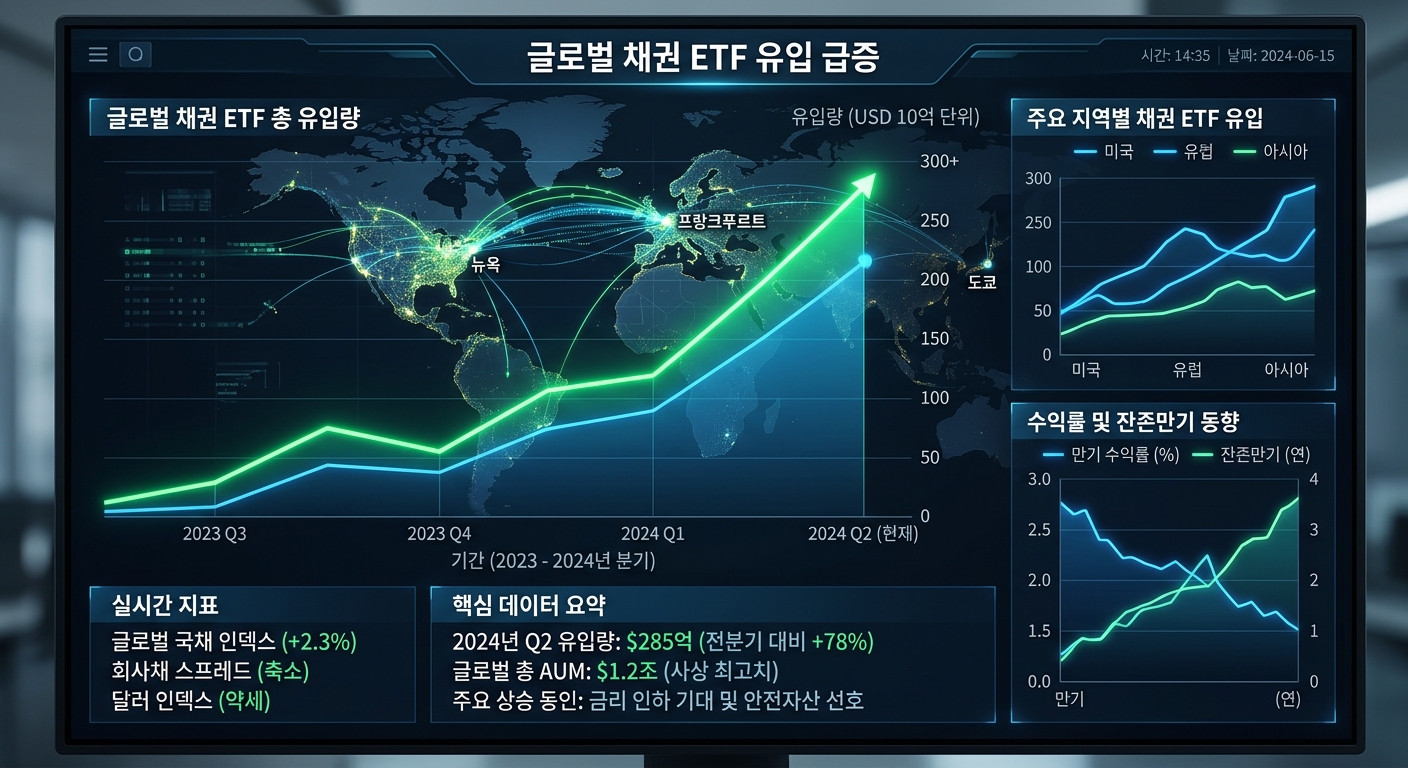
The global bond ETF market recently surpassed $3 trillion in total net assets for the first time in history, staging a historic inflow of capital.
Amid a "three-pole decoupling" in which the macroeconomic environments of the United States, Europe, and Asia are fragmenting respectively, investors are busy searching for safe havens rather than directional trading.
In particular, as high global interest rates persist, more than 60% of all debt assets offer yields exceeding 4% per annum.
As a result, a clear concentration of capital is observed in ultra-short treasury ETFs, where sideline cash parks, and active bond ETFs that aggressively seek excess market returns.
Current Status Summary
As of intraday trading on August 28, 2026 (tentative), the cumulative net inflows into the global bond ETF market over the past six months reached nearly $580 billion, accounting for about half of all global ETF inflows.
In today's Seoul foreign exchange market, the KRW/USD exchange rate recorded 1382.10 won during the day, maintaining relative tension for the greenback against major currencies.
In the domestic stock market, the KOSPI index is fighting for direction around the 6912.37 level intraday, while the KOSDAQ index is moving sideways near the 837.65 level.
Meanwhile, the tech-heavy US Nasdaq index is trading around the 26527.53 level intraday, maintaining a tight balance between high-valuation pressures and expectations of a policy pivot.
Amid these market conditions, Daily Stock's proprietary Fear & Greed Index reflects the market's cautious stance.
Currently, the KOSPI Fear & Greed Index stands at 54.8, hovering at a "Neutral" level similar to last week's 52.1, clearly recovering from the "Extreme Fear (11.9)" phase seen a month ago.
The Nasdaq Fear & Greed Index is also pointing at "Neutral" at 55.1, showing a notable improvement in investor sentiment compared to the "Fear (37.6)" stage a month ago.
As global interest rate cut paths diverge based on each country's fundamentals, liquidity is moving away from equity volatility toward fixed-income assets that offer safe and guaranteed high yields.
Financial Analysis
Unlike the past low-interest-rate era, prolonged high global interest rates have become a driving force pulling massive liquidity out of deposits and cash into the bond market.
In particular, if global rate cuts are implemented gradually, yields on cash or MMFs will fall rapidly, but bonds can deliver both high interest income and capital gains from rising bond prices.
In fact, historical data analysis shows that the average return on cash was only around 2.8% during the one year immediately following rate cuts by major central banks.
In contrast, global bond portfolios performed exceptionally well during the same period, delivering average total returns of 7% to 9%.
| Classification (Bond ETF Type) | Share of Inflows (Last 6 Months) | Primary Purpose & Key Features |
|---|---|---|
| Ultra-Short Treasury ETFs (e.g., SGOV) | ~23% of total bond inflows | High-yield "parking" cash replacing bank deposits and MMFs |
| Investment Grade (IG) Corporate Bond ETFs | ~36% of total bond inflows | Strategy to secure stable credit spreads from large corporations |
| Active Bond ETFs | ~30% of total bond inflows | Seeking excess returns at manager's discretion amid market volatility |
| Long-Term Treasuries & Aggregate Bonds | ~11% of total bond inflows | Strategy to maximize capital gains when interest rates begin a full descent |
According to the global asset management industry, BlackRock's iShares platform led market growth, surpassing $1.3 trillion in bond ETF assets alone.
Moving away from passive index-centric bond management, the market is undergoing a structural shift, with active bond ETFs—which allow managers to respond flexibly to market conditions—surging more than 30% compared to last year.
Valuation
The value of global fixed-income assets currently sits in a very unique position relative to historical averages.
High-quality bonds with a Yield to Maturity (YTM) exceeding 4% account for a whopping 60% of the entire global bond universe, standing in stark contrast to less than 20% in 2019.
Relative spreads among US 10-year Treasury yields, German Bunds, and Japanese 10-year Government Bonds (JGBs) reflect the growth rate differentials between these regions.
The Japanese 10-year yield, which recently broke 2.94% to hit a 30-year high, is impacting capital flows in Asia and acting as a catalyst for recalibrating global bond valuations.
Furthermore, for currency-hedged global bond ETFs, distortions in the net after-tax distribution rate are appearing due to hedging costs and regional tax codes.
Even if nominal distribution rates range from 6% to 9%, investors must carefully compare the actual YTM of the underlying assets, as this could be an optical illusion accompanied by principal losses.
Expert & Institutional Analysis
Analysts at major asset management firms and investment banks note that bond ETFs have evolved beyond simple portfolio diversification tools to become the "core anchor of asset allocation."
Alyse Terry, Head of US iShares at BlackRock, evaluated that advisors are using bonds as core solutions to achieve target outcomes rather than simply as low-cost market exposure vehicles.
Global institutions, including Morgan Stanley, point out that the services and manufacturing PMI data in the US and Europe are tracing different trajectories, deepening fundamental decoupling.
In an environment with rising macroeconomic uncertainty, the view that institutional capital is rotating heavily into bond ETFs to ease valuation burdens in equity markets and secure stability is gaining strong support.
Policy divergence among central banks, such as the People's Bank of China (PBOC) cutting its reserve requirement ratio (RRR) and the European Central Bank (ECB) maintaining a hawkish hold, also highlights the utility of active management in bond ETFs.
Experts added that even if the path of rate cuts is delayed beyond market expectations, the current high coupon rates themselves will firmly support asset prices against downward pressure.
Risk Factors
[Image: /stdaily/uploads/202608/gen_6a90899e99c3a5.40243883.png]
Behind the rapid growth of the global bond ETF market, non-negligible macro and micro risk factors still exist.
The biggest threat is a scenario where oil and major commodity prices, such as copper, spike due to escalating military tensions in the Middle East or global supply chain disruptions.
If commodity-driven inflationary pressures flare up again, major central banks may have to delay rate cuts or consider additional tightening, which could inflict immediate price correction shocks on long-term bond ETFs.
Additionally, as currency values fluctuate sharply amid the US-Europe-Asia decoupling, hedging costs for ETFs investing in foreign bonds could rise steeply.
Lastly, if yield-seeking investors flock excessively to corporate and high-yield bond ETFs, they may be exposed to the risk of principal loss due to rising default rates of marginal companies and spiking credit spreads during an economic downturn.
Investment Perspective Outlook
Overall, the flow of funds into global bond ETFs is judged to be part of a mid-to-long-term portfolio restructuring process rather than a temporary flight to safety.
At a time when the relative strength of major indices is diverging, bonds can act as a powerful portfolio cushion and an attractive source of fixed income.
In the short term, a strategy of rolling cash assets through ultra-short treasury ETFs, which have extremely low interest rate risk, to fully enjoy high-interest benefits could be effective.
From a mid-to-long-term perspective, a two-pronged scenario is recommended: weighing a gradual increase in exposure to high-quality active bond ETFs or long-term treasury ETFs as the policy pivot phase becomes clearer.
Investor Checklist Q&A
Q1. What is driving the total asset size of global bond ETFs to break $3 trillion?
A1. It is because more than 60% of high-quality bond assets worldwide offer high annual yields of 4% or more, causing the stable interest appeal of bonds to surge compared to bank deposits or MMFs.
Q2. Why is investing in bond ETFs more advantageous than holding cash when rate cuts begin?
A2. When rates are cut, returns on cash and MMFs drop quickly, but bond ETFs can maintain their existing high interest income while simultaneously generating capital gains from rising bond prices.
Q3. What is the difference between passive index bond ETFs and active bond ETFs?
A3. Passive ETFs replicate and track a specific index, whereas active ETFs allow professional fund managers to flexibly adjust maturity (duration) and credit ratings depending on market conditions to seek excess returns.
Q4. How should I decide whether to currency-hedge when investing in foreign bond ETFs?
A4. If you do not want exposure to currency fluctuations against the Korean Won, choose currency-hedged (H) products. However, you must check the prospectus for hidden costs arising from hedging expenses and tax structures.
Q5. What is the most critical macroeconomic risk that bond ETF investors should watch out for?
A5. A resurgence of inflation triggered by geopolitical shocks or spikes in commodity prices, forcing central banks to keep interest rates high for much longer than expected or raise them again.