Hello, this is Daily Stock, analyzing major trends in global stock markets and presenting preemptive response strategies.
[Image: /stdaily/uploads/202608/gen_6a8b43dac4e387.52261307.png]
Key Highlights
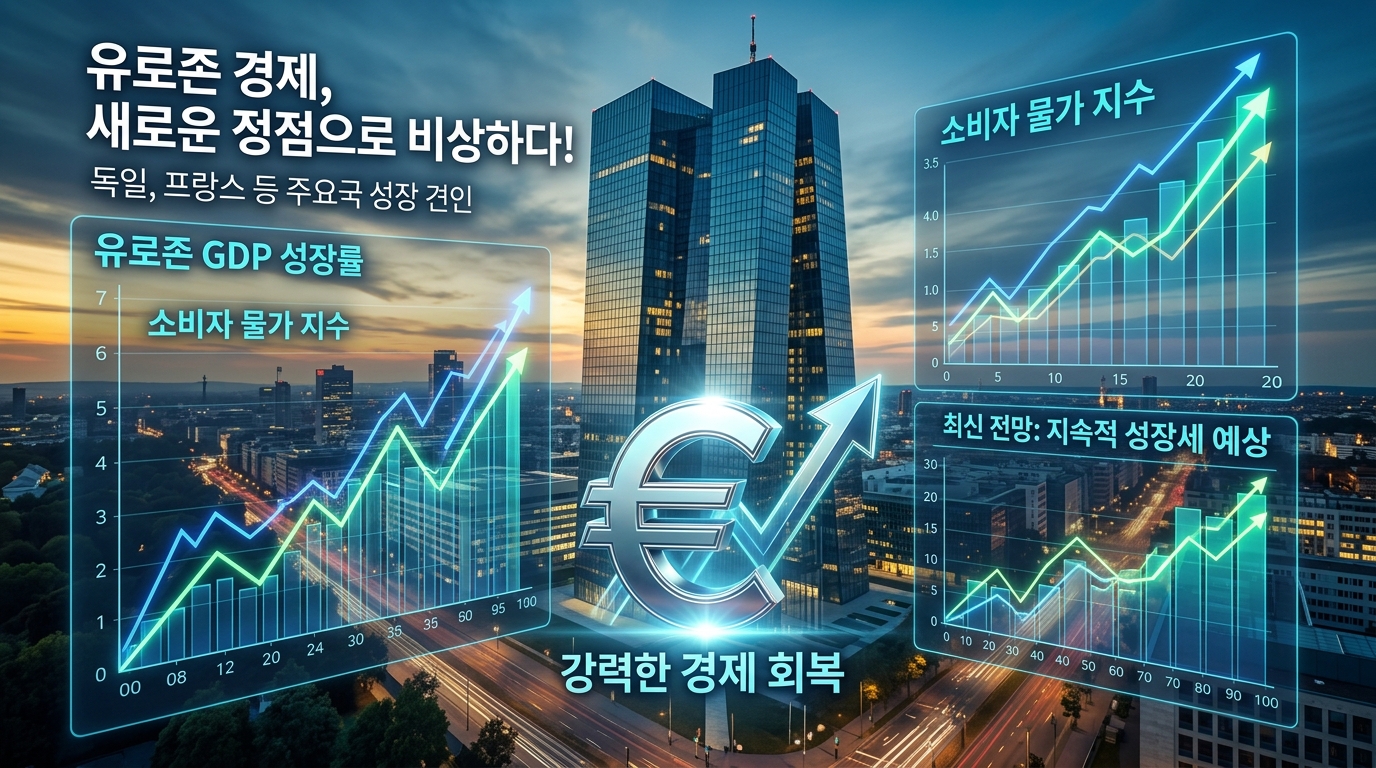
While the Eurozone's August manufacturing economic indicators unexpectedly rebounded to hit a four-year high, the value of the Euro has closed in tightly on the $1.17 level.
As a result, market expectations for an additional rate hike by the European Central Bank (ECB) in September are gaining traction.
Amid changes in global liquidity and asset allocation, the tri-polar decoupling trend among the US, Europe, and Asia is becoming more pronounced.
The temperature differences in economic recovery may act as a factor that increases volatility in the asset markets.
Current Status Summary
The recently released preliminary (Flash) Eurozone Manufacturing Purchasing Managers' Index (PMI) for August stood at 52.8, significantly beating the market forecast of 51.8.
Germany's manufacturing PMI surged to 54.1, powerfully driving the growth of the overall manufacturing sector.
On the other hand, services PMIs for Germany (48.5) and France (48.4) hovered below the baseline of 50, showing an extreme polarization between manufacturing and services.
The sluggishness in services suggests that household real purchasing power has not yet recovered amid high interest rates.
Meanwhile, as of intraday on August 24, 2026 (tentative), major domestic and global indices are showing mixed trends.
The KOSPI is at 6,912.95 points, the KOSDAQ is at 801.94 points, the US NASDAQ is at 26,180.46 points, and the KRW/USD exchange rate is hovering around 1,388.00 won.
According to Daily Stock's proprietary Fear & Greed Index, global investment sentiment is currently cooling down its overheating and staying in a cautious exploration territory.
- **KOSPI Fear & Greed Index:** Currently Neutral (55.4) / 1 Week Ago Neutral (50.9) / 1 Month Ago Extreme Fear (12.8) / 3 Months Ago Neutral (57.1)
- **NASDAQ Fear & Greed Index:** Currently Neutral (55.2) / 1 Week Ago Greed (64) / 1 Month Ago Neutral (43.4) / 3 Months Ago Neutral (52.6)
Financial Analysis
Major macroeconomic indicators representing the Eurozone's economic fundamentals strongly point to inflation reigniting risks.
The Eurozone's Consumer Price Index (CPI) for July rose by 2.9% year-on-year, accelerating compared to June (2.8%).
Energy prices surged by 10.3% year-on-year, led by rising conflicts in the Middle East and bottlenecks in the Strait of Hormuz, driving overall inflation.
Core inflation, which excludes volatile energy, also stood at 2.5%, exceeding the ECB's mid-term target of 2.0%.
Nevertheless, buoyed by the August PMI surprise, the Eurozone's Q3 GDP growth forecast is expected to maintain a moderate expansion of around 0.3%.
You can grasp the detailed real economic status of the Eurozone through the indicator comparison table below.
| Indicator | July 2026 Value | August 2026 (Flash) | Market Forecast | Key Analytical Features |
|---|---|---|---|---|
| **Manufacturing PMI** | 51.9 | 52.8 | 51.8 | Recorded the longest expansion pace in 4 years (54 months) |
| **Services PMI** | 51.7 | 51.7 | 51.5 | Same as the previous month, but maintained expansion above 50 |
| **Composite PMI** | 52.0 | 52.1 | 51.7 | Supported moderate GDP recovery, hitting a 9-month high |
| **Headline CPI** | 2.9% | Unreleased | - | Accelerated compared to the previous month based on July final data |
| **Core CPI** | 2.5% | Unreleased | - | Excluding food and energy, proving sticky inflation |
Valuation
In the foreign exchange and bond markets, relative value changes due to the tri-polar decoupling of the US, EU, and Asia are being actively reflected.
The US Treasury Department increased its Treasury buyback volume to $4 billion per session, more than doubling the previous size, which put relative downward pressure on the US dollar.
At the same time, expectations for the resumption of the ECB's hawkish monetary policy flowed in, driving the Euro/Dollar (EUR/USD) exchange rate up to the $1.1677 to $1.1699 range.
Consequently, sharp adjustments in currency allocation and currency hedging strategies are being detected among global investment funds.
[Image: /stdaily/uploads/202608/gen_6a8b43e5700f78.41354077.png]
In the European bond market, the yield on Germany's 10-year government bond (Bund) is facing upward pressure, narrowing the yield gap with the US.
This places a high interest rate discount rate burden on the European stock market, which could become a variable that blocks a rapid rerating of the index despite strong manufacturing.
Professional & Institutional Analysis
Chris Williamson, Chief Business Economist at S&P Global, evaluated that this rise in PMI is driving job recovery and quarterly GDP growth in the Eurozone.
However, he diagnosed that "the hawkish stance of the ECB could strengthen due to manufacturing vitalization and persistent price pressures, making it hard to rule out the possibility of additional rate hikes."
Overseas investment bank (IB) analysts analyze that the misalignment between the US Fed's pivot timing and the ECB's surprise hike scenario could induce one-sided flows in the foreign exchange market.
This could serve as an opportunity to highlight the relative value of Euro assets amid temporary cracks in dollar hegemony.
Therefore, the speeches by central bankers of major countries to be announced at the Jackson Hole meeting in late August and President Christine Lagarde's response message will be the biggest watershed determining the direction of asset markets.
If the scenario of Europe lifting its rate freeze early materializes, the transition from a liquidity-driven market to a fundamental-driven market could be accelerated.
Risk Factors
Deepening Polarization in the Domestic Sector
While manufacturing has been vitalized by government spending and military budget increases, service PMIs in Germany and France remain trapped in the 48 range, meaning the shadow of sluggish domestic demand is still deep.
This imbalance could be a critical weakness undermining the sustainability of real economic recovery.
Cost Pressure from Surging Energy Prices
As Brent crude oil threatens the $93 per barrel mark due to Middle East geopolitical shocks, the margin pressure on Eurozone manufacturers and the risk of secondary inflation transition are rising.
The rise in imported raw material prices could have a devastating impact on Europe's current account surplus structure.
Adverse Effects of Monetary Tightening
With the deposit rate already at 2.25% and the MRO rate at 2.40%, a hasty additional rate hike by the ECB could increase household debt burdens.
Furthermore, it is difficult to rule out the possibility of triggering consecutive credit defaults of marginal firms in the Eurozone.
Investment Perspective Summary
The unusual recovery of Eurozone manufacturing has the potential to dilute economic recession worries and lead a technical rebound in traditional industrials.
In particular, the joint strengthening trend of the Yen and Euro could serve as an opportunity to diversify global asset portfolios away from USD dominance.
However, sticky inflation and vigilance over the ECB's additional rate hikes are likely to tightly limit the upper bound of valuations for the overall European stock market.
The discount rate burden from tightening may create a structure that allows only limited access focused on large-cap, business-cycle-sensitive stocks.
Therefore, in the global liquidity tri-polar decoupling phase, defensive diversified investment centered on currency value changes and commodity-benefiting assets rather than highly volatile assets could be a realistic alternative.
It also seems desirable for domestic investors to flexibly adjust their allocations of blue-chip domestic stocks and high-dividend assets that can hedge the volatility of the KRW/USD exchange rate.
Investor Checklist Q&A
Q1: What are the specific reasons for the surge in the Eurozone's August manufacturing PMI?
A1: Germany's large-scale fiscal stimulus spending and increased defense budgets had a significant impact.
In addition, in response to Middle East geopolitical risks, companies preemptively built up inventories, which sharply pulled up manufacturing operating rates for the first time in four months.
Q2: What is the current status of the ECB's key interest rates, and what is the outlook?
A2: After raising the Deposit rate to 2.25% and the MRO rate to 2.40% last June, it kept them unchanged in July, but the recent rebound in inflation and economic strength are clear.
Accordingly, the probability of an additional rate hike in September is being actively priced into the financial markets.
Q3: What is the main background behind the rise in the Euro/Dollar (EUR/USD) exchange rate?
A3: It is because the US dollar index faced downward pressure due to the US Treasury's increase in buybacks, while expectations for additional rate hikes in the Eurozone grew stronger.
This is interpreted as a structural change where currency attractiveness tilted slightly toward the Euro.
Q4: Why is the services PMI still weak despite the manufacturing boom?
A4: It is because the real purchasing power of general households has not recovered due to prolonged high interest rates and rising prices.
In particular, because services are sensitive to domestic demand, they directly reflect the sluggish consumption trends in major countries like Germany and France.
Q5: How should Korean market participants respond to these Eurozone indicator changes?
A5: Concerns over prolonged ECB tightening could weigh down overall global risk asset investment sentiment.
Therefore, it is safe to check foreign exchange risks and tightening scenarios for export stocks overall, and respond by buying on dips and securing cash holdings rather than relying on unconditional optimism.