Hello, this is Daily Stock.
Today (2026-08-23), we will look in depth into the trends in margin transaction balances in the KOSPI market, which is emerging as a short-term fuse, and its impact on market volatility.
Key Summary
[Image: /stdaily/uploads/202608/gen_6a8aa2f6c41bd2.98223677.png]
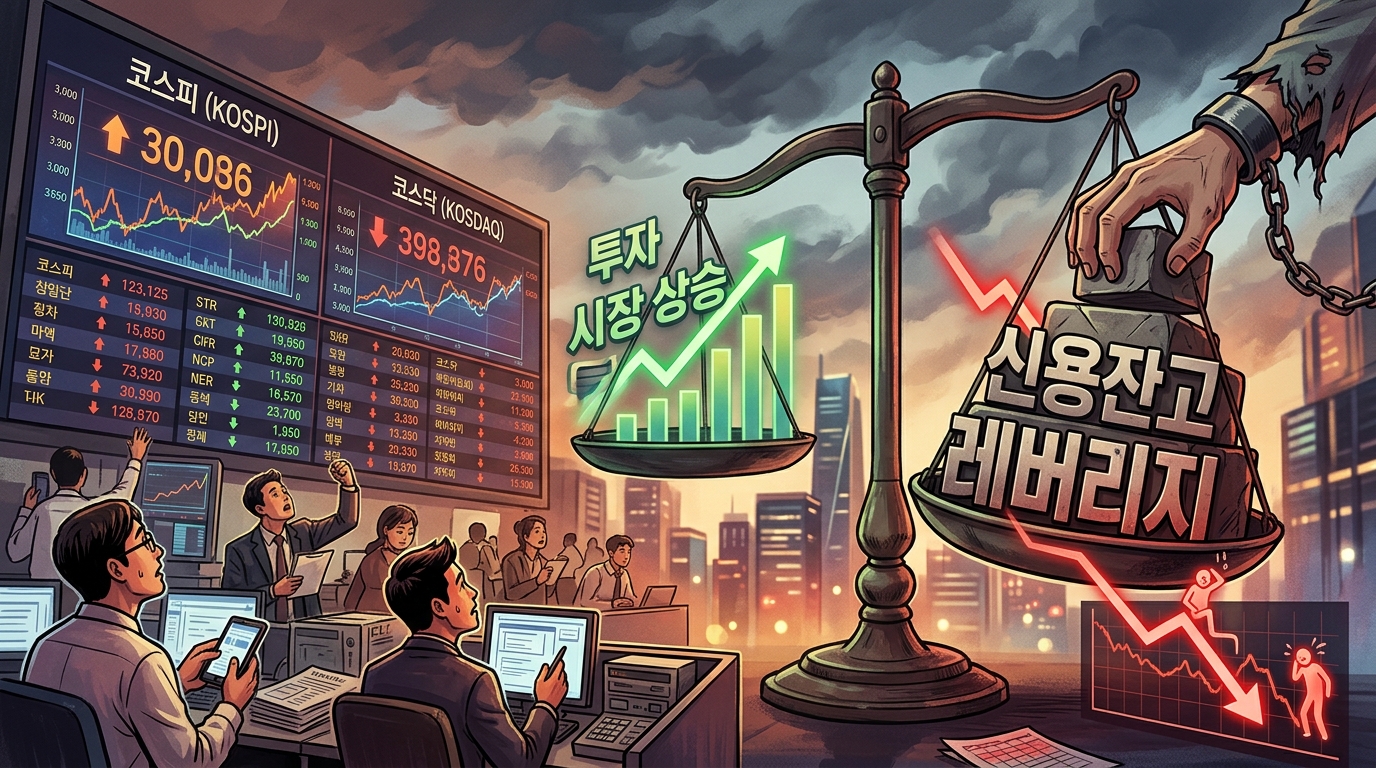
As the KOSPI has recently staged a rebound from a sharp decline, the margin loan balance of retail investors (debt investing) is rapidly increasing and is once again nearing 32 trillion won.
While a short-term index recovery is positive, a rapid influx of leveraged capital can become a major volatility factor that amplifies drops due to margin calls if market shocks occur again. Therefore, a conditional response is necessary.
Market Summary
Today (2026-08-23) in the Korean stock market, the KOSPI index closed at 6,912.95 points, and the KOSDAQ index stood at 801.94 points.
The USD/KRW exchange rate fluctuated in the 1,388.00 won range, heightening supply and demand tension regarding large export stocks.
According to Daily Stock's proprietary Fear & Greed Index, which reflects investment sentiment, the KOSPI Fear & Greed Index is currently at 55.4 (Neutral), up slightly from a week ago (50.9).
This suggests that investor sentiment has stabilized quickly compared to the 12.8 (Extreme Fear) recorded during the sharp index drop a month ago.
The Nasdaq Fear & Greed Index is also currently at 55.2 (Neutral), cooling down somewhat from last week's 64 (Greed), showing that the global market has entered a short-term breathing phase.
Financial Analysis
Looking at actual leverage capital flows in the stock market, we can see that individual investors are entering at a faster pace along with the establishment of downward rigidity in the market.
The total margin loan balance, which had shrunk to its year-low of 27.4038 trillion won on August 4, surged 16.4% to 31.8938 trillion won (as of August 20) in just 16 days.
| Capital Indicator Category | 2026 August Low (Recent) | Figures as of August 20, 2026 | Change Rate vs. Recent Low |
|---|---|---|---|
| **Total Margin Loan Balance** | 27.4038 trillion won (Aug 4) | 31.8938 trillion won | +16.4% |
| **Securities-Backed Loans** | 24.1378 trillion won (Aug 4) | 25.3785 trillion won | +5.1% |
| **Unpaid Transaction Balance** | 867.0 billion won (Aug 14) | 1.0973 trillion won | +26.6% |
| **Customer Deposits** | 97.9289 trillion won (Aug 11) | 105.3542 trillion won | Decreased 1.22T won MoM |
[Image: /stdaily/uploads/202608/gen_6a8aa302d35b17.58972639.png]
The unpaid transaction balance, which has the characteristics of ultra-short-term credit trading, also quickly broke above the 1 trillion won mark to 1.0973 trillion won after shrinking to the 867.0 billion won level.
On the other hand, customer deposits, which are the fundamental physical strength of the stock market, stood at only 105.3542 trillion won, down 1.2207 trillion won from the previous day. This shows that rather than the inflow of pure waiting capital, the leverage utilization ratio of existing capital has risen sharply.
Valuation
A major feature of margin loans observed in the current KOSPI rebound phase is the 'concentration phenomenon' around specific large-cap stocks such as semiconductors.
Retail margin buying aiming for bargain-hunting is concentrated on Samsung Electronics and SK Hynix, which have announced large-scale shareholder return policies and treasury stock cancellation plans.
In fact, Samsung Electronics' margin balance increased from the 4.2 trillion won range early this month to the recent 4.8 trillion won range, and SK Hynix is also maintaining its level in the 4.6 trillion won range.
As regulations on single-stock leveraged exchange-traded funds (ETFs) tighten, individual investors have shifted in large numbers to spot margin trading, leaving the potential for index distortion present.
Expert & Institutional Analysis
Stock market experts are raising voices of caution regarding the pattern where the margin balance balloons steeply before the index shows a clear trend upward.
While margin trading acts as a catalyst to push the index higher during rising markets, it is highly likely to act as supply pressure in a volatile market where support levels are not firmly established.
Institutional investors are focusing in particular on the difference in the speed of margin liquidation between the KOSPI and KOSDAQ.
In the case of KOSDAQ, nearly 40% of the margin loan balance was liquidated due to collateral shortfalls during the sharp decline in the index. However, for KOSPI large-caps, the evaluation is that the potential selling wall remains thick as the liquidation speed has not kept pace with the index's decline.
Risk Factors
[Image: /stdaily/uploads/202608/gen_6a8aa30d852cc9.47240312.png]
The most concerning risk scenario is 'domino margin calls' that occur when the index undergoes another correction due to external variables or concerns over an economic slowdown.
Generally, when a deluge of margin calls hits the settlement date because investors fail to meet the collateral maintenance ratio (140%) of brokerage firms, this leads to a vicious cycle that drags down individual stock prices.
The fact that the USD/KRW exchange rate is running high in the late 1,380 won range, delaying a strong net buying turn by foreigners, is also a burden.
If only individual leverage positions increase while supply and demand are empty, the risk of the volatility index (V-KOSPI) surging even with one or two short-term negative factors increases.
Investment Perspective Summary
Investing in the KOSPI market at this point is recommended to maintain a conservative view, focusing thoroughly on risk management rather than directional buying.
This is because it is highly challenging to respond to the market solely with fundamental analysis in intervals where short-term volatility of the index expands due to supply and demand factors.
It seems advisable to avoid small and mid-cap stocks with excessively high margin loan ratios or some large-cap stocks with excessive leverage concentration for the time being.
Instead, it is time to consider forming a defensive portfolio centered on high-quality, low-PBR companies that have excellent self-sustaining cash flow generation capabilities and have proven their capacity for viable shareholder returns.
Investment Checklist
- **Re-evaluate the margin balance ratio of your holdings**
- If the margin balance ratio of an individual company exceeds 5%, it may suffer a significant supply shock during an index correction, so it should be monitored periodically.
- **Always maintain a cash proportion of over 15% in your account**
- You must leave a cash buffer in your account that can immediately defend the collateral ratio when uncertain short-term macroeconomic events occur.
- **Refrain from ultra-short-term unpaid transactions and chasing rallies**
- In the current market where daily volatility has increased, chasing rallies using credit extremely increases the risk of forced liquidation via margin calls during unpredictable short-term sharp drops.
- **Check foreign futures supply and demand alongside exchange rate trends**
- The accumulation of net futures selling by foreigners and whether the USD/KRW exchange rate breaks through 1,390 won can trigger the liquidation of margin volumes centered on large caps, so they should be checked together.
- **Adopt split entry by stock and establish tolerable stop-loss criteria**
- When entering the market, rather than executing capital all at once, respond thoroughly with split buying, and strictly set stop-loss limits based on principles to protect your account.